The changing look of PKS 2149-306
Aims: We study the blazar nature of the high-redshift Flat-Spectrum Radio Quasar PKS 2149-306 (z = 2.345) by investigating its long-term behavior. Methods: We analyzed all publicly available optical-t
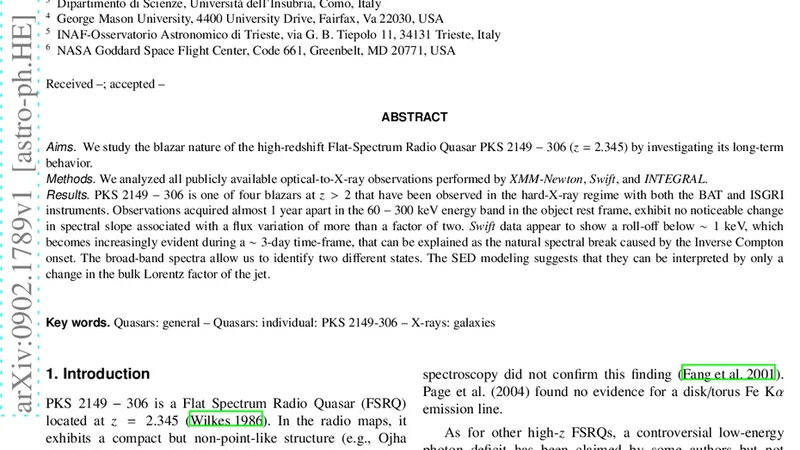
Aims: We study the blazar nature of the high-redshift Flat-Spectrum Radio Quasar PKS 2149-306 (z = 2.345) by investigating its long-term behavior. Methods: We analyzed all publicly available optical-to-X-ray observations performed by XMM-Newton, Swift, and INTEGRAL. Conclusions: PKS 2149-306 is one of four blazars at z>2 that have been observed in the hard-X-ray regime with both the BAT and ISGRI instruments. Observations acquired almost 1 year apart in the 60-300 keV energy band in the object rest frame, exhibit no noticeable change in spectral slope associated with a flux variation of more than a factor of two. Swift data appear to show a roll-off below ~1 keV, which becomes increasingly evident during a ~3-day time-frame, that can be explained as the natural spectral break caused by the Inverse Compton onset. The broad-band spectra allow us to identify two different states. The SED modeling suggests that they can be interpreted by only a change in the bulk Lorentz factor of the jet.
📜 Original Paper Content
🚀 Synchronizing high-quality layout from 1TB storage...