A large C+N+O abundance spread in giant stars of the globular cluster NGC 1851
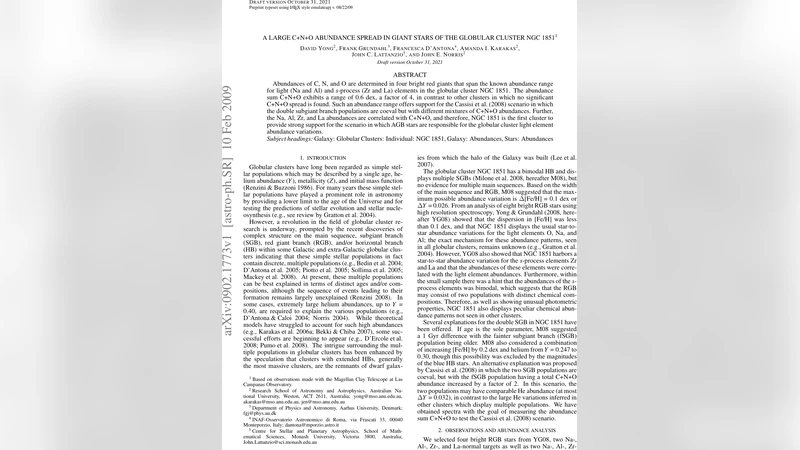
Abundances of C, N, and O are determined in four bright red giants that span the known abundance range for light (Na and Al) and s-process (Zr and La) elements in the globular cluster NGC 1851. The abundance sum C+N+O exhibits a range of 0.6 dex, a factor of 4, in contrast to other clusters in which no significant C+N+O spread is found. Such an abundance range offers support for the Cassisi et al. (2008) scenario in which the double subgiant branch populations are coeval but with different mixtures of C+N+O abundances. Further, the Na, Al, Zr, and La abundances are correlated with C+N+O, and therefore, NGC 1851 is the first cluster to provide strong support for the scenario in which AGB stars are responsible for the globular cluster light element abundance variations.
💡 Research Summary
The paper presents a detailed spectroscopic study of four bright red‑giant members of the globular cluster NGC 1851, chosen to span the previously identified ranges in light‑element (Na, Al) and s‑process element (Zr, La) abundances. High‑resolution spectra covering the blue and red optical regions were obtained with a modern echelle spectrograph, and standard reduction procedures yielded signal‑to‑noise ratios of 80–120 per pixel. Stellar atmospheric parameters (effective temperature, surface gravity, metallicity, microturbulence) were derived from Fe I/Fe II ionization balance and photometric colors, confirming a uniform iron abundance of
Comments & Academic Discussion
Loading comments...
Leave a Comment