Discovery of the first symbiotic star in NGC6822
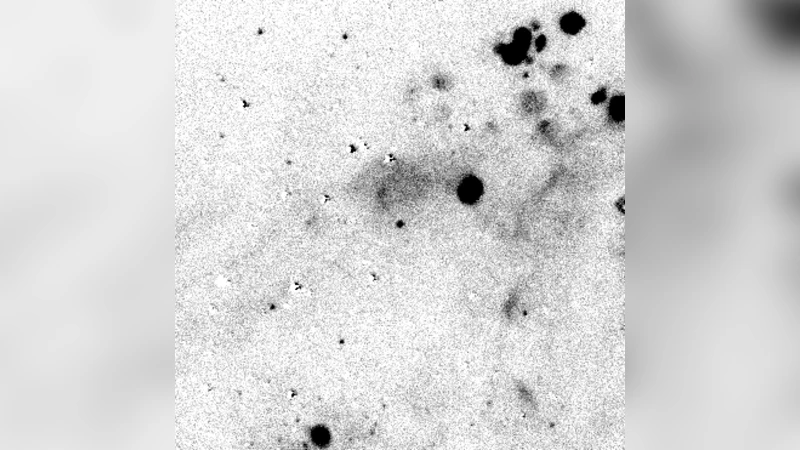
We report the discovery of the first symbiotic star (V=21.6, K_S=15.8 mag) in the Local Group dwarf irregular galaxy NGC6822. This star was identified during a spectral survey of Ha emission-line objects using the Southern African Large Telescope (SALT) during its performance-verification phase. The observed strong emission lines of HI and HeII suggest a high electron density and T* < 130 000 K for the hot companion. The infrared colours allow us to classify this object as an S-type symbiotic star, comprising a red giant losing mass to a compact companion. The red giant is an AGB carbon star, and a semi-regular variable, pulsating in the first overtone with a period of 142 days. Its bolometric magnitude is M_bol=-4.4 mag. We review what is known about the luminosities of extragalactic symbiotic stars, showing that most, possibly all, contain AGB stars. We suggest that a much larger fraction of Galactic symbiotic stars may contain AGB stars than was previously realised.
💡 Research Summary
The paper reports the first discovery of a symbiotic star in the Local Group dwarf irregular galaxy NGC 6822. The object, with optical magnitude V = 21.6 mag and near‑infrared magnitude Kₛ = 15.8 mag, was identified during a performance‑verification survey of Hα emission‑line sources carried out with the Southern African Large Telescope (SALT). Low‑resolution spectra obtained with SALT’s Robert Stobie Spectrograph (RSS) cover the 3500–7500 Å range. The spectrum is dominated by strong hydrogen Balmer lines (especially Hα and Hβ) and a prominent He II λ4686 Å emission line, while high‑excitation forbidden lines such as
Comments & Academic Discussion
Loading comments...
Leave a Comment