Constraining Star Formation and AGN in z~2 Massive Galaxies using High Resolution MERLIN Radio Observations
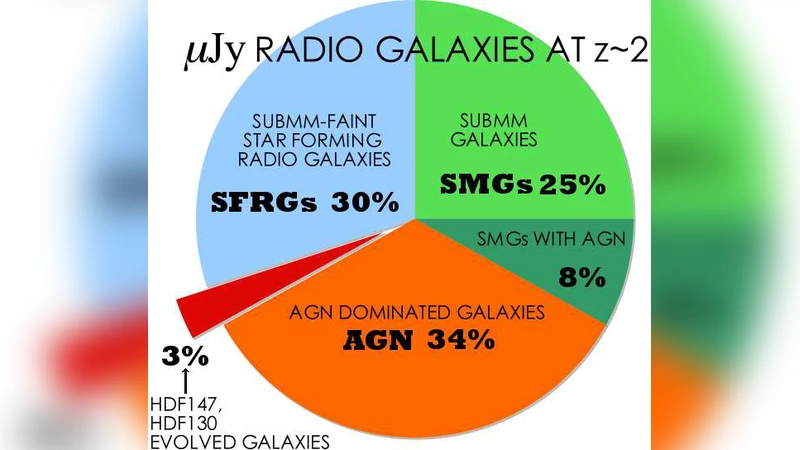
We present high spatial resolution MERLIN 1.4GHz radio observations of two high redshift (z~2) sources, RGJ123623 (HDF147) and RGJ123617 (HDF130), selected as the brightest radio sources from a sample of submillimetre-faint radio galaxies. They have starburst classifications from their rest-frame UV spectra. However, their radio morphologies are remarkably compact (<80mas and <65mas respectively), demanding that the radio luminosity be dominated by Active Galactic Nuclei (AGN) rather than starbursts. Near-IR imaging (HST NICMOS F160W) shows large scale sizes (R_(1/2)~0.75", diameters ~12kpc) and SED fitting to photometric points (optical through the mid-IR) reveals massive (5x10^(11) M_sun), old (a few Gyr) stellar populations. Both sources have low flux densities at observed 24um and are undetected in observed 70um and 850um, suggesting a low mass of interstellar dust. They are also formally undetected in the ultra-deep 2Ms Chandra data, suggesting that any AGN activity is likely intrinsically weak. We suggest both galaxies have evolved stellar populations, low star formation rates, and low accretion rates onto massive black holes (10^(8.6) M_sun) whose radio luminosity is weakly beamed (by factors of a few). A cluster-like environment has been identified near HDF130 by an over-density of galaxies at z=1.99, reinforcing the claim that clusters lead to more rapid evolution in galaxy populations. These observations suggest that high-resolution radio (MERLIN) can be a superb diagnostic tool of AGN in the diverse galaxy populations at z2.
💡 Research Summary
This paper presents a detailed investigation of two massive galaxies at redshift ≈ 2 (RGJ123623, also known as HDF147, and RGJ123617, HDF130) using the Multi‑Element Radio Linked Interferometer Network (MERLIN) at 1.4 GHz with sub‑arcsecond resolution. The objects were selected as the brightest radio sources from a sample of sub‑millimetre‑faint radio galaxies (SMG‑faint RGs) that, based on rest‑frame UV spectroscopy, had previously been classified as starburst systems. The authors aimed to test whether the radio emission truly originates from intense star formation or from an active galactic nucleus (AGN).
MERLIN’s high angular resolution (≤ 80 mas, corresponding to ≤ 0.7 kpc at z ≈ 2) revealed that both galaxies possess extremely compact radio morphologies: the emission is confined to regions smaller than 80 mas for HDF147 and 65 mas for HDF130. Such compactness is inconsistent with the extended (tens of kiloparsecs) synchrotron halos expected from vigorous starbursts, and instead points to a dominant AGN contribution.
Near‑infrared imaging with HST/NICMOS (F160W) shows that the stellar components are much larger, with half‑light radii of ~0.75 arcsec (≈ 12 kpc). Spectral energy distribution (SED) fitting across optical, near‑IR, and mid‑IR bands indicates that each galaxy hosts a massive (≈ 5 × 10¹¹ M☉) and relatively old stellar population (ages of a few gigayears). The SEDs also reveal very low flux densities at observed 24 µm and non‑detections at 70 µm and 850 µm, implying a paucity of cold dust and consequently low ongoing star‑formation rates.
X‑ray data from the ultra‑deep 2 Ms Chandra observations do not detect either source, suggesting that any AGN activity is intrinsically weak or only modestly obscured. Black‑hole mass estimates, derived from the stellar masses and standard scaling relations, give M_BH ≈ 10⁸·⁶ M☉. The authors argue that the observed radio luminosities can be explained by weakly beamed AGN jets, with modest Doppler boosting (a factor of a few).
An additional environmental clue comes from the identification of a galaxy overdensity at z = 1.99 around HDF130, indicative of a proto‑cluster. This supports the hypothesis that dense environments accelerate galaxy evolution, leading to early quenching of star formation and reduced accretion onto central black holes.
In summary, the study demonstrates that high‑resolution radio interferometry with MERLIN is a powerful diagnostic for uncovering hidden AGN in diverse high‑redshift galaxy populations. The compact radio cores, together with massive, evolved stellar bodies and minimal dust emission, paint a picture of galaxies that have largely completed their star‑forming phase, host relatively massive but low‑accretion black holes, and reside in environments conducive to rapid evolutionary processes. The findings underscore the importance of combining sub‑arcsecond radio imaging with multi‑wavelength data to disentangle the relative contributions of star formation and AGN activity in the early Universe.
Comments & Academic Discussion
Loading comments...
Leave a Comment