Detection of X-rays from the jet-driving Symbiotic Star MWC 560
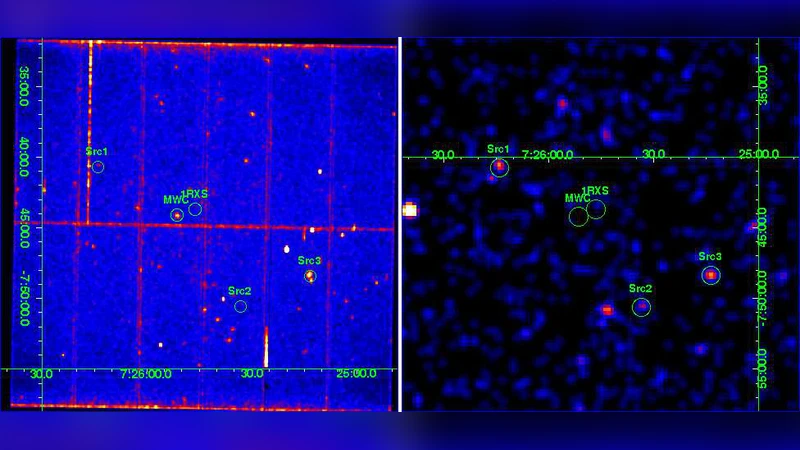
We report the detection of X-ray emission from the jet-driving symbiotic star MWC 560. We observed MWC 560 with XMM-Newton for 36 ks. We fitted the spectra from the EPIC pn, MOS1 and MOS2 instruments with XSPEC and examined the light curves with the package XRONOS. The spectrum can be fitted with a highly absorbed hard X-ray component from an optically-thin hot plasma, a Gaussian emission line with an energy of 6.1 keV and a less absorbed soft thermal component. The best fit is obtained with a model in which the hot component is produced by optically thin thermal emission from an isobaric cooling flow with a maximum temperature of 61 keV, which might be created inside an optically-thin boundary layer on the surface of the accreting with dwarf. The derived parameters of the hard component detected in MWC 560 are in good agreement with similar objects as CH Cyg, SS7317, RT Cru and T CrB, which all form a new sub-class of symbiotic stars emitting hard X-rays. Our previous numerical simulations of the jet in MWC 560 showed that it should produce detectable soft X-ray emission. We infer a temperature of 0.17 keV for the observed soft component, i.e. less than expected from our models. The total soft X-ray flux (i.e. at < 3 keV) is more than a factor 100 less than predicted for the propagating jet soon after its birth (<0.3 yr), but consistent with the value expected due its decrease with age. The ROSAT upper limit is also consistent with such a decrease. We find aperiodic or quasi-periodic variability on timescales of minutes and hours, but no periodic rapid variability. All results are consistent with an accreting white dwarf powering the X-ray emission and the existence of an optically-thin boundary layer around it.
💡 Research Summary
This paper presents the first detection of X‑ray emission from the jet‑driving symbiotic star MWC 560, based on a 36 ks XMM‑Newton observation using the EPIC pn, MOS1, and MOS2 detectors. The authors performed standard data reduction with the SAS pipeline, extracted spectra and light curves, and carried out spectral fitting with XSPEC. The resulting spectrum cannot be described by a single thermal component; instead, a three‑component model provides the best fit. The dominant hard component is heavily absorbed (N_H ≈ 10^23 cm⁻²) and is well described by an isobaric cooling‑flow model with a maximum temperature of ~61 keV, indicative of optically thin thermal plasma likely originating in a thin boundary layer on the surface of an accreting white dwarf. A Gaussian emission line at 6.1 keV, consistent with Fe Kα fluorescence, is also required. A softer component, subject to much lower absorption (N_H ≈ 10^21 cm⁻²), exhibits a temperature of ~0.17 keV. This soft emission is far weaker—by more than two orders of magnitude—than the flux predicted by earlier hydrodynamic simulations of the MWC 560 jet for a young (<0.3 yr) outflow. The discrepancy is interpreted as evidence that the jet has aged, leading to a substantial decline in its X‑ray luminosity, a conclusion that is also compatible with the ROSAT upper limits.
Temporal analysis using XRONOS reveals aperiodic or quasi‑periodic variability on timescales of minutes to hours, but no coherent rapid pulsations. This variability pattern supports the presence of an unstable, optically thin boundary layer rather than a magnetically channeled accretion column. The hard X‑ray characteristics (temperature, absorption, luminosity) of MWC 560 closely resemble those of other hard‑X‑ray emitting symbiotic stars such as CH Cyg, SS 7317, RT Cru, and T CrB, suggesting the emergence of a distinct subclass of symbiotic systems dominated by boundary‑layer emission.
In the discussion, the authors compare the observed hard component with theoretical expectations for accretion onto a white dwarf, concluding that the inferred accretion rate and boundary‑layer properties are physically plausible. They also revisit their jet simulations, noting that while the jet should produce detectable soft X‑rays, the observed soft flux is consistent with a mature jet whose emission has faded with age. The lack of a strong Fe Kα line at 6.4 keV, together with the modest equivalent width of the 6.1 keV feature, further points to a relatively low reflection component.
The paper concludes that MWC 560 hosts an accreting white dwarf surrounded by an optically thin boundary layer that generates the observed hard X‑rays, while its jet contributes a faint, cooling soft X‑ray component. The authors advocate for future high‑resolution X‑ray spectroscopy and long‑term monitoring to track the evolution of both the boundary layer and the jet, which will improve our understanding of accretion physics and jet formation in symbiotic binaries.