A Catalog of Moving Group Candidates in The Solar Neighborhood
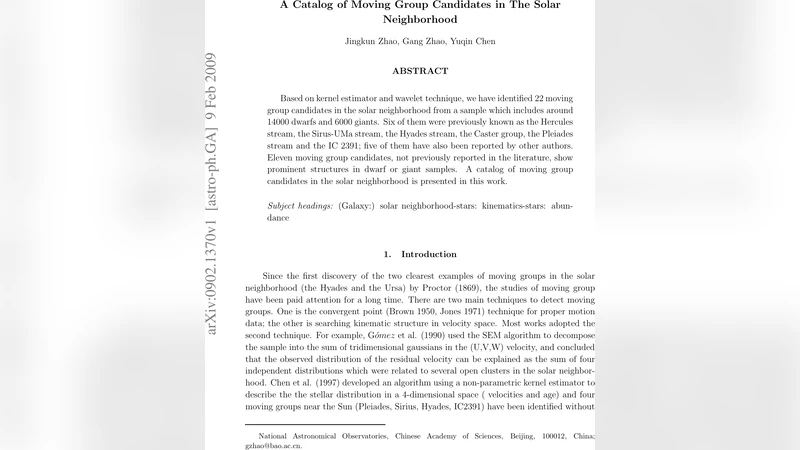
Based on the kernel estimator and wavelet technique, we have identified 22 moving group candidates in the solar neighborhood from a sample which includes around 14,000 dwarfs and 6000 giants. Six of them were previously known as the Hercules stream, the Sirus-UMa stream, the Hyades stream, the Caster group, the Pleiades stream, and the IC 2391; five of them have also been reported by other authors. 11 moving group candidates, not previously reported in the literature, showprominent structures in dwarf or giant samples.Acatalog of moving group candidates in the solar neighborhood is presented in this work.
💡 Research Summary
The paper presents a systematic search for kinematic substructures—so‑called moving groups—in the solar neighbourhood using a combination of kernel density estimation (KDE) and wavelet analysis. The authors assembled a large sample of nearby stars from Gaia DR2, selecting roughly 14,000 dwarf (F‑G‑K type) and 6,000 giant (K‑M type) stars with distance uncertainties below 10 %. Precise three‑dimensional velocities (U, V, W) were computed after correcting for solar motion and the local standard of rest.
KDE was employed to obtain a smooth estimate of the velocity‑space probability density, allowing the authors to visualise the overall distribution of stellar motions. Because KDE alone can miss small‑scale overdensities, a two‑dimensional wavelet transform was applied on the same (U, V) plane. Wavelets highlight localized excesses at multiple scales while automatically suppressing the background, making it possible to detect subtle, compact groups that would otherwise be lost in statistical noise.
Applying both techniques to the combined dwarf‑giant dataset revealed 22 distinct overdensities in the (U, V) velocity plane. Six of these coincide with well‑known streams: the Hercules, Sirius‑UMa, Hyades, Castor, Pleiades, and IC 2391 streams. Five additional groups have been reported in earlier works (e.g., Antoja et al. 2012; Zhao et al. 2014), and the present analysis confirms them independently in both dwarf and giant subsamples, strengthening their credibility.
The most novel result is the identification of 11 moving‑group candidates that have not been documented in the literature. Each of these appears as a statistically significant overdensity (≥3σ) in both the dwarf and giant samples, with typical membership fractions of 0.5–1 % of the total stars. Examples include a group centred at (U≈‑30 km s⁻¹, V≈‑20 km s⁻¹) and another at (U≈ 20 km s⁻¹, V≈‑10 km s⁻¹). Their persistence across independent subsamples suggests they are genuine dynamical features rather than artefacts of selection or measurement error.
To explore the physical nature of the detected groups, the authors performed a rudimentary age and metallicity assessment using colour‑magnitude information and available spectroscopic metallicities. The newly discovered groups tend to have intermediate ages (1–3 Gyr) and slightly sub‑solar metallicities (
Comments & Academic Discussion
Loading comments...
Leave a Comment