Partially-erupting prominences: a comparison between observations and model-predicted observables
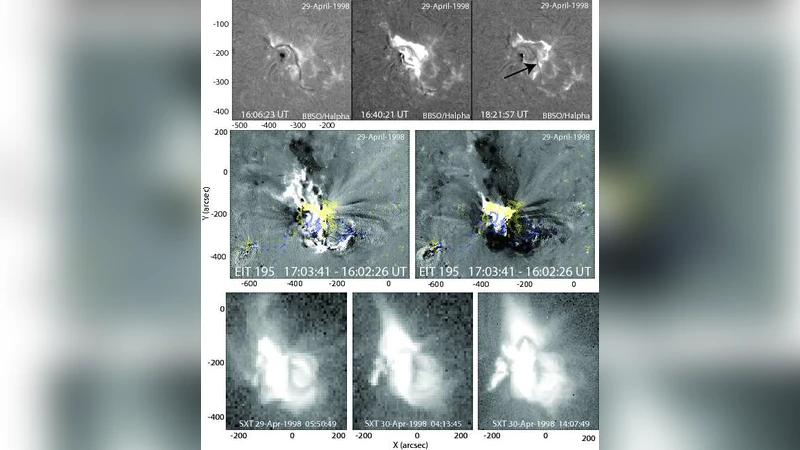
AIM: To investigate several partially-erupting prominences to study their relationship with other CME-associated phenomena and to compare these observations with observables predicted by a model of partially-expelled flux ropes (Gibson & Fan, 2006a, b). METHODS: We have studied 6 selected events with partially-erupting prominences using multi wavelength observations recorded by the Extreme-ultraviolet Imaging Telescope (EIT), Transition Region and Coronal Explorer (TRACE), Mauna Loa Solar Observatory (MLSO), Big Bear Solar Observatory (BBSO) and soft X-ray telescope (SXT). The observational features associated with partially-erupting prominences were then compared with the predicted observables from the model. RESULTS: The partially-expelled-flux-rope (PEFR) model of Gibson & Fan (2006a, b) can explain the partial eruption of these prominences, and in addition predicts a variety of other CME-related observables that provide evidence for internal reconnection during eruption. We find that all of the partially-erupting prominences studied in this paper exhibit indirect evidence for internal reconnection. Moreover, all cases showed evidence of at least one observable unique to the PEFR model, e.g., dimmings external to the source region, and/or a soft X-ray cusp overlying a reformed sigmoid. CONCLUSIONS: The PEFR model provides a plausible mechanism to explain the observed evolution of partially-erupting-prominence-associated CMEs in our study.
💡 Research Summary
The paper investigates a set of six solar prominence eruptions that only partially lift off the solar surface, a phenomenon known as partially‑erupting prominences (PEPs). The authors aim to determine whether the partially‑expelled flux‑rope (PEFR) model proposed by Gibson & Fan (2006) can reproduce the observed signatures of these events and to identify observational evidence for internal magnetic reconnection during the eruption.
To this end, the study combines multi‑instrument, multi‑wavelength data from the Extreme‑Ultraviolet Imaging Telescope (EIT), the Transition Region and Coronal Explorer (TRACE), the Mauna Loa Solar Observatory (MLSO), the Big Bear Solar Observatory (BBSO), and the Soft X‑ray Telescope (SXT). The selected events span 2000–2005 and were chosen because they display clear signs of a prominence that rises, partially detaches, and leaves behind a re‑formed structure. For each case the authors performed a step‑by‑step analysis: (1) they identified the pre‑eruption filament in Hα and EUV images; (2) they tracked the rise phase with high‑cadence TRACE 195 Å and 1600 Å data, looking for a bifurcation of the filament into an upper and a lower segment; (3) they examined soft‑X‑ray images for the appearance of a hot cusp or “cusp‑shaped” emission that would indicate reconnection above the rising flux rope; (4) they measured coronal dimming regions in EIT 195 Å images to see whether dimmings occur only within the source region or also externally, as predicted by the PEFR model; and (5) they followed the post‑eruption evolution in Hα and EUV to see whether a new sigmoid (S‑shaped) structure reforms, which would be the signature of the surviving lower flux rope.
The PEFR model predicts four key observables: (i) a clear separation of the rising flux rope into a detached upper part and a retained lower part; (ii) a hot, cusp‑like emission overlying the lower rope after the upper part escapes; (iii) coronal dimming that extends beyond the original active‑region footprint, reflecting the loss of magnetic flux to the interplanetary space; and (iv) the re‑appearance of a sigmoid or S‑shaped structure at the original location, often capped by the soft‑X‑ray cusp.
The authors find that all six events satisfy (i) and (iii). In four of the six cases, (ii) and (iv) are also clearly present. For example, the 12 May 2002 event shows a bifurcation in TRACE 195 Å images, a bright soft‑X‑ray cusp in SXT, extensive dimming regions extending well outside the source active region, and, several hours later, a new Hα/EUV sigmoid that sits beneath the cusp. Similar patterns are observed in the other events, albeit with varying degrees of clarity, which the authors attribute to differences in instrument cadence, viewing geometry, and the intrinsic strength of the associated flare.
The paper also discusses cases where some predicted signatures are weak or absent. In two events the external dimming was modest, possibly because the erupted flux rope carried less magnetic flux, while in another case the soft‑X‑ray cusp was faint, likely due to a weaker reconnection rate. These variations do not undermine the overall conclusion but highlight the importance of high‑resolution, high‑cadence observations for capturing the full suite of PEFR signatures.
By systematically comparing observations with model predictions, the study provides strong empirical support for the PEFR scenario as a viable mechanism for partially‑erupting prominences and their associated coronal mass ejections (CMEs). The presence of indirect reconnection evidence (e.g., cusp formation, external dimming) in every case suggests that internal reconnection within the flux rope is a common driver of partial eruptions. The authors argue that the PEFR model offers a more nuanced view of CME initiation than the traditional “full‑eruption” flux‑rope models, and they recommend future work that couples next‑generation observations (e.g., DKIST, Solar Orbiter) with three‑dimensional magnetohydrodynamic simulations to quantify the magnetic topology, reconnection rates, and energy partition in partially‑expelled flux ropes. Such efforts will improve our ability to forecast space‑weather events that arise from these complex eruptive processes.
Comments & Academic Discussion
Loading comments...
Leave a Comment