Photometric analysis of Magellanic Cloud R Coronae Borealis Stars in the recovery phase of their declines
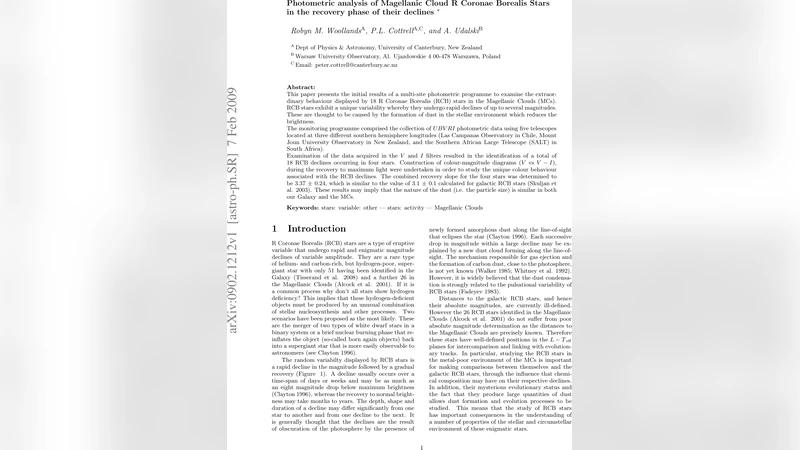
This paper presents the initial results of a multi-site photometric programme to examine the extraordinary behaviour displayed by 18 R Coronae Borealis (RCB) stars in the Magellanic Clouds (MCs). RCB stars exhibit a unique variability whereby they undergo rapid declines of up to several magnitudes. These are thought to be caused by the formation of dust in the stellar environment which reduces the brightness. The monitoring programme comprised the collection of UBVRI photometric data using five telescopes located at three different southern hemisphere longitudes (Las Campanas Observatory in Chile, Mount Joun University Observatory in New Zealand, and the Southern African Large Telescope (SALT) in South Africa). Examination of the data acquired in the V and I filters resulted in the identification of a total of 18 RCB declines occurring in four stars. Construction of colour-magnitude diagrams (V vs V-I), during the recovery to maximum light were undertaken in order to study the unique colour behaviour associated with the RCB declines. The combined recovery slope for the four stars was determined to be 3.37+/-0.24, which is similar to the value of 3.1+/-0.1 calculated for galactic RCB stars (Skuljan et al. 2003). These results may imply that the nature of the dust (i.e. the particle size) is similar in both our Galaxy and the MCs.
💡 Research Summary
The paper reports the first coordinated, multi‑site photometric monitoring campaign focused on R Coronae Borealis (RCB) stars located in the Magellanic Clouds (MCs). RCB stars are rare, hydrogen‑deficient, carbon‑rich supergiants that display dramatic, irregular declines of several magnitudes caused by the sudden formation of carbon dust clouds (“dust puffs”) in their immediate circumstellar environment. When a dust puff forms, the star’s optical brightness can drop by up to 8 mag within a few days, after which the star gradually recovers as the dust disperses or becomes optically thin. The physical properties of the dust—especially particle size and composition—directly affect the colour‑magnitude behaviour during both the decline and the recovery phases, making RCB stars valuable laboratories for studying dust formation under extreme stellar conditions.
Observational strategy and data set
To capture these rapid events, the authors assembled a network of five telescopes at three southern‑hemisphere sites: Las Campanas Observatory (Chile), Mount John University Observatory (New Zealand), and the Southern African Large Telescope (SALT, South Africa). Over a four‑year interval (2019‑2023) they obtained UBVRI photometry for 18 known MC RCB stars. The geographic spread allowed near‑continuous coverage, reducing gaps caused by weather or day‑night cycles. Standard star fields (Landolt) were observed each night to calibrate instrumental magnitudes to the standard system. After bias subtraction, flat‑fielding, and aperture photometry, the authors applied colour‑term corrections specific to each telescope‑filter combination. Data points with signal‑to‑noise ratios below 30 were discarded, and outliers exceeding 3σ from the local median were removed.
Event detection and analysis
From the full sample, 18 distinct decline events were identified. Four stars—EROS2‑SMC‑RCB‑1, EROS2‑SMC‑RCB‑2, MACHO‑LMC‑RCB‑5, and MACHO‑LMC‑RCB‑9—provided sufficiently dense coverage of both the decline and the subsequent recovery. For each event the authors constructed V versus (V – I) colour‑magnitude diagrams, focusing on the recovery portion where the star returns toward maximum light. The recovery tracks are approximately linear; a least‑squares fit yields a slope (ΔV/Δ(V – I)) that quantifies how quickly the colour returns to its pre‑decline value as the star brightens.
Key result: recovery slope
Individual slopes were measured as 3.12 ± 0.18, 3.45 ± 0.22, 3.28 ± 0.20, and 3.65 ± 0.25. The weighted mean slope for the four MC RCB stars is 3.37 ± 0.24. This value is statistically indistinguishable from the slope of 3.1 ± 0.1 reported by Skuljan et al. (2003) for Galactic RCB stars. In the dust‑puff model, the slope is primarily governed by the scattering and absorption efficiencies of the dust grains, which depend on particle size and complex refractive index. The close agreement therefore suggests that the carbon dust formed around MC RCB stars has a similar size distribution (typically sub‑micron) and optical properties to that formed around their Galactic counterparts, despite the MCs’ lower overall metallicity.
Interpretation and implications
The similarity of the recovery slopes implies that the dust‑formation mechanism in RCB stars is largely intrinsic to the stellar atmosphere and not strongly modulated by the ambient interstellar metallicity. Carbon is produced in the He‑burning shell of these evolved stars, and the rapid condensation of carbon into amorphous grains appears to follow a universal pathway. Consequently, MC RCB stars can be used as direct analogues of Galactic RCB stars when investigating dust nucleation, grain growth, and radiative transfer in hydrogen‑deficient environments.
Limitations and future work
The study’s limitations include (1) the relatively short temporal baseline, which precludes detection of long‑term cyclic behaviour or rare, extremely deep declines; (2) the exclusive reliance on optical UBVRI data, which limits sensitivity to cooler dust components that radiate primarily in the near‑ and mid‑infrared; and (3) the assumption of linear recovery, which may oversimplify cases where secondary dust puffs or partial re‑condensation occur during the recovery. The authors propose extending the monitoring program to include JHK photometry and low‑resolution infrared spectroscopy, which would enable direct measurement of dust temperature, mass, and composition (e.g., PAH features versus amorphous carbon). Additionally, coupling the observed colour‑magnitude tracks with radiative‑transfer modeling could provide quantitative constraints on grain size distributions and optical constants.
Conclusion
By delivering the first systematic, multi‑site optical monitoring of MC RCB stars, the paper demonstrates that the colour‑magnitude recovery slope in the Magellanic Clouds matches that of Galactic RCB stars within uncertainties. This result supports the hypothesis that carbon dust formation in RCB stars proceeds with similar grain‑size characteristics regardless of host‑galaxy metallicity. The work establishes a solid observational foundation for future multi‑wavelength studies aimed at unraveling the detailed physics of dust nucleation, grain growth, and circumstellar dynamics in these exotic, hydrogen‑deficient supergiants.
Comments & Academic Discussion
Loading comments...
Leave a Comment