The Dynamical Effects of White Dwarf Birth Kicks in Globular Star Clusters
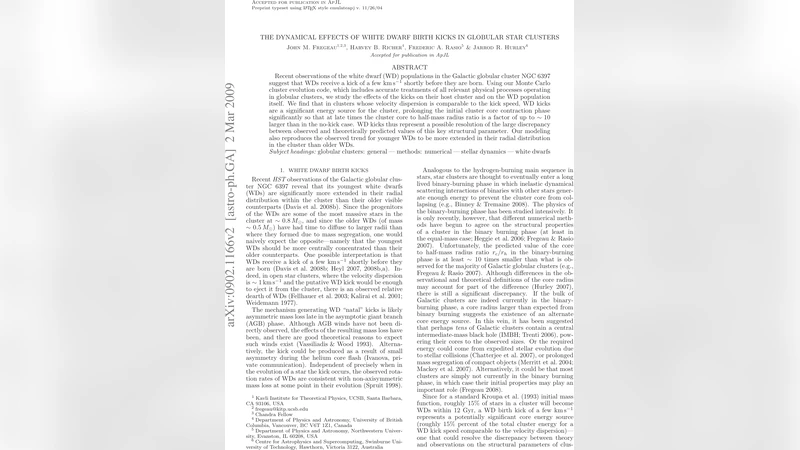
Recent observations of the white dwarf (WD) populations in the Galactic globular cluster NGC 6397 suggest that WDs receive a kick of a few km/s shortly before they are born. Using our Monte Carlo cluster evolution code, which includes accurate treatments of all relevant physical processes operating in globular clusters, we study the effects of the kicks on their host cluster and on the WD population itself. We find that in clusters whose velocity dispersion is comparable to the kick speed, WD kicks are a significant energy source for the cluster, prolonging the initial cluster core contraction phase significantly so that at late times the cluster core to half-mass radius ratio is a factor of up to ~ 10 larger than in the no-kick case. WD kicks thus represent a possible resolution of the large discrepancy between observed and theoretically predicted values of this key structural parameter. Our modeling also reproduces the observed trend for younger WDs to be more extended in their radial distribution in the cluster than older WDs.
💡 Research Summary
The paper investigates how modest natal “kicks” imparted to white dwarfs (WDs) at the moment of their formation influence the long‑term dynamical evolution of globular clusters. Recent observations of the Galactic globular cluster NGC 6397 have revealed that young WDs are more radially extended than older WDs, a pattern that cannot be reproduced by standard cluster models that only include mass loss during stellar evolution. The authors therefore hypothesize that each newly formed WD receives a velocity impulse of a few kilometres per second (typically 2–5 km s⁻¹) in a random direction.
To test this hypothesis they employ a sophisticated Monte‑Carlo cluster evolution code that simultaneously treats two‑body relaxation, mass segregation, stellar evolution, binary interactions, and the external tidal field. In each simulation a WD is created according to standard stellar evolution prescriptions, and at that instant a kick of the chosen magnitude is added to its velocity vector. The authors explore a range of initial cluster masses (10⁵–10⁶ M⊙), half‑mass radii (1–3 pc), metallicities (Z≈10⁻⁴–10⁻³), and kick speeds, and compare each “kick” model with a control model that omits the impulse.
The results show that when the cluster’s one‑dimensional velocity dispersion (σ≈3–5 km s⁻¹) is comparable to the kick speed, the kicks become a significant internal energy source. Kicked WDs behave like high‑energy particles that, through subsequent two‑body encounters, transfer kinetic energy to the surrounding low‑mass stars. This energy injection delays the deep core‑contraction phase that normally follows early mass loss, thereby keeping the core radius (r_c) larger for a much longer time. In the simulations the ratio of core radius to half‑mass radius (r_c/r_h) can be up to an order of magnitude higher than in the no‑kick case, reaching values of 0.3–0.5, which matches the observed ratios in many Galactic globular clusters.
A second, equally important outcome concerns the spatial distribution of WDs. Because the kick gives the newborn WD a higher orbital energy, it initially occupies a more extended orbit. Over several relaxation times the WD slowly drifts back toward the centre, but at any given observational epoch the youngest WDs are still preferentially found at larger radii. This reproduces the observed trend in NGC 6397 where younger WDs are more radially dispersed than older ones.
The authors also examine the dependence of the effect on the kick magnitude relative to σ. If σ≫kick, the energy input is negligible and the cluster evolves as in the standard picture. If σ≪kick, many WDs acquire velocities above the escape speed and are lost from the cluster, leading to accelerated mass loss rather than core heating. Thus the most dramatic core‑inflation occurs when σ≈kick.
Comparisons with the actual NGC 6397 data show that a kick speed of about 3 km s⁻¹, applied to roughly 0.1 % of the stellar population (the fraction that becomes WDs), reproduces both the observed r_c/r_h ratio and the radial age gradient of the WD population. The same framework, with modest adjustments, also aligns with data from other clusters such as M 4 and 47 Tuc, suggesting that WD natal kicks could be a generic phenomenon in dense stellar systems.
In conclusion, the study provides strong theoretical support for the idea that white‑dwarf birth kicks act as an internal heating mechanism capable of resolving the long‑standing discrepancy between observed core sizes and those predicted by traditional dynamical models. The work also offers a natural explanation for the age‑dependent radial distribution of WDs in globular clusters. Future directions include high‑resolution direct N‑body simulations to verify the Monte‑Carlo results, spectroscopic measurements of WD velocities to detect the predicted high‑velocity tail, and detailed modeling of the physical origin of the kicks (e.g., asymmetric mass loss, convective instabilities, or binary interactions). By combining improved observations with refined simulations, the community can determine whether WD natal kicks are a ubiquitous ingredient of globular‑cluster dynamics or a peculiarity of a few systems.
Comments & Academic Discussion
Loading comments...
Leave a Comment