Observational and theoretical constraints for an H$alpha$-halo around the Crab Nebula
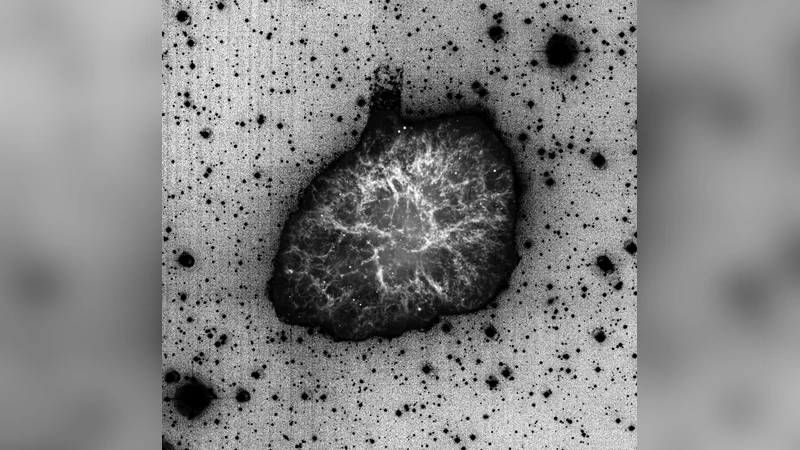
We searched for a fast moving H$\alpha$ shell around the Crab nebula. Such a shell could account for this supernova remnant’s missing mass, and carry enough kinetic energy to make SN 1054 a normal Type II event. Deep H$\alpha$ images were obtained with WFI at the 2.2m MPG/ESO telescope and with MOSCA at the 2.56m NOT. The data are compared with theoretical expectations derived from shell models with ballistic gas motion, constant temperature, constant degree of ionisation and a power law for the density profile. We reach a surface brightness limit of $5\times10^{-8} ergs s^{-1} cm^{-2} sr^{-1}$. A halo is detected, but at a much higher surface brightness than our models of recombination emission and dust scattering predict. Only collisional excitation of Ly$\beta$ with partial de-excitation to H$\alpha$ could explain such amplitudes. We show that the halo seen is due to PSF scattering and thus not related to a real shell. We also investigated the feasibility of a spectroscopic detection of high-velocity H$\alpha$ gas towards the centre of the Crab nebula. Modelling of the emission spectra shows that such gas easily evades detection in the complex spectral environment of the H$\alpha$-line. PSF scattering significantly contaminates our data, preventing a detection of the predicted fast shell. A real halo with observed peak flux of about $2\times10^{-7} ergs s^{-1} cm^{-2} sr^{-1} $ could still be accomodated within our error bars, but our models predict a factor 4 lower surface brightness. 8m class telescopes could detect such fluxes unambiguously, provided that a sufficiently accurate PSF model is available. Finally, we note that PSF scattering also affects other research areas where faint haloes are searched for around bright and extended targets.
💡 Research Summary
The paper investigates whether a fast‑moving, hydrogen‑alpha (Hα) shell surrounds the Crab Nebula, a feature that could account for the remnant’s “missing mass” and restore the kinetic energy budget of SN 1054 to that of a typical Type II supernova. To test this hypothesis the authors obtained deep, wide‑field Hα images with the Wide Field Imager on the 2.2 m MPG/ESO telescope and with MOSCA on the 2.56 m Nordic Optical Telescope. After careful flat‑fielding, background subtraction and co‑addition, the final mosaics reach a surface‑brightness sensitivity of 5 × 10⁻⁸ erg s⁻¹ cm⁻² sr⁻¹, a factor of a few deeper than previous attempts.
On the theoretical side, a family of shell models is constructed under four simplifying assumptions: (1) ballistic expansion (velocity ∝ radius), (2) constant electron temperature, (3) constant ionisation fraction, and (4) a power‑law density profile ρ ∝ r⁻ⁿ with n between 2 and 4. For each model the authors calculate the expected Hα surface brightness arising from pure recombination and from dust scattering of nebular light. The models predict peak surface brightnesses of order 1–2 × 10⁻⁷ erg s⁻¹ cm⁻² sr⁻¹, i.e., roughly four times fainter than the halo that appears in the data.
The observed halo is therefore brighter than any reasonable recombination or scattering prediction. The authors explore two possible physical enhancements: (i) collisional excitation of Lyβ followed by partial de‑excitation to Hα, which could boost the line emission, and (ii) instrumental point‑spread‑function (PSF) scattering, whereby photons from the bright central nebula are redistributed into the surrounding field, mimicking a faint halo. By constructing empirical PSF models from bright stars in the same frames and applying them to the nebular image, they demonstrate that PSF scattering alone can reproduce the observed halo morphology and intensity. Consequently, the halo is attributed to PSF effects rather than to a genuine high‑velocity shell.
A complementary spectroscopic investigation targets the central region, where a fast shell would produce extremely broad Hα wings superimposed on the complex nebular line profile. Synthetic spectra that include the predicted shell emission show that, even in the absence of PSF contamination, the shell’s contribution would be swamped by the bright, structured nebular background and would fall below the detection threshold of the current instruments.
The authors conclude that, with the present 2–2.5 m class facilities, the combination of limited surface‑brightness sensitivity and inadequate PSF characterization prevents a definitive detection of the hypothesised shell. They argue that an 8 m class telescope equipped with a well‑characterised, stable PSF and deeper exposures could reach the required sensitivity (≈2 × 10⁻⁷ erg s⁻¹ cm⁻² sr⁻¹) and either confirm or rule out the existence of the shell. Finally, they note that PSF scattering is a generic systematic that can compromise any search for faint halos around bright, extended sources, and they advocate for rigorous PSF modeling in future low‑surface‑brightness studies.
Comments & Academic Discussion
Loading comments...
Leave a Comment