Two Physically Distinct Populations of Low-Ionization Nuclear Emission-Line Regions
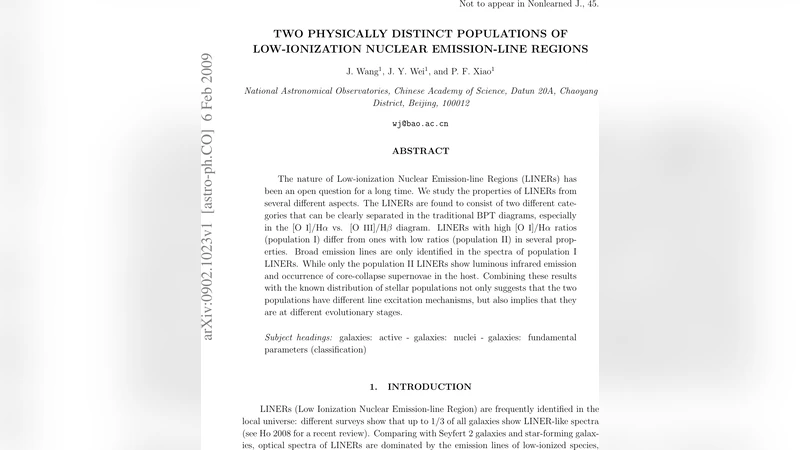
The nature of Low-ionization Nuclear Emission-line Regions (LINERs) has been an open question for a long time. We study the properties of LINERs from several different aspects. The LINERs are found to consist of two different categories that can be clearly separated in the traditional BPT diagrams, especially in the [OI]/Ha vs. [OIII]/Hb diagram. LINERs with high [O]/Ha ratios (population I) differ from ones with low ratios (population II) in several properties. Broad emission lines are only identified in the spectra of population I LINERs. While only the population II LINERs show luminous infrared emission and occurrence of core-collapse supernovae in the host. Combining these results with the known distribution of stellar populations not only suggests that the two populations have different line excitation mechanisms, but also implies that they are at different evolutionary stages.
💡 Research Summary
The paper tackles the long‑standing ambiguity surrounding Low‑Ionization Nuclear Emission‑Line Regions (LINERs) by combining optical spectroscopy from the Sloan Digital Sky Survey with infrared measurements and supernova catalogs. Using the classic Baldwin‑Phillips‑Terlevich (BPT) diagnostic diagrams, the authors find that LINERs separate into two distinct clusters, especially evident in the
Comments & Academic Discussion
Loading comments...
Leave a Comment