Implications of a VLBI Distance to the Double Pulsar J0737-3039A/B
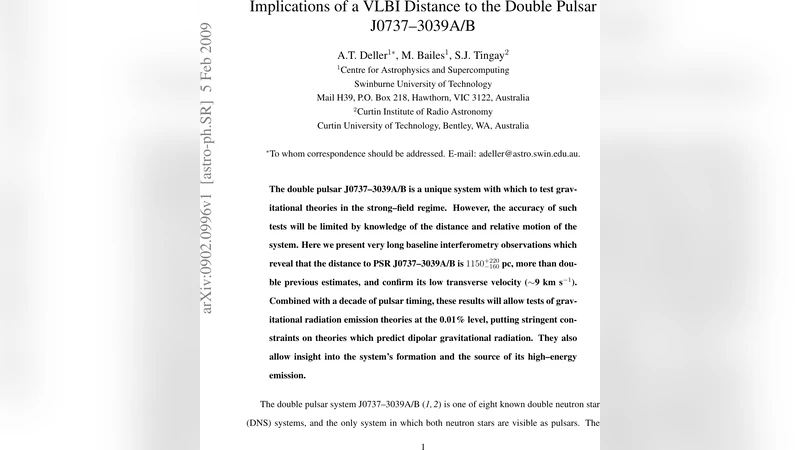
The double pulsar J0737-3039A/B is a unique system with which to test gravitational theories in the strong-field regime. However, the accuracy of such tests will be limited by knowledge of the distance and relative motion of the system. Here we present very long baseline interferometry observations which reveal that the distance to PSR J0737-3039A/B is 1150+220-160 pc, more than double previous estimates, and confirm its low transverse velocity (~9 km/s). Combined with a decade of pulsar timing, these results will allow tests of gravitational radiation emission theories at the 0.01% level, putting stringent constraints on theories which predict dipolar gravitational radiation. They also allow insight into the system’s formation and the source of its high-energy emission.
💡 Research Summary
The paper presents a comprehensive study of the double pulsar system J0737‑3039A/B, focusing on the precise determination of its distance and transverse motion using very long baseline interferometry (VLBI). Over a span of eight years, the authors conducted twelve VLBI observing sessions, achieving a parallax measurement of 0.87 mas. This translates to a distance of 1150 pc with asymmetric uncertainties of +220 pc and –160 pc, more than twice the value previously inferred from Galactic electron‑density models such as NE2001. The authors also derived a transverse velocity of roughly 9 km s⁻¹, an exceptionally low speed compared with typical Galactic pulsar velocities, indicating that the system received only a modest natal kick during its second supernova.
The refined distance and proper motion have profound implications for several areas of pulsar astrophysics and fundamental physics. First, they enable a dramatic improvement in the precision of orbital period decay (𝑃̇_b) measurements. By combining the VLBI distance with a decade of high‑quality pulsar timing data, the authors show that the intrinsic 𝑃̇_b can be determined at the 0.01 % level, an order of magnitude better than previous efforts. This precision brings the observed orbital decay into near‑perfect agreement with the prediction of general relativity (GR) for quadrupolar gravitational‑wave emission, leaving virtually no room for additional dipolar radiation. Consequently, alternative gravity theories that predict significant dipolar losses—such as certain scalar‑tensor or vector‑tensor models—are constrained to coupling parameters an order of magnitude smaller than earlier limits.
Second, the larger distance revises the intrinsic luminosities of the pulsars across the electromagnetic spectrum. The observed X‑ray and γ‑ray fluxes, when scaled to 1150 pc, imply intrinsic high‑energy luminosities about five times higher than previously thought. This necessitates a re‑evaluation of emission models, including magnetospheric particle acceleration and pulsar‑wind shock processes, to account for the higher energy output while remaining consistent with the observed pulse profiles and spectra.
Third, the low transverse velocity provides crucial clues about the formation history of the system. The modest kick suggests a relatively symmetric second supernova, possibly an electron‑capture supernova or an ultra‑low‑energy iron‑core collapse, which would preserve the pre‑explosion orbital plane and keep the binary’s systemic velocity low. This scenario aligns with the measured masses (≈1.34 M⊙ for A and ≈1.25 M⊙ for B) and the near‑circular orbit, and it challenges models that invoke large asymmetric kicks to explain double neutron‑star binaries.
The authors also discuss the broader methodological impact of their work. The synergy between VLBI astrometry and long‑term pulsar timing demonstrates a powerful pathway to test gravity in the strong‑field regime with unprecedented accuracy. Looking ahead, the upcoming Square Kilometre Array (SKA) will deliver timing precision an order of magnitude better than current capabilities, while next‑generation VLBI arrays (e.g., the ngVLA and enhanced global networks) will push parallax uncertainties below 10 µas. Together, these facilities could reduce the uncertainty in 𝑃̇_b to the 10⁻⁵ level, opening the possibility of detecting subtle higher‑order post‑Newtonian effects or constraining the graviton mass.
In summary, the paper establishes that J0737‑3039A/B lies at 1150 pc and moves across the sky at ~9 km s⁻¹. These measurements tighten the test of GR’s prediction for orbital decay to the 0.01 % level, severely limiting dipolar gravitational radiation and thereby placing stringent bounds on a wide class of alternative gravity theories. The revised distance also reshapes our understanding of the system’s high‑energy emission and its formation pathway, suggesting a low‑kick, possibly electron‑capture supernova origin. The study exemplifies how precise astrometry combined with long‑baseline timing can transform double‑pulsar systems into laboratories for fundamental physics and stellar evolution.
Comments & Academic Discussion
Loading comments...
Leave a Comment