Aperture Synthesis Observations of the Nearby Spiral NGC 6503: Modeling the Thin and Thick HI Disks
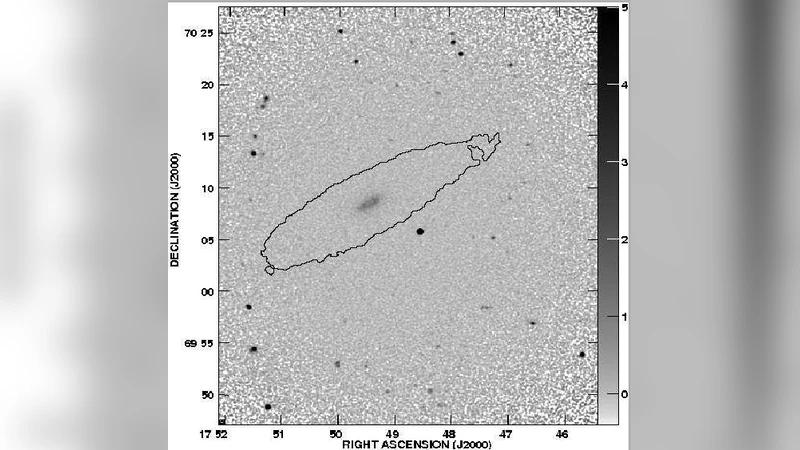
We present sensitive aperture synthesis observations of the nearby, late-type spiral galaxy NGC 6503, and produce HI maps of considerably higher quality than previous observations by van Moorsel & Wells (1985). We find that the velocity field, while remarkably regular, contains clear evidence for irregularities. The HI is distributed over an area much larger than the optical image of the galaxy, with spiral features in the outer parts and localized holes within the HI distribution. The absence of absorption towards the nearby quasar 1748+700 yields an upper limit of 5 10^{17} cm^{-2} for the column density of cold HI gas along a line of sight which should intersect the disk at a radius of 29 kpc. This suggests that the radial extent of the HI disk is not much larger than that which we trace in HI emission (23 kpc). The observed HI distribution is inconsistent with models of a single thin or thick disk. Instead, the data require a model containing a thin disk plus a thicker low column-density HI layer that rotates more slowly than the thin disk and that extends only to approximately the optical radius. This suggests that the presence of extra-planar gas in this galaxy is largely the result of star formation in the disk rather than cold gas accretion. Improved techniques for interferometric imaging including multi-scale Clean that were used in this work are also described.
💡 Research Summary
This paper presents new, high‑sensitivity aperture‑synthesis observations of the nearby late‑type spiral galaxy NGC 6503 obtained with the VLA in its C and D configurations. By employing a multi‑scale CLEAN imaging technique, the authors achieve substantially higher dynamic range and spatial resolution than the classic 1985 study by van Moorsel & Wells. The resulting 21 cm HI maps reveal that neutral hydrogen extends well beyond the optical disk, reaching a radius of about 23 kpc, and displays outer‑disk spiral features as well as localized holes. A regular overall velocity field is observed, but subtle asymmetries and non‑circular motions appear in the outer parts.
Crucially, the HI distribution cannot be reproduced by a single thin or a single thick disk model. The authors construct three‑dimensional models consisting of (1) a thin, high‑column‑density disk that follows the optical extent and (2) a thicker, low‑column‑density layer that is confined roughly to the optical radius and rotates 15–20 km s⁻¹ more slowly than the thin disk. This two‑component model successfully matches both the surface‑density profile and the detailed kinematics.
An additional constraint comes from a non‑detection of HI absorption toward the background quasar 1748+700, which lies behind the galaxy at a projected radius of 29 kpc. The derived upper limit of N(H I) < 5 × 10¹⁷ cm⁻² implies that the neutral gas does not extend significantly beyond the radius traced in emission, reinforcing the idea that the observed HI envelope is not the product of a massive, extended cold‑flow accretion.
The authors interpret the thick, slowly rotating component as extra‑planar gas generated by star‑formation feedback within the disk—essentially a galactic fountain—rather than by external cold‑gas accretion. Supernovae and stellar winds lift disk material into the halo, where it cools and falls back, forming a low‑density layer that lags behind the thin disk’s rotation.
Beyond the scientific results, the paper also details the improved interferometric imaging workflow, highlighting the advantages of multi‑scale CLEAN for simultaneously recovering diffuse emission and compact structures. The study therefore provides both a refined picture of NGC 6503’s neutral‑hydrogen architecture and a methodological template for future high‑fidelity HI observations of nearby galaxies.
Comments & Academic Discussion
Loading comments...
Leave a Comment