Star formation around RCW 120, the perfect bubble
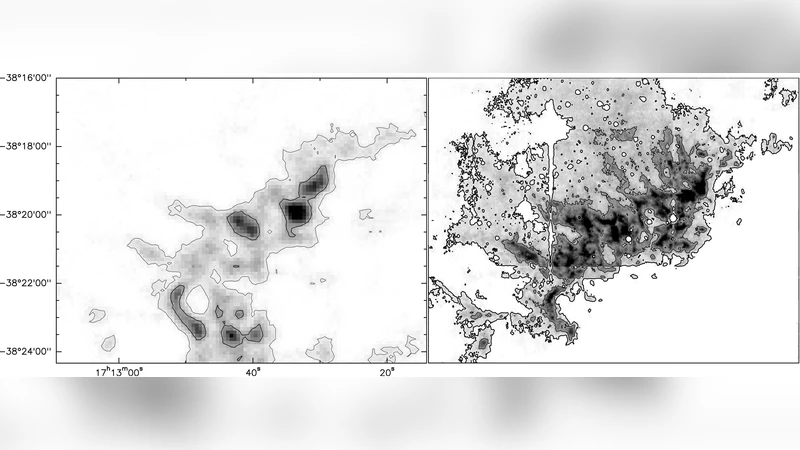
We take advantage of the very simple morphology of RCW 120 – a perfect bubble – to understand the mechanisms triggering star formation around an HII region and to establish what kind of stars are formed there. We present 870 microns observations of RCW 120, obtained with the APEX-LABOCA camera. These show the distribution of cold dust, and thus of neutral material. We use Spitzer-MIPS observations at 24 and 70 microns to detect the young stellar objects (YSOs) present in this region and to estimate their evolutionary stages. A layer of dense neutral material surrounds the HII region, having been swept up during the region’s expansion. This layer has a mass greater than 2000 solar masses and is fragmented, with massive fragments elongated along the ionization front (IF). We measured the 24 microns flux of 138 sources. Of these, 39 are Class I or flat-spectrum YSOs observed in the direction of the collected layer. We show that several triggering mechanisms are acting simultaneously in the swept-up shell, where they form a second generation of stars. No massive YSOs are detected. However, a massive, compact 870 microns core lies adjacent to the IF. A 70 microns source with no 24 microns counterpart is detected at the same position. This source is a likely candidate for a Class 0 YSO. Also at 24 microns, we detect a chain of about ten regularly spaced Class I or flat spectrum sources, parallel to the IF, in the direction of the most massive fragment. We suggest that the formation of these YSOs is the result of Jeans gravitational instabilities in the collected layer. Finally, the 870 microns emission, the 24 microns emission, and the Halpha emission show the existence of an extended and partially ionized photodissociation region around RCW 120.
💡 Research Summary
The paper exploits the remarkably simple, almost spherical morphology of the Galactic H II region RC W 120 – often described as a “perfect bubble” – to investigate how expanding ionized bubbles trigger the formation of a second generation of stars and what types of stars are produced. Using the APEX‑LABOCA camera, the authors obtained a high‑resolution 870 µm continuum map that traces cold dust and therefore the distribution of neutral material surrounding the ionized cavity. The map reveals a dense, swept‑up shell that completely encircles the H II region. The shell’s total mass exceeds 2 × 10³ M⊙ and it is not a smooth layer; instead it is fragmented into several massive clumps that are elongated parallel to the ionization front (IF). These clumps have masses of a few hundred solar masses and appear to be the product of the “collect‑and‑collapse” process, in which the expanding ionization front sweeps up ambient gas into a dense layer that subsequently becomes gravitationally unstable.
To identify young stellar objects (YSOs) embedded in the shell, the authors used Spitzer‑MIPS images at 24 µm and 70 µm. They measured the 24 µm flux of 138 point sources within the field. By constructing colour–colour diagrams and calculating the spectral index α, they classified 39 of these sources as Class I or flat‑spectrum YSOs, i.e. objects in the earliest observable protostellar phases. All of these protostars are projected onto the dense shell, confirming that star formation is occurring in the material that has been collected by the expanding H II region. No massive (≥8 M⊙) YSOs are found, but a particularly interesting feature is a compact, bright 870 µm core located directly adjacent to the IF. This core is associated with a 70 µm point source that has no counterpart at 24 µm, making it a strong candidate for a Class 0 protostar – the very first stage of protostellar evolution, still deeply embedded and invisible at shorter mid‑infrared wavelengths.
In addition to the isolated core, the authors report a striking linear arrangement of roughly ten Class I or flat‑spectrum sources that run parallel to the IF and lie in the direction of the most massive fragment of the shell. The spacing between these sources is regular (≈0.1 pc), which matches the Jeans length calculated for the measured temperature (~20 K) and density of the fragment. This regular spacing strongly suggests that the YSOs formed via Jeans gravitational instabilities within the collected layer, rather than being triggered individually by external radiation-driven implosion (RDI). Consequently, the authors argue that several triggering mechanisms are operating simultaneously: the global collect‑and‑collapse of the swept‑up shell, local RDI acting on pre‑existing dense clumps, and internal Jeans fragmentation of the massive fragments themselves.
The multi‑wavelength view also reveals an extended, partially ionized photodissociation region (PDR) surrounding RC W 120. The PDR is traced by diffuse 8 µm PAH emission, the Hα recombination line, and the faint 24 µm and 870 µm emission that extends beyond the bright rim. This PDR marks the transition zone where far‑ultraviolet photons from the central O‑type star dissociate molecules and heat the gas, providing the physical conditions that shape the morphology of the shell and influence subsequent star formation.
In summary, the study demonstrates that the simple geometry of RC W 120 allows a clear view of how an expanding H II region can collect a massive neutral shell, fragment it through gravitational instability, and give birth to a new generation of low‑ to intermediate‑mass stars. The detection of a possible Class 0 core, the chain of regularly spaced Class I objects, and the massive fragmented clumps all support the collect‑and‑collapse scenario, while the presence of the PDR and the lack of massive YSOs indicate that the process is still in an early evolutionary stage. Future high‑resolution (e.g., ALMA) observations of the compact core and the fragmented clumps will be essential to determine the exact masses, kinematics, and evolutionary status of the protostars, thereby refining our understanding of triggered star formation in bubble‑like H II regions.
Comments & Academic Discussion
Loading comments...
Leave a Comment