A Study of Active Galactic Nuclei in Low Surface Brightness Galaxies with Sloan Digital Sky Survey Spectroscopy
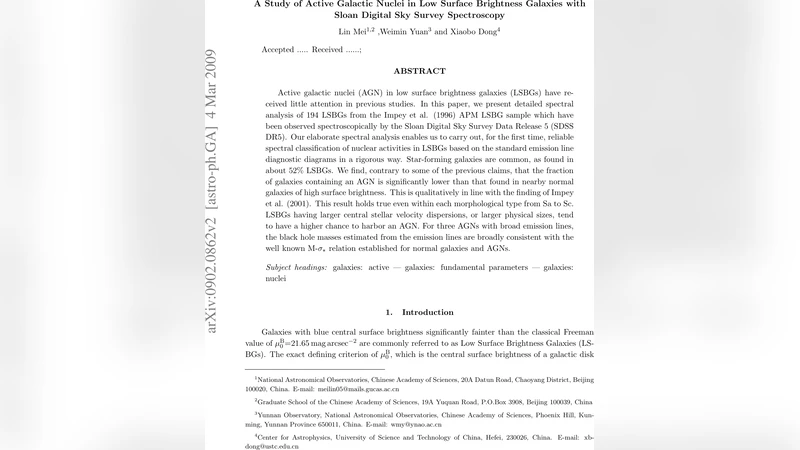
Active galactic nuclei (AGN) in low surface brightness galaxies (LSBGs) have received little attention in previous studies. In this paper, we present detailed spectral analysis of 194 LSBGs from the Impey et al. (1996) APM LSBG sample which have been observed spectroscopically by the Sloan Digital Sky Survey Data Release 5 (SDSS DR5). Our elaborate spectral analysis enables us to carry out, for the first time, reliable spectral classification of nuclear activities in LSBGs based on the standard emission line diagnostic diagrams in a rigorous way. Star-forming galaxies are common, as found in about 52% LSBGs. We find, contrary to some of the previous claims, that the fraction of galaxies containing an AGN is significantly lower than that found in nearby normal galaxies of high surface brightness. This is qualitatively in line with the finding of Impey et al. (2001). This result holds true even within each morphological type from Sa to Sc. LSBGs having larger central stellar velocity dispersions, or larger physical sizes, tend to have a higher chance to harbor an AGN. For three AGNs with broad emission lines, the black hole masses estimated from the emission lines are broadly consistent with the well known M-$\sigma_\ast$ relation established for normal galaxies and AGNs.
💡 Research Summary
This paper presents the first comprehensive spectroscopic study of active galactic nuclei (AGN) in low‑surface‑brightness galaxies (LSBGs) using data from the Sloan Digital Sky Survey Data Release 5 (SDSS DR5). The authors selected 194 LSBGs from the Impey et al. (1996) APM LSBG catalog that have SDSS spectra and performed a meticulous spectral decomposition. First, the observed spectra were corrected for atmospheric absorption and sky background, then the stellar continuum was modeled and subtracted using full‑spectrum fitting tools such as pPXF. This step removed the stellar absorption features with high fidelity, allowing reliable measurement of weak emission lines.
Key emission lines—
Comments & Academic Discussion
Loading comments...
Leave a Comment