The redshift and afterglow of the extremely energetic gamma-ray burst GRB 080916C
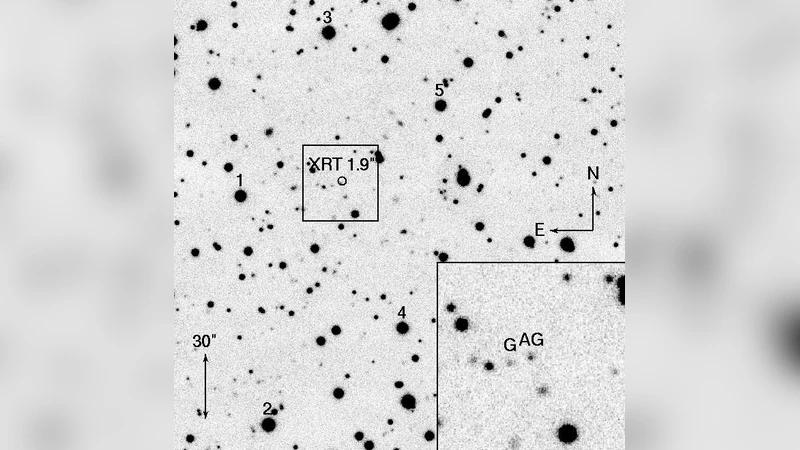
The detection of GeV photons from gamma-ray bursts (GRBs) has important consequences for the interpretation and modelling of these most-energetic cosmological explosions. The full exploitation of the high-energy measurements relies, however, on the accurate knowledge of the distance to the events. Here we report on the discovery of the afterglow and subsequent redshift determination of GRB 080916C, the first GRB detected by the Fermi Gamma-Ray Space Telescope with high significance detection of photons at >0.1 GeV. Observations were done with 7-channel imager GROND at the 2.2m MPI/ESO telescope, the SIRIUS instrument at the Nagoya-SAAO 1.4m telescope in South Africa, and the GMOS instrument at Gemini-S. The afterglow photometric redshift of z=4.35+-0.15, based on simultaneous 7-filter observations with the Gamma-Ray Optical and Near-infrared Detector (GROND), places GRB 080916C among the top 5% most distant GRBs, and makes it the most energetic GRB known to date. The detection of GeV photons from such a distant event is rather surprising. The observed gamma-ray variability in the prompt emission together with the redshift suggests a lower limit for the Lorentz factor of the ultra-relativistic ejecta of Gamma > 1090. This value rivals any previous measurements of Gamma in GRBs and strengthens the extreme nature of GRB 080916C.
💡 Research Summary
The paper reports the discovery and multi‑wavelength follow‑up of GRB 080916C, the first gamma‑ray burst detected by the Fermi Gamma‑Ray Space Telescope with a statistically significant signal above 0.1 GeV. Prompt emission recorded by Fermi‑LAT and GBM showed extremely high‑energy photons, including a 13 GeV photon arriving within the first 16 seconds, indicating an unprecedented energy release. To determine the distance, the authors employed the 7‑channel imager GROND on the 2.2 m MPI/ESO telescope, the SIRIUS instrument on the 1.4 m Nagoya‑SAAO telescope in South Africa, and GMOS on Gemini‑South. Simultaneous observations in seven filters (g′, r′, i′, z′, J, H, K_s) were obtained within an hour after the trigger, revealing an afterglow with r′ ≈ 22 mag. Spectral‑energy‑distribution fitting, anchored by the Lyman‑α break, yielded a photometric redshift of z = 4.35 ± 0.15. This places GRB 080916C among the most distant 5 % of known bursts and makes it the most energetic GRB recorded to date, with an isotropic‑equivalent energy E_iso ≈ 6.5 × 10⁵⁴ erg.
The prompt light curve exhibits variability on timescales as short as ~200 ms. Combining this rapid variability with the high redshift, the authors calculate a lower limit on the bulk Lorentz factor of the ejecta using the condition that the source must be optically thin to photon‑photon pair production. The resulting constraint, Γ > 1090, exceeds all previously reported values (typically Γ ≈ 400–800) and implies an ultra‑relativistic outflow with an extremely thin shell. Such a high Γ alleviates the γ‑γ opacity problem, allowing GeV photons to escape despite the dense photon field expected in the internal‑shock region. Moreover, the detection of GeV photons from a source at z ≈ 4.35 demonstrates that extragalactic background light attenuation is not prohibitive at these energies, providing new constraints on models of intergalactic photon fields.
Methodologically, the study showcases the power of simultaneous multi‑band imaging for rapid redshift estimation. GROND’s seven‑filter capability reduces uncertainties associated with extrapolating between non‑simultaneous observations, while the complementary near‑infrared data from SIRIUS and optical spectroscopy from GMOS refine the afterglow’s spectral shape. This coordinated approach establishes a template for future high‑energy GRB follow‑up, where swift, broadband observations are essential for deriving distances and physical parameters.
In summary, GRB 080916C represents an extreme case in gamma‑ray burst astrophysics: a very distant event that still emitted photons up to tens of GeV, and whose ejecta must have moved with a Lorentz factor exceeding 1000. These findings challenge existing models of jet acceleration, internal shock efficiency, and photon propagation through the early universe. Continued monitoring by Fermi and rapid ground‑based follow‑up will enable statistical studies of such ultra‑energetic bursts, improving our understanding of the most powerful explosions in the cosmos.