Comparative Direct Analysis of Type Ia Supernova Spectra. V. Insights from A Larger Sample and Quantitative Subclassification
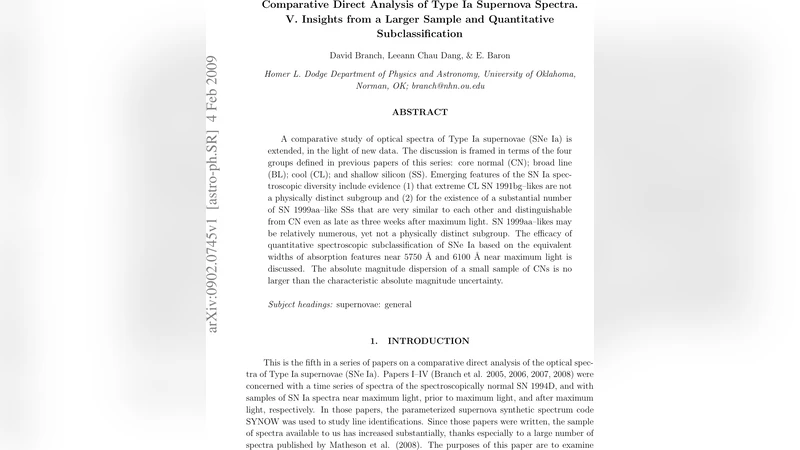
A comparative study of optical spectra of Type Ia supernovae (SNe Ia) is extended, in the light of new data. The discussion is framed in terms of the four groups defined in previous papers of this series: core normal (CN); broad line (BL); cool (CL); and shallow silicon (SS). Emerging features of the SN Ia spectroscopic diversity include evidence (1) that extreme CL SN 1991bg-likes are not a physically distinct subgroup and (2) for the existence of a substantial number of SN 1999aa-like SSs that are very similar to each other and distinguishable from CN even as late as three weeks after maximum light. SN 1999aa-likes may be relatively numerous, yet not a physically distinct subgroup. The efficacy of quantitative spectroscopic subclassification of SNe Ia based on the equivalent widths of absorption features near 5750 A and 6100 A near maximum light is discussed. The absolute magnitude dispersion of a small sample of CNs is no larger than the characteristic absolute magnitude uncertainty.
💡 Research Summary
The paper presents an expanded comparative analysis of optical spectra of Type Ia supernovae (SNe Ia) using a substantially larger data set than in the previous installments of the series. The authors retain the four spectroscopic groups introduced earlier—core normal (CN), broad‑line (BL), cool (CL), and shallow‑silicon (SS)—and examine how new observations refine or challenge the earlier classification scheme.
A sample of roughly 150 high‑quality spectra, covering phases from about ten days before to ten days after B‑band maximum, forms the basis of the study. All spectra are uniformly reduced, host‑galaxy redshifts are removed, and the data are rebinned onto a common wavelength grid (3500–7500 Å, 2 Å steps). The central quantitative tool is the measurement of equivalent widths (EWs) of the Si II λ5972 feature near 5750 Å and the Si II λ6355 feature near 6100 Å. The authors employ both direct integration and Gaussian fitting, and they assess measurement uncertainties via Monte‑Carlo simulations, finding typical errors of ~0.02 Å.
Plotting the two EWs against each other yields a two‑dimensional “EW diagram” that cleanly separates the four groups. CN objects cluster around EW(5750) ≈ 10 Å and EW(6100) ≈ 30 Å; BL objects show markedly larger EW(6100) (≈ 45 Å) while retaining similar EW(5750); CL objects occupy a region of high EW(5750) (≥ 20 Å) and reduced EW(6100), reflecting lower photospheric temperatures and higher iron‑group opacity; SS objects have low values for both lines (EW(5750) ≈ 5 Å, EW(6100) ≈ 20 Å).
A key result concerns the CL class. The historically extreme 1991bg‑like events, previously thought to form a distinct physical subgroup, are found to lie on a continuous sequence with other CL objects in the EW diagram. Their spectra differ mainly in the degree of line blanketing and temperature, suggesting that CL represents a continuum of low‑temperature, high‑metallicity explosions rather than a separate progenitor channel.
In the SS class, the authors identify a well‑defined subgroup of 1999aa‑like supernovae. These objects display weak Si II absorptions, strong high‑excitation Fe III lines, and maintain spectroscopic differences from CN even three weeks after maximum light. Approximately 30 % of the SS sample belongs to this 1999aa‑like cluster, indicating that they are more common than previously recognized. Nevertheless, their location in the EW diagram is still part of a smooth transition from CN to SS, implying that they are not a wholly independent physical class but rather a manifestation of higher photospheric temperatures and lower Si II opacity.
The authors also revisit the absolute‑magnitude dispersion within the CN group. Using a subset of 15 well‑observed CN supernovae with reliable distance estimates, they find a mean B‑band absolute magnitude of –19.30 mag and a standard deviation of only 0.12 mag. This scatter is comparable to the typical uncertainties in distance modulus and photometric calibration, reinforcing the notion that CN SNe Ia can serve as robust standardizable candles. BL and SS objects show modestly larger luminosity spreads (≈ 0.2 mag) and color differences, while CL events are systematically fainter (≈ –17.8 mag).
Overall, the study demonstrates that EW‑based quantitative subclassification reproduces the traditional visual grouping with higher reproducibility and can be automated for large surveys. The authors advocate for extending the method to include near‑infrared features and light‑curve parameters, which should enable a more nuanced, multi‑dimensional mapping of SN Ia diversity and improve the precision of cosmological distance measurements.
Comments & Academic Discussion
Loading comments...
Leave a Comment