The Chemical Evolution of Globular Clusters I. Reactive Elements and Non-Metals
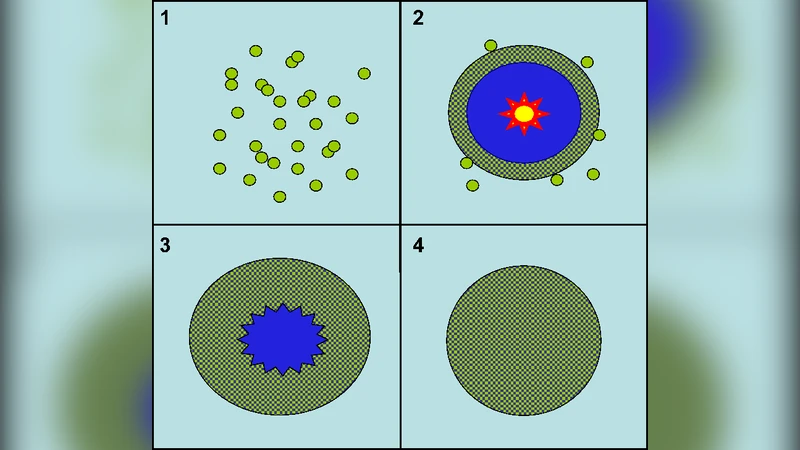
We propose a new chemical evolution model aimed at explaining the chemical properties of globular clusters (GC) stars. Our model depends upon the existence of (i) a peculiar pre-enrichment phase in the GC’s parent galaxy associated with very low-metallicity Type II supernovae (SNeII), and (ii) localized inhomogeneous enrichment from a single Type Ia supernova (SNeIa) and intermediate-mass (4 7Msun) asymptotic giant branch (AGB) field stars. GC formation is then assumed to take place within this chemically-peculiar region. Thus, in our model the first low-mass GC stars to form are those with peculiar abundances (i.e., O-depleted and Na-enhanced) while ``normal’’ stars (i.e., O-rich and Na depleted) are formed in a second stage when self-pollution from SNeII occurs and the peculiar pollution from the previous phase is dispersed. In this study, we focus on three different GCs: NGC6752, NGC6205 (M13) and NGC2808. We demonstrate that, within this framework, a model can be constructed which is consistent with (i) the elemental abundance anti-correlations, (ii) isotopic abundance patterns, and (iii) the extreme [O/Fe] values observed in NGC2808 and M13, without violating the global constraints of approximately unimodal [Fe/H] and C+N+O.
💡 Research Summary
The paper presents a novel chemical‑evolution framework designed to explain the puzzling abundance patterns observed in globular‑cluster (GC) stars. Traditional multi‑generation scenarios, which invoke continuous self‑enrichment by massive stars and asymptotic‑giant‑branch (AGB) ejecta, struggle to reproduce simultaneously the pronounced O‑Na and Mg‑Al anti‑correlations, the near‑constant C+N+O sum, and the essentially unimodal iron content. The authors therefore propose a two‑stage pre‑enrichment model that operates before the bulk of GC star formation.
In the first stage, the parent dwarf galaxy experiences a brief, extremely metal‑poor Type II supernova (SNe II) epoch (≈
Comments & Academic Discussion
Loading comments...
Leave a Comment