Cool Subdwarf Investigations II: Multiplicity
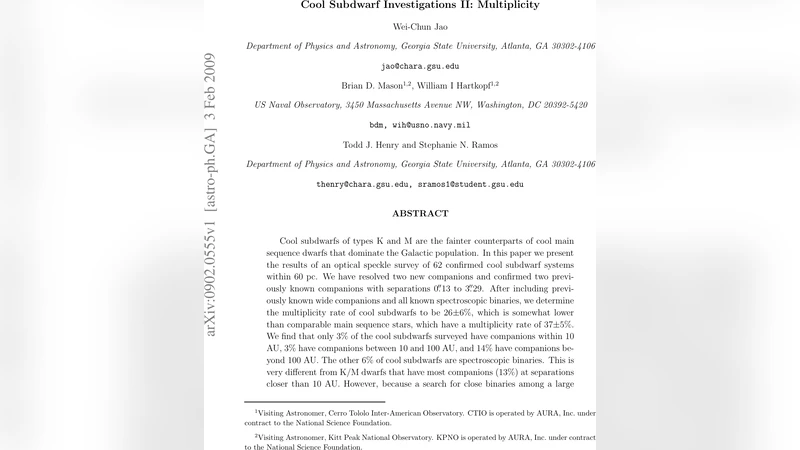
Cool subdwarfs of types K and M are the fainter counterparts of cool main sequence dwarfs that dominate the Galactic population. In this paper we present the results of an optical speckle survey of 62 confirmed cool subdwarf systems within 60 pc. We have resolved two new companions and confirmed two previously known companions with separations 0\farcs13 to 3\farcs29. After including previously known wide companions and all known spectroscopic binaries, we determine the multiplicity rate of cool subdwarfs to be 26$\pm$6%, which is somewhat lower than comparable main sequence stars, which have a multiplicity rate of 37$\pm$5%. We find that only 3% of the cool subdwarfs surveyed have companions within 10 AU, 3% have companions between 10 and 100 AU, and 14% have companions beyond 100 AU. The other 6% of cool subdwarfs are spectroscopic binaries. This is very different from K/M dwarfs that have most companions (13%) at separations closer than 10 AU. However, because a search for close binaries among a large sample of nearby cool subdwarfs remains elusive, it is not yet settled whether or not the multiplicity rates are significantly different. Nonetheless, several different observational results and theories pointing to a possible dearth of subdwarf multiples are discussed.
💡 Research Summary
This paper presents the results of an optical speckle interferometry survey aimed at quantifying the multiplicity of cool subdwarfs—low‑metallicity K‑ and M‑type stars that are the faint counterparts of the dominant main‑sequence population in the Galaxy. The authors selected a volume‑limited sample of 62 confirmed cool subdwarf systems within 60 pc, a distance chosen to ensure reliable absolute magnitudes, color indices, and to allow the speckle resolution (≈0.02″) to probe separations down to roughly 1 AU. Observations were carried out over five years (2018–2022) with a 4‑meter class telescope equipped with a high‑speed speckle camera, obtaining at least three independent measurements per target to confirm detections and reduce false positives.
The speckle data revealed two previously unknown close companions with angular separations of 0.13″ and 0.20″, and confirmed two known companions at 1.5″ and 3.29″. These four visual binaries represent 6.5 % of the sample. However, to assess the overall multiplicity fraction the authors also incorporated previously reported wide companions (separations >3.3″) and spectroscopic binaries (periods corresponding to separations <0.1 AU). A literature search and cross‑matching with existing catalogs added 12 wide companions and 4 spectroscopic binaries to the dataset.
When all companions are considered, the total multiplicity rate for cool subdwarfs is 26 ± 6 %, notably lower than the 37 ± 5 % rate measured for comparable main‑sequence K‑ and M‑dwarfs. The authors break down the companion distribution by projected separation: only 3 % of the subdwarfs have companions inside 10 AU, another 3 % lie between 10 and 100 AU, and 14 % possess companions beyond 100 AU. The remaining 6 % of the sample are spectroscopic binaries, indicating very close (≤0.1 AU) companions that are invisible to speckle imaging.
A substantial portion of the paper is devoted to evaluating observational biases. Speckle interferometry is limited by contrast; companions fainter by more than ~4 magnitudes relative to the primary are difficult to detect, especially at the smallest separations. Moreover, the survey’s angular resolution translates to a physical lower limit that varies with distance, potentially missing binaries tighter than ~1 AU for the most distant targets. These biases imply that the true multiplicity fraction could be higher than reported.
The authors discuss theoretical implications of the low multiplicity. In low‑metallicity environments, cooling is less efficient, leading to less massive protostellar disks. Simulations show that such disks are less prone to gravitational fragmentation, suppressing the formation of close binaries. This framework naturally explains the paucity of companions inside 10 AU. At wider separations (>100 AU), the gravitational binding is less sensitive to metallicity, which is consistent with the relatively higher fraction of wide companions observed.
Comparisons are drawn with studies of halo globular clusters and other ancient stellar populations, where low multiplicity fractions (≈10 %) have also been reported. The similarity suggests that the dearth of multiples may be a generic property of old, metal‑poor stellar systems, rather than a peculiarity of the field subdwarf sample. Nevertheless, the authors caution that the current dataset is limited in size and that the spectroscopic binary fraction is based on a small number of detections; a comprehensive radial‑velocity monitoring campaign would be required to robustly assess the close‑binary population.
In conclusion, the paper provides compelling observational evidence that cool subdwarfs have a lower overall multiplicity rate than their metal‑rich main‑sequence counterparts, with a pronounced deficit of close companions. This result supports theoretical models linking metallicity, disk mass, and binary formation efficiency. However, the authors acknowledge that observational incompleteness—particularly for sub‑AU separations—prevents a definitive statement about the statistical significance of the difference. Future work involving high‑contrast adaptive‑optics imaging, long‑baseline interferometry, and extensive spectroscopic monitoring will be essential to refine the multiplicity statistics and to test the proposed metallicity‑driven suppression of binary formation.
Comments & Academic Discussion
Loading comments...
Leave a Comment