Evolution of the Barium abundance in the early Galaxy from a NLTE analysis of the Ba lines in a homogeneous sample of EMP stars
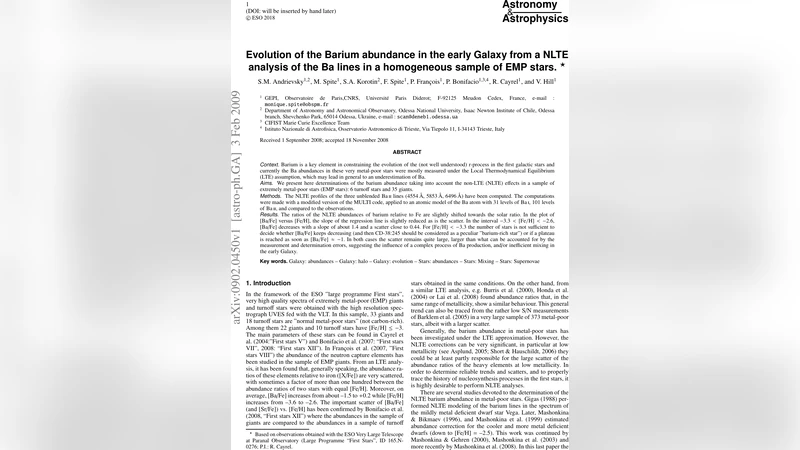
Barium is a key element in constraining the evolution of the (not well understood) r-process in the first galactic stars and currently the Ba abundances in these very metal-poor stars were mostly measured under the Local Thermodynamical Equilibrium (LTE) assumption, which may lead in general to an underestimation of Ba. We present here determinations of the barium abundance taking into account the non-LTE (NLTE) effects in a sample of extremely metal-poor stars (EMP stars): 6 turnoff stars and 35 giants. The NLTE profiles of the three unblended Ba II lines (455.4, 585.3, 649.6nm) have been computed. The computations were made with a modified version of the MULTI code, applied to an atomic model of the Ba atom with 31 levels of Ba I, 101 levels of Ba II, and compared to the observations. The ratios of the NLTE abundances of barium relative to Fe are slightly shifted towards the solar ratio. In the plot of [Ba/Fe] versus [Fe/H], the slope of the regression line is slightly reduced as is the scatter. In the interval -3.3 <[Fe/H] < -2.6, [Ba/Fe] decreases with a slope of about 1.4 and a scatter close to 0.44. For [Fe/H] <-3.3 the number of stars is not sufficient to decide whether [Ba/Fe] keeps decreasing (and then CD-38:245 should be considered as a peculiar “barium-rich star”) or if a plateau is reached as soon as [Ba/Fe] ~ -1. In both cases the scatter remains quite large, larger than what can be accounted for by the measurement and determination errors, suggesting the influence of a complex process of Ba production, and/or inefficient mixing in the early Galaxy.
💡 Research Summary
The paper addresses the long‑standing problem of accurately determining barium (Ba) abundances in extremely metal‑poor (EMP) stars, which are crucial tracers of the early Galaxy’s r‑process nucleosynthesis. Historically, most Ba measurements in these stars have relied on the assumption of Local Thermodynamic Equilibrium (LTE). However, LTE can underestimate Ba because it neglects departures from equilibrium that become significant in the low‑density atmospheres of EMP stars. To overcome this limitation, the authors performed a non‑LTE (NLTE) analysis on a homogeneous sample of 41 EMP stars (6 turn‑off stars and 35 giants) covering the metallicity range –3.3 <
Comments & Academic Discussion
Loading comments...
Leave a Comment