Monte-Carlo Simulation of Solar Active-Region Energy
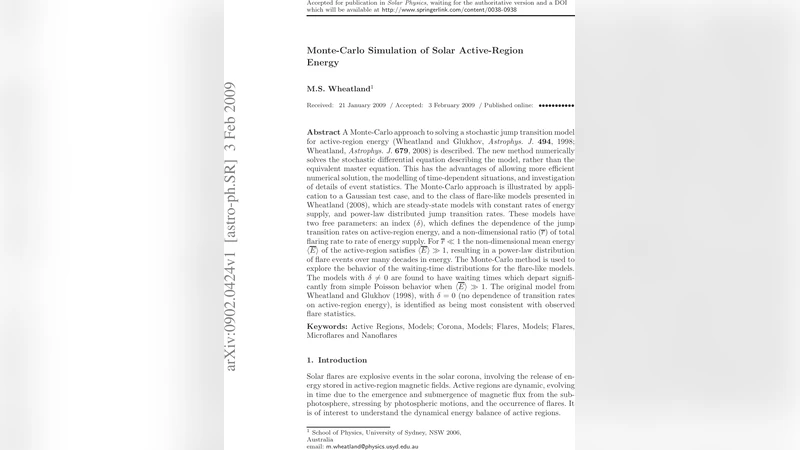
A Monte-Carlo approach to solving a stochastic jump transition model for active-region energy (Wheatland and Glukhov, Astrophys. J. 494, 1998; Wheatland, Astrophys. J. 679, 2008) is described. The new method numerically solves the stochastic differential equation describing the model, rather than the equivalent master equation. This has the advantages of allowing more efficient numerical solution, the modelling of time-dependent situations, and investigation of details of event statistics. The Monte-Carlo approach is illustrated by application to a Gaussian test case, and to the class of flare-like models presented in Wheatland (2008), which are steady-state models with constant rates of energy supply, and power-law distributed jump transition rates. These models have two free parameters: an index ($\delta $), which defines the dependence of the jump transition rates on active-region energy, and a non-dimensional ratio ($\overline{r})$ of total flaring rate to rate of energy supply. For $\overline{r}\ll 1$ the non-dimensional mean energy $<\overline{E}>$ of the active-region satisfies $<\overline{E}> \gg 1$, resulting in a power-law distribution of flare events over many decades in energy. The Monte-Carlo method is used to explore the behavior of the waiting-time distributions for the flare-like models. The models with $\delta\neq 0$ are found to have waiting times which depart significantly from simple Poisson behavior when $<\overline{E}> \gg 1$. The original model from Wheatland and Glukhov (1998), with $\delta=0$ (no dependence of transition rates on active-region energy), is identified as being most consistent with observed flare statistics.
💡 Research Summary
The paper presents a Monte‑Carlo technique for solving the stochastic jump‑transition model that describes the energy evolution of solar active regions (ARs). Earlier work by Wheatland & Glukhov (1998) and Wheatland (2008) treated the problem through a master equation, which, while analytically tractable, is computationally intensive and ill‑suited for time‑dependent scenarios. By reformulating the model as a stochastic differential equation (SDE) and integrating it directly with a Monte‑Carlo scheme, the authors achieve a more efficient numerical solution and open the door to studying non‑steady‑state situations.
The underlying physical picture assumes a constant energy supply rate λ to an AR, while flare events are represented as stochastic jumps that reduce the stored energy. The jump transition rate Γ(E) is taken to be proportional to E^δ · E^{‑α}, where δ controls how strongly the rate depends on the current energy E, and α (>0) sets the power‑law slope of the flare‑energy distribution, consistent with observations (α≈1.5–2.5). Two dimensionless parameters fully characterize the model: the ratio r̄ = R/λ of the total flare occurrence rate R to the supply rate, and the normalized mean energy ⟨Ē⟩, which is a function of r̄ and δ. When r̄ ≪ 1, energy builds up quickly, giving ⟨Ē⟩ ≫ 1; in this regime the flare‑energy distribution follows a clean power law over many decades. Conversely, when r̄ approaches unity, the system reaches a quasi‑steady balance, ⟨Ē⟩ becomes modest, and the power‑law range shrinks.
The authors first validate the Monte‑Carlo SDE solver on a Gaussian test case, confirming that the simulated mean and variance match analytical expectations. They then apply the method to the class of “flare‑like” models introduced by Wheatland (2008). By scanning a grid of (δ, r̄) values, they examine how the flare‑energy and waiting‑time statistics respond to changes in the model parameters.
Key findings include:
-
Flare‑energy distribution – For δ = 0 (no dependence of the transition rate on AR energy), the simulated energy histogram exhibits a robust power‑law tail when ⟨Ē⟩ ≫ 1, reproducing the observed frequency–energy relation of solar flares. Positive δ values increase the likelihood of large‑energy jumps, flattening the power‑law slope and producing an excess of high‑energy events not seen in the data.
-
Waiting‑time distribution – When δ = 0 the inter‑event times follow an exponential (Poisson) distribution, indicating statistically independent flare occurrences. For δ ≠ 0, especially δ > 0, the waiting‑time distribution develops a heavy tail, deviating markedly from Poisson behavior. This suggests that an energy‑dependent transition rate introduces clustering of events, contrary to most observational studies that find near‑Poisson flare timing.
-
Time‑dependent extensions – Because the SDE formulation directly integrates the energy evolution, the method can accommodate a time‑varying supply rate λ(t) (e.g., sudden magnetic reconnection bursts). This flexibility is a major advantage over the master‑equation approach, which would require re‑deriving the entire probability framework for each λ(t) profile.
The overall conclusion is that the original Wheatland & Glukhov (1998) model, corresponding to δ = 0, best matches observed solar flare statistics in both energy and timing. The Monte‑Carlo SDE approach not only reproduces these results efficiently but also provides a platform for exploring more realistic, non‑steady scenarios and for incorporating additional physical processes (e.g., spatial heterogeneity, feedback between flares and energy supply). Consequently, the technique represents a valuable tool for future theoretical investigations and for improving statistical flare‑forecasting models.
Comments & Academic Discussion
Loading comments...
Leave a Comment