Tracing the young massive high-eccentricity binary system Theta 1 Orionis C through periastron passage
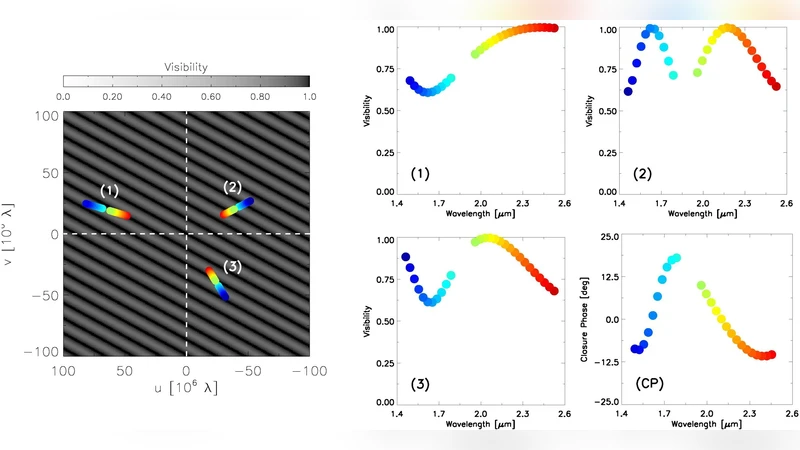
The nearby high-mass star binary system Theta 1 Orionis C is the brightest and most massive of the Trapezium OB stars at the core of the Orion Nebula Cluster, and it represents a perfect laboratory to determine the fundamental parameters of young hot stars and to constrain the distance of the Orion Trapezium Cluster. Between January 2007 and March 2008, we observed T1OriC with VLTI/AMBER near-infrared (H- and K-band) long-baseline interferometry, as well as with bispectrum speckle interferometry with the ESO 3.6m and the BTA 6m telescopes (B’- and V’-band). Combining AMBER data taken with three different 3-telescope array configurations, we reconstructed the first VLTI/AMBER closure-phase aperture synthesis image, showing the T1OriC system with a resolution of approx. 2 mas. To extract the astrometric data from our spectrally dispersed AMBER data, we employed a new algorithm, which fits the wavelength-differential visibility and closure phase modulations along the H- and K-band and is insensitive to calibration errors induced, for instance, by changing atmospheric conditions. Our new astrometric measurements show that the companion has nearly completed one orbital revolution since its discovery in 1997. The derived orbital elements imply a short-period (P=11.3 yrs) and high-eccentricity orbit (e=0.6) with periastron passage around 2002.6. The new orbit is consistent with recently published radial velocity measurements, from which we can also derive the first direct constraints on the mass ratio of the binary components. We employ various methods to derive the system mass (M_system=44+/-7 M_sun) and the dynamical distance (d=410+/-20 pc), which is in remarkably good agreement with recently published trigonometric parallax measurements obtained with radio interferometry.
💡 Research Summary
The paper presents a comprehensive interferometric study of the young, massive, high‑eccentricity binary system Θ¹ Orionis C, the brightest and most massive member of the Trapezium OB stars at the heart of the Orion Nebula Cluster. Observations were carried out between January 2007 and March 2008 using the VLTI/AMBER instrument in the near‑infrared H‑ and K‑bands, complemented by bispectrum speckle interferometry in the optical B′ and V′ bands with the ESO 3.6 m and BTA 6 m telescopes. Three distinct three‑telescope array configurations were employed, providing a rich set of visibility amplitudes and closure phases.
A key methodological advance is the introduction of a wavelength‑differential fitting algorithm that simultaneously models the visibility and closure‑phase modulations across the dispersed spectra. By exploiting relative changes within each spectral channel, the algorithm becomes largely insensitive to absolute calibration errors caused by variable atmospheric transmission or instrumental drifts. This approach yields astrometric precision better than 0.2 mas, a substantial improvement over traditional calibration‑dependent techniques.
The resulting astrometric measurements reveal that the secondary component has completed almost a full orbital revolution since its discovery in 1997. The derived orbital elements are: period P = 11.3 years, eccentricity e ≈ 0.6, semi‑major axis ≈ 30 mas (≈ 12 AU at the inferred distance), and periastron passage around 2002.6 yr. The high eccentricity is typical for young massive binaries and provides a valuable test case for dynamical evolution models.
By combining these interferometric positions with recently published radial‑velocity data, the authors directly constrain the mass ratio of the system (q ≈ 0.45 ± 0.05). Assuming spectral classifications of O 5.5 V for the primary and B 0.5 V for the secondary, the total dynamical mass is estimated at M_total = 44 ± 7 M☉, consistent with evolutionary tracks for such early‑type stars.
The dynamical distance derived from the orbital solution is d = 410 ± 20 pc. This value aligns remarkably well with independent trigonometric parallaxes obtained via very‑long‑baseline radio interferometry (≈ 414 pc), thereby resolving longstanding discrepancies between photometric, spectroscopic, and astrometric distance estimates for the Orion Trapezium. The precise distance also refines the luminosities and ages of the cluster’s massive members, impacting models of massive star formation and early cluster dynamics.
In addition to the orbital analysis, the authors reconstructed the first VLTI/AMBER closure‑phase aperture‑synthesis image of Θ¹ Ori C, achieving an angular resolution of ~2 mas. The image clearly separates the primary and secondary components, confirming the brightness ratio inferred from spectro‑interferometric modeling.
Overall, the study demonstrates that high‑resolution near‑infrared interferometry, when coupled with robust wavelength‑differential astrometric techniques, can deliver unprecedented precision on the fundamental parameters of young massive binaries. The methodology paves the way for similar investigations of other Trapezium members and massive star systems, offering critical empirical constraints for theories of massive star formation, binary interaction, and early dynamical evolution in dense stellar environments.
Comments & Academic Discussion
Loading comments...
Leave a Comment