True polar wander driven by late-stage volcanism and the distribution of paleopolar deposits on Mars
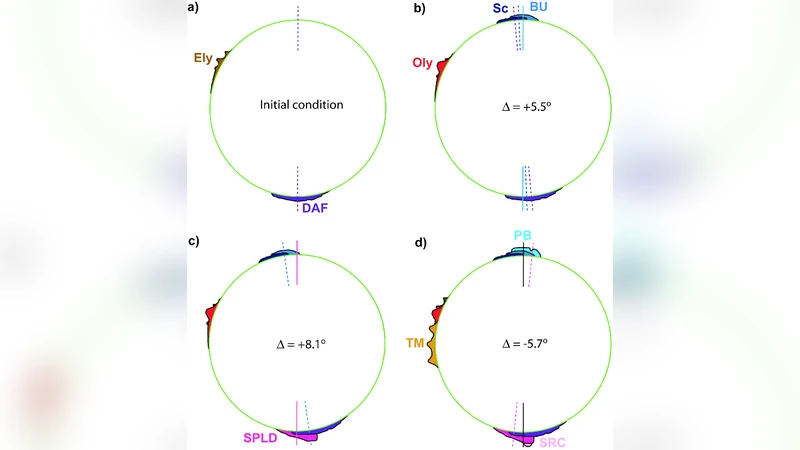
The areal centroids of the youngest polar deposits on Mars are offset from those of adjacent paleopolar deposits by 5-10 degrees. We test the hypothesis that the offset is the result of true polar wander (TPW), the motion of the solid surface with respect to the spin axis, caused by a mass redistribution within or on the surface of Mars. In particular, we consider TPW driven by late-stage volcanism during the late Hesperian to Amazonian. There is observational and qualitative support for this hypothesis: in both North and South, observed offsets lie close to a great circle 90 degrees from Tharsis, as expected for polar wander after Tharsis formed. We calculate the magnitude and direction of TPW produced by mapped late-stage lavas for a range of lithospheric thicknesses, lava thicknesses, eruption histories, and prior polar wander events. If Tharsis formed close to the equator, the stabilizing effect of a fossil rotational bulge located close to the equator leads to predicted TPW of <2 degrees, too small to account for observed offsets. If, however, Tharsis formed far from the equator, late-stage TPW driven by low-latitude, late-stage volcanism would be 6-33 degrees, similar to that inferred from the location of paleopolar deposits. 4.4+/-1.3x10^19 kg of young erupted lava can account for the offset of the Dorsa Argentea Formation from the present-day south rotation pole. This mass is consistent with prior mapping-based estimates and would imply a mass release of CO2 by volcanic degassing similar to that in the atmosphere at the present time. The South Polar Layered Deposits are offset from the spin axis in the opposite sense to the other paleopolar deposits. This can be explained by an additional contribution from a plume beneath Elysium. We conclude with a list of observational tests of the TPW hypothesis.
💡 Research Summary
The paper investigates why the centroids of the youngest polar deposits on Mars are displaced by 5–10° from the centroids of adjacent older (paleopolar) deposits. The authors propose that true polar wander (TPW)—the motion of the planet’s solid surface relative to its spin axis—driven by late‑stage volcanism during the late Hesperian to Amazonian can account for this offset.
First, the authors map the positions of modern polar layered deposits (PLDs) and several paleopolar units such as the Dorsa Argentea Formation (DAF) and other ancient north‑ and south‑polar deposits. All older units lie on a great‑circle arc roughly 90° from the Tharsis volcanic province, a geometry that is expected if the planet has undergone TPW after Tharsis formed.
The core of the analysis is a quantitative TPW model that incorporates (i) the mass and spatial distribution of mapped late‑stage lava flows, (ii) a range of lithospheric thicknesses (30–150 km), (iii) plausible lava thicknesses (10–300 m), and (iv) different eruption histories (single pulse versus prolonged activity). The model solves the rotational dynamics equations for a planet with an existing fossil rotational bulge (the equatorial bulge frozen in after early Tharsis emplacement) and computes the resulting shift of the spin axis.
Two contrasting scenarios for the original Tharsis location are examined. If Tharsis formed near the equator, the fossil bulge strongly stabilizes the spin axis, limiting any subsequent TPW to less than 2°, far too small to explain the observed 5–10° offsets. Conversely, if Tharsis formed at higher latitudes, the stabilizing effect is weaker. In this case, low‑latitude, late‑stage volcanism can generate TPW of 6–33°, comfortably encompassing the measured offsets.
The authors estimate that 4.4 ± 1.3 × 10¹⁹ kg of young lava would be required to move the Dorsa Argentea Formation from its present‑day location to the ancient south pole. This mass is consistent with previous mapping‑based estimates of late‑stage volcanic output. Importantly, the same amount of volcanic degassing would release a CO₂ mass comparable to the current Martian atmospheric inventory, implying that late volcanism could have had a non‑trivial impact on atmospheric pressure and climate.
The south polar layered deposits (SPLD) display an offset in the opposite sense to the other paleopolar units. The authors suggest that an additional mass anomaly beneath the Elysium region—potentially a mantle plume—could have contributed a counter‑acting torque, producing the observed opposite shift.
To test the TPW hypothesis, the paper proposes several observational strategies: (1) high‑resolution radar and gravity measurements to constrain lithospheric thickness and elastic rigidity across the planet; (2) precise radiometric dating of late‑stage lava flows to refine eruption timelines; (3) isotopic analysis of atmospheric CO₂ to detect signatures of volcanic degassing; and (4) detailed stratigraphic and sedimentological studies of the paleopolar deposits to pinpoint the timing of their formation relative to the inferred TPW events.
In conclusion, the study demonstrates that if Tharsis originated far from the equator, the mass redistribution associated with late‑stage volcanism is sufficient to drive true polar wander of the magnitude required to explain the spatial offsets of Martian paleopolar deposits. This links volcanic resurfacing, planetary rotation dynamics, and atmospheric evolution in a coherent framework and provides clear, testable predictions for future Mars missions.
Comments & Academic Discussion
Loading comments...
Leave a Comment