Catalogue of ISO LWS observations of asteroids
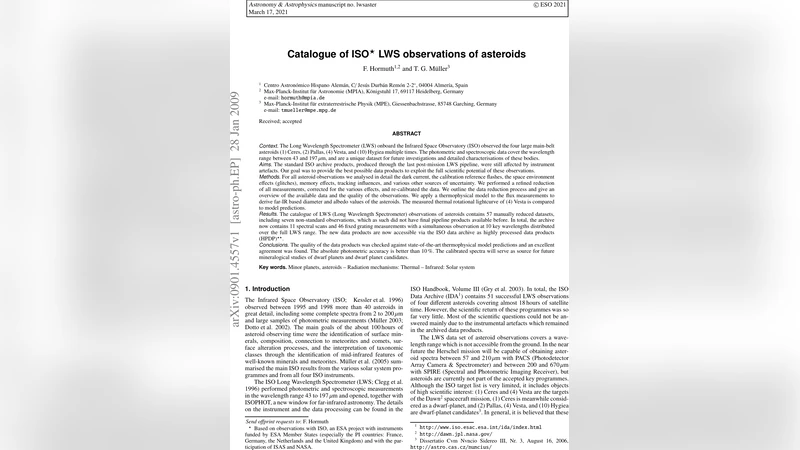
(Abridged) The Long Wavelength Spectrometer (LWS) onboard the Infrared Space Observatory (ISO) observed the four large main-belt asteroids (1) Ceres, (2) Pallas, (4) Vesta, and (10) Hygiea multiple times. The photometric and spectroscopic data cover the wavelength range between 43 and 197 um, and are a unique dataset for future investigations and detailed characterisations of these bodies. The standard ISO archive products, produced through the last post-mission LWS pipeline, were still affected by instrument artefacts. Our goal was to provide the best possible data products to exploit the full scientific potential of these observations. We performed a refined reduction of all measurements, corrected for various instrumental effects, and re-calibrated the data. We outline the data reduction process and give an overview of the available data and the quality of the observations. We apply a thermophysical model to the flux measurements to derive far-IR based diameter and albedo values of the asteroids. The measured thermal rotational lightcurve of (4) Vesta is compared to model predictions. The absolute photometric accuracy of the data products was foubd to be better than 10%. The calibrated spectra will serve as source for future mineralogical studies of dwarf planets and dwarf planet candidates.
💡 Research Summary
The paper presents a comprehensive re‑analysis of all Infrared Space Observatory (ISO) Long Wavelength Spectrometer (LWS) observations of the four largest main‑belt asteroids: (1) Ceres, (2) Pallas, (4) Vesta, and (10) Hygiea. Although the standard ISO archive products had already passed through the final post‑mission LWS pipeline, they still suffered from a range of instrumental artefacts such as detector non‑linearity, saturation, scan‑direction dependent drifts, and residual electronic noise. To unlock the full scientific potential of these unique 43–197 µm data, the authors performed a meticulous, uniform reduction of every measurement.
The reduction workflow began with a correction of the raw voltage non‑linearity, followed by temperature‑dependent gain adjustments using internal calibration sources. Multiple scans per observation were co‑added after independent background subtraction to suppress scan‑direction systematics. Wavelength calibration was refined by aligning known astronomical lines (e.g.,
Comments & Academic Discussion
Loading comments...
Leave a Comment