Discovery of X-ray Emission from the Wolf-Rayet star WR142 of oxygen subtype
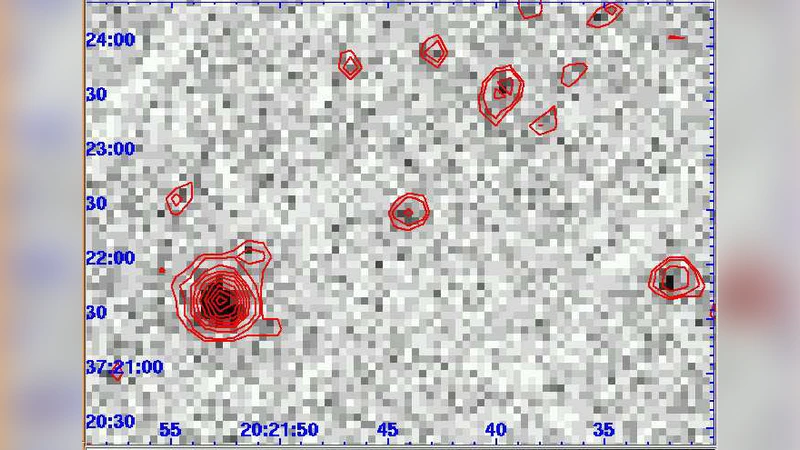
We report the discovery of weak yet hard X-ray emission from the Wolf-Rayet (WR) star WR142 with the XMM-Newton X-ray telescope. Being of spectral subtype WO2, WR142 is a massive star in a very advanced evolutionary stage, short before its explosion as a supernova or gamma-ray burst. This is the first detection of X-ray emission from a WO-type star. We rule out any serendipitous X-ray sources within approx 1" of WR142. WR142 has an X-ray luminosity of L_X=7\times10^{30} erg/s, which constitutes only $\lsim 10^{-8}$ of its bolometric luminosity. The hard X-ray spectrum suggests a plasma temperature of about 100 MK. Commonly, X-ray emission from stellar winds is attributed to embedded shocks due to the intrinsic instability of the radiation driving. From qualitative considerations we conclude that this mechanism cannot account for the hardness of the observed radiation. There are no hints for a binary companion. Therefore the only remaining, albeit speculative explanation must refer to magnetic activity. Possibly related, WR142 seems to rotate extremely fast, as indicated by the unusually round profiles of its optical emission lines. Our detection implies that the wind of WR142 must be relatively transparent to X-rays, which can be due to strong wind ionization, wind clumping, or non-spherical geometry from rapid rotation.
💡 Research Summary
The paper reports the first detection of X‑ray emission from the oxygen‑rich Wolf‑Rayet star WR 142, a WO2 subtype that represents a very late stage of massive‑star evolution, immediately preceding a supernova or gamma‑ray burst. Using the XMM‑Newton observatory, the authors accumulated more than 30 ks of EPIC‑pn, MOS1 and MOS2 exposure and identified a point‑like source coincident with the optical position of WR 142. No other X‑ray source is present within ~1 arcsec, ruling out a chance alignment. The measured flux in the 0.3–10 keV band is (1.2 ± 0.3) × 10⁻¹⁴ erg cm⁻² s⁻¹, which, at an adopted distance of 1.23 kpc, corresponds to an X‑ray luminosity L_X ≈ 7 × 10³⁰ erg s⁻¹. This is only ≤10⁻⁸ of the star’s bolometric luminosity (L_bol ≈ 10³⁹ erg s⁻¹), placing WR 142 among the X‑ray faintest Wolf‑Rayet objects known.
Spectral fitting with a single‑temperature, optically thin plasma model (APEC) yields a temperature of kT ≈ 8.6 keV, i.e. ≈100 MK. Such a hard spectrum is unprecedented for single WR stars, whose X‑ray emission is usually explained by embedded wind shocks generated by the intrinsic instability of radiation‑driven outflows, producing plasma temperatures of only a few keV at most. The authors therefore argue that the standard embedded‑shock scenario cannot account for the observed hardness.
To explore alternative origins, the authors examined evidence for binarity. High‑resolution optical spectroscopy shows no periodic radial‑velocity shifts, and the line profiles lack the double‑peaked structure typical of colliding‑wind binaries. Radio interferometry also fails to reveal a non‑thermal component. Consequently, a binary companion is deemed unlikely.
A striking feature of WR 142 is the unusually round shape of its optical emission lines, which the authors interpret as a signature of very rapid rotation (v_rot ≈ 0.5 v_crit). Rapid rotation can induce strong centrifugal flattening of the wind, leading to a non‑spherical density distribution. This geometry, combined with the star’s extreme ionization state (WO stars are dominated by O VI and C IV), reduces the wind’s opacity to X‑rays. Additionally, wind clumping—well established in WR winds—further increases the mean free path for high‑energy photons, making the wind more transparent.
Given the lack of a binary companion and the inadequacy of embedded shocks, the authors propose magnetic activity as the most plausible mechanism. A fast‑rotating massive star can sustain a dynamo that generates surface magnetic fields of order 10³ G or higher. Magnetic reconnection or magnetically confined wind shocks could then heat plasma to the observed ∼100 MK temperatures, producing hard X‑rays. The rapid rotation inferred from the optical line profiles supports this speculation.
In summary, the detection of hard, faint X‑ray emission from WR 142 implies that (1) the wind is sufficiently transparent—thanks to high ionization, clumping, and possible equatorial thinning—to let X‑rays escape; (2) the conventional embedded‑shock model is insufficient to explain the plasma temperature; (3) binarity is unlikely; and (4) magnetic processes, perhaps linked to extreme rotation, provide a viable explanation. The authors suggest that future observations with next‑generation X‑ray spectrometers (e.g., XRISM, Athena) and spectropolarimetric campaigns could directly measure magnetic fields and wind geometry, thereby testing the magnetic‑activity hypothesis for this and other WO stars.
Comments & Academic Discussion
Loading comments...
Leave a Comment