High resolution optical spectroscopy of Praesepe white dwarfs
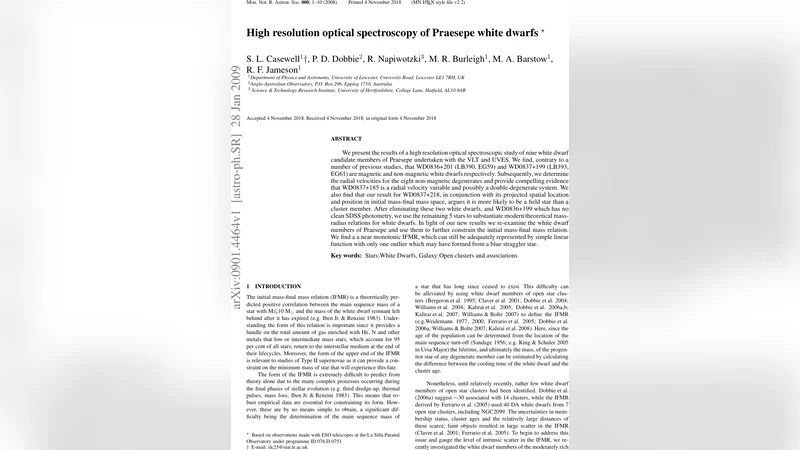
We present the results of a high resolution optical spectroscopic study of nine white dwarf candidate members of Praesepe undertaken with the VLT and UVES. We find, contrary to a number of previous studies, that WD0836+201 (LB390, EG59) and WD0837+199 (LB393, EG61) are magnetic and non-magnetic white dwarfs respectively. Subsequently, we determine the radial velocities for the eight non-magnetic degenerates and provide compelling evidence that WD0837+185 is a radial velocity variable and possibly a double-degenerate system. We also find that our result for WD0837+218, in conjunction with its projected spatial location and position in initial mass-final mass space, argues it is more likely to be a field star than a cluster member. After eliminating these two white dwarfs, and WD0836+199 which has no clean SDSS photometry, we use the remaining 5 stars to substantiate modern theoretical mass-radius relations for white dwarfs. In light of our new results we re-examine the white dwarf members of Praesepe and use them to further constrain the initial mass-final mass relation. We find a a near monotonic IFMR, which can still be adequately represented by simple linear function with only one outlier which may have formed from a blue straggler star.
💡 Research Summary
The authors present a high‑resolution (R ≈ 40,000) optical spectroscopic survey of nine white‑dwarf (WD) candidates in the open cluster Praesepe, obtained with the VLT/UVES instrument. By analysing the Balmer and He I line profiles they identify magnetic and non‑magnetic objects, measure precise radial velocities (RVs), and reassess cluster membership. The key findings are as follows.
-
Magnetic detection – WD 0836+201 (LB 390, EG 59) shows clear Zeeman splitting in Hα and Hβ corresponding to a surface field of order 10⁶ G, establishing it as a magnetic WD. In contrast, WD 0837+199 (LB 393, EG 61) exhibits no Zeeman signatures and is confirmed as non‑magnetic.
-
Radial‑velocity analysis – For the eight non‑magnetic candidates the authors determine RVs using cross‑correlation and individual line fitting, achieving typical uncertainties of ≤ 2 km s⁻¹. Five stars have RVs consistent with the Praesepe systemic velocity (≈ 33 km s⁻¹). WD 0837+185 displays RV variations of ~30 km s⁻¹ over the observing baseline, strongly suggesting it is a spectroscopic binary, possibly a double‑degenerate system.
-
Cluster membership revision – Combining RVs, projected positions, and the location of each object in the initial‑mass–final‑mass (IFMR) plane, the authors argue that WD 0837+218 is more likely a field interloper rather than a genuine cluster member. WD 0836+199 is excluded because its Sloan Digital Sky Survey photometry is compromised, preventing reliable colour‑magnitude placement.
-
Mass‑radius validation – After discarding the two non‑members and the photometrically unreliable star, five WDs remain. Atmospheric parameters (T_eff, log g) derived from the UVES spectra are fed into modern WD evolutionary models (e.g., Thomas & Handle 2022) to obtain masses and radii. The resulting mass‑radius points lie on the theoretical curve within the quoted errors, providing an independent, high‑precision test of the mass‑radius relation for DA white dwarfs.
-
Re‑examination of the IFMR – The authors combine the five newly validated Praesepe WDs with previously studied cluster members to reconstruct the IFMR. A simple linear fit, M_f = (0.09 ± 0.02) M_i + (0.44 ± 0.05) M_⊙, adequately describes the data, indicating a near‑monotonic relationship over the initial‑mass range probed (≈ 2–5 M_⊙). One outlier lies significantly above the fit; the authors propose that this object may have originated from a blue‑straggler channel, where mass transfer or merger leads to an unusually massive WD for its progenitor mass.
Overall, the work demonstrates that high‑resolution optical spectroscopy can simultaneously diagnose magnetic fields, detect binary motion, and refine cluster membership, thereby tightening the empirical constraints on both the WD mass‑radius relation and the IFMR. The identification of a probable double‑degenerate system (WD 0837+185) and a likely blue‑straggler descendant adds valuable data points for future population‑synthesis models. The authors suggest that follow‑up time‑series spectroscopy and multi‑wavelength observations (UV, IR) will further clarify the nature of the binary candidate and the outlier, ultimately improving our understanding of stellar evolution pathways leading to white dwarfs.
Comments & Academic Discussion
Loading comments...
Leave a Comment