Properties of the ionized gas in HH202. II: Results from echelle spectrophotometry with UVES
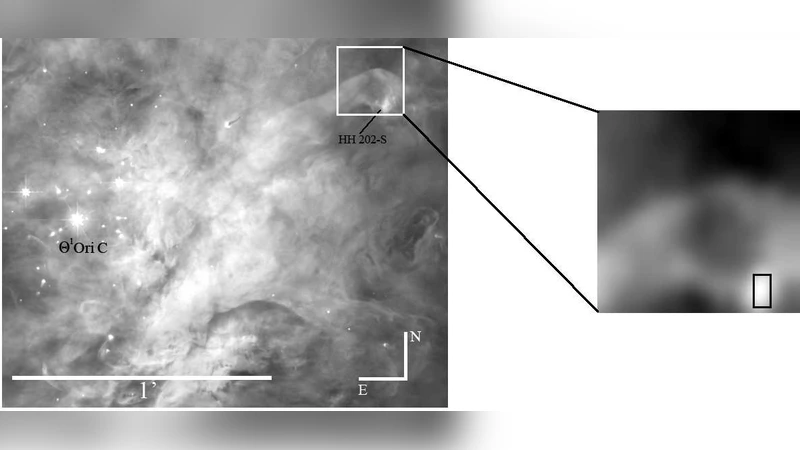
We present results of deep echelle spectrophotometry of the brightest knot of the HH202 in the Orion Nebula –HH202-S– using the ultraviolet Visual Echelle Spectrograph (UVES). The high spectral resolution has permitted to separate the component associated with the ambient gas from that associated with the gas flow. We derive electron densities and temperatures for both components, as well as the chemical abundances of several ions and elements from collisionally excited lines, including the first determinations of Ca^{+} and Cr^{+} abundances in the Orion Nebula. We also calculate the He^{+}, C^{2+}, O^{+} and O^{2+} abundances from recombination lines. The difference between the O^{2+} abundances determined from collisionally excited and recombination lines –the so-called abundance discrepancy factor– is 0.35 dex and 0.11 dex for the shock and nebular components, respectively. Assuming that the abundance discrepancy is produced by spatial variations in the electron temperature, we derive values of the temperature fluctuation parameter, t^2, of 0.050 and 0.016, for the shock and nebular components, respectively. Interestingly, we obtain almost coincident t^2 values for both components from the analysis of the intensity ratios of He I lines. We find significant departures from case B predictions in the Balmer and Paschen flux ratios of lines of high principal quantum number n. We analyze the ionization structure of HH202-S, finding enough evidence to conclude that the flow of HH202-S has compressed the ambient gas inside the nebula trapping the ionization front. We measure a strong increase of the total abundances of nickel and iron in the shock component, the abundance pattern and the results of photoionization models for both components are consistent with the partial destruction of dust after the passage of the shock wave in HH202-S.
💡 Research Summary
This paper presents a detailed spectroscopic study of the brightest knot of the Herbig‑Haro object HH 202 (designated HH 202‑S) located in the Orion Nebula, using the Ultraviolet Visual Echelle Spectrograph (UVES) on the VLT. The authors obtained deep, high‑resolution (R ≈ 40 000) echelle spectra covering the wavelength range 3100–10400 Å, with a total exposure time of about three hours, achieving signal‑to‑noise ratios exceeding 100 for the strongest lines.
The high spectral resolution allowed the authors to decompose each emission line into two kinematically distinct components: a “shock” component associated with the high‑velocity flow of HH 202‑S (average radial velocity ≈ −30 km s⁻¹, line width ≈ 15 km s⁻¹) and a “nebular” component representing the ambient ionized gas of the Orion H II region (near systemic velocity, width ≈ 10 km s⁻¹). By measuring density‑sensitive ratios such as
Comments & Academic Discussion
Loading comments...
Leave a Comment