High Velocity Dust Collisions: Forming Planetesimals in a Fragmentation Cascade with Final Accretion
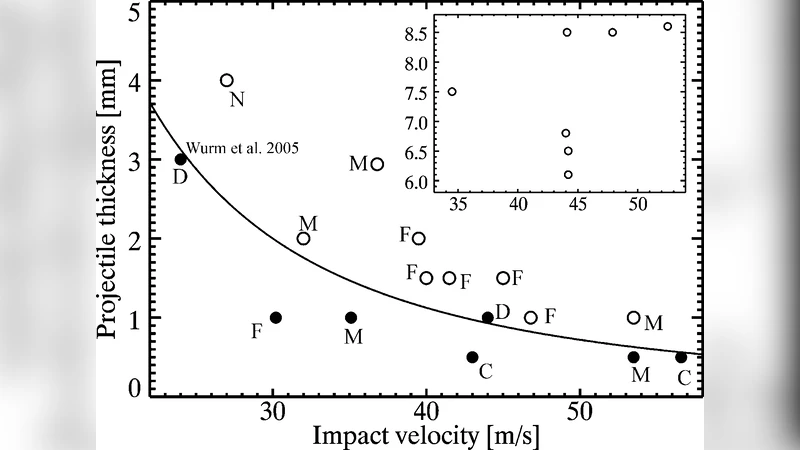
In laboratory experiments we determine the mass gain and loss in central collisions between cm to dm-size SiO2 dust targets and sub-mm to cm-size SiO2 dust projectiles of varying mass, size, shape, and at different collision velocities up to ~56.5 m/s. Dust projectiles much larger than 1 mm lead to a small amount of erosion of the target but decimetre targets do not break up. Collisions produce ejecta which are smaller than the incoming projectile. Projectiles smaller than 1 mm are accreted by a target even at the highest collision velocities. This implies that net accretion of decimetre and larger bodies is possible. Independent of the original size of a projectile considered, after several collisions all fragments will be of sub-mm size which might then be (re)-accreted in the next collision with a larger body. The experimental data suggest that collisional growth through fragmentation and reaccretion is a viable mechanism to form planetesimals.
💡 Research Summary
The paper presents a systematic laboratory investigation of collisions between centimeter‑ to decimeter‑scale silica (SiO₂) dust targets and sub‑millimeter to centimeter‑scale silica projectiles at velocities ranging from 10 m s⁻¹ up to 56.5 m s⁻¹. By varying projectile mass, size, shape, and impact speed, the authors quantify both mass loss (erosion) of the target and mass gain (accretion) from the projectile. The experimental setup uses a high‑speed gas gun to launch projectiles directly onto the geometric centre of cylindrical targets (1 cm, 5 cm, and 10 cm in height). High‑speed imaging and post‑impact particle analysis allow precise measurement of ejecta size distributions, target mass change, and the fraction of projectile material that remains attached.
Key findings can be grouped into three regimes. First, projectiles larger than ~1 mm cause a small amount of erosion on the target surface. The erosion is minute—typically 0.05 %–0.2 % of the projectile mass—and never leads to catastrophic breakup or large cracks in the decimeter‑scale targets. Second, the ejecta produced by these larger impacts are always smaller than the incoming projectile; the mean fragment size drops to <0.2 mm after a single impact, indicating rapid fragmentation. Third, projectiles ≤1 mm in size are completely accreted even at the highest tested velocities (56.5 m s⁻¹). No measurable fragments are produced, and the target mass increases by the full projectile mass.
The authors extrapolate these results to a “fragmentation–re‑accretion cycle” model. In this picture, an initially large projectile undergoes successive high‑velocity impacts, each time breaking into progressively smaller fragments. After a few collisions, all fragments fall below the ~1 mm threshold, after which any subsequent encounter with a larger body results in total accretion. Because the erosion per impact is negligible, the net mass balance over many collisions is positive, allowing steady growth of bodies from decimeter to meter scales. Numerical estimates suggest that a 10 cm seed could reach metre size within ~10⁴ years under typical protoplanetary‑disk conditions, even when relative velocities are as high as tens of metres per second.
The study directly challenges the traditional “bouncing barrier” and “fragmentation barrier” concepts that have long been thought to halt dust growth at millimeter to centimeter sizes. By demonstrating that high‑speed collisions can both fragment and, crucially, re‑accrete material efficiently, the work provides a viable pathway for planetesimal formation that does not rely on low‑velocity sticking or special concentration mechanisms (e.g., streaming instability). The authors also discuss the relevance of their findings to recent ALMA observations, which reveal substantial populations of millimeter‑centimeter grains in young disks despite the expectation of rapid destructive collisions. The experimental evidence that sub‑millimeter fragments are readily incorporated into larger bodies offers a natural explanation for the persistence of such grains.
In summary, the paper delivers robust experimental evidence that (1) decimeter‑scale dust aggregates survive high‑velocity impacts without catastrophic disruption, (2) large projectiles erode targets only minimally while generating smaller fragments, and (3) sub‑millimeter projectiles are fully accreted even at the highest velocities tested. These results underpin a fragmentation‑re‑accretion growth scenario, suggesting that planetesimals can emerge from a cascade of collisions that progressively grind down material to sizes that are then efficiently re‑absorbed. This mechanism expands the theoretical toolkit for early planet formation and provides a concrete, testable framework for future numerical simulations and observational studies.
Comments & Academic Discussion
Loading comments...
Leave a Comment