A Wide-field High Resolution HI Mosaic of Messier 31: I. Opaque Atomic Gas and Star Formation Rate Density
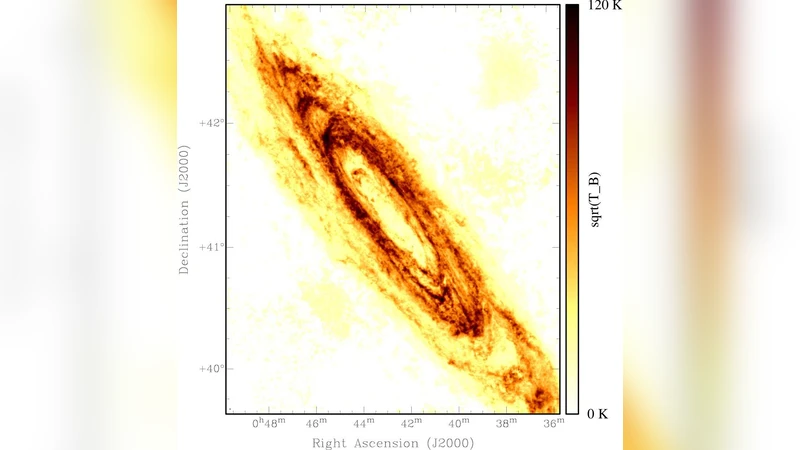
We have undertaken a deep, wide-field HI imaging survey of M31, reaching a maximum resolution of about 50 pc and 2 km/s across a 95x48 kpc region. The HI mass and brightness sensitivity at 100 pc resolution for a 25 km/s wide spectral feature is 1500 M_Sun and 0.28 K. Our study reveals ubiquitous HI self-opacity features, discernible in the first instance as filamentary local minima in images of the peak HI brightness temperature. Local minima are organized into complexes of more than kpc length and are particularly associated with the leading edge of spiral arm features. Just as in the Galaxy, there is only patchy correspondence of self-opaque features with CO(1-0) emission. Localized opacity corrections to the column density exceed an order of magnitude in many cases and add globally to a 30% increase in the atomic gas mass over that inferred from the integrated brightness under the usual assumption of negligible self-opacity. Opaque atomic gas first increases from 20 to 60 K in spin temperature with radius to 12 kpc but then declines again to 20 K beyond 25 kpc. We have extended the resolved star formation law down to physical scales more than an order of magnitude smaller in area and mass than has been possible previously. The relation between total-gas-mass- and star-formation-rate-density is significantly tighter than that with molecular-mass and is fully consistent in both slope and normalization with the power law index of 1.56 found in the molecule-dominated disk of M51 at 500 pc resolution. Below a gas-mass-density of about 5 M_Sun/pc^2, there is a down-turn in star-formation-rate-density which may represent a real local threshold for massive star formation at a cloud mass of about 5x10^4 M_Sun.
💡 Research Summary
The authors present a deep, wide‑field 21 cm HI survey of the Andromeda galaxy (M31) that reaches an unprecedented spatial resolution of roughly 50 pc and a spectral resolution of 2 km s⁻¹ over a 95 × 48 kpc area. The survey achieves a brightness sensitivity of 0.28 K at 100 pc resolution for a 25 km s⁻¹ wide line, corresponding to a mass sensitivity of about 1.5 × 10³ M⊙. These capabilities allow the detection of fine‑scale structures and subtle variations in the HI line profile that were previously inaccessible.
A key discovery is the prevalence of HI self‑opacity (opaque) features throughout the disk. In the peak‑brightness temperature maps, these appear as filamentary local minima, often organized into complexes extending over kiloparsec scales. They are preferentially located along the leading edges of spiral arms, suggesting a dynamical association between cold, dense atomic gas and the spiral density wave. The authors interpret the minima as signatures of high optical depth (τ > 1) and low spin temperature (Tₛ) gas that absorbs its own emission.
To quantify the effect, they fit a simple radiative‑transfer model to each line of sight, solving simultaneously for Tₛ and τ. The derived spin temperatures rise from ~20 K near the centre to a maximum of ~60 K at a galactocentric radius of ~12 kpc, then decline back to ~20 K beyond 25 kpc. In many locations the opacity correction raises the inferred HI column density by up to an order of magnitude. When integrated over the whole disk, the corrected atomic gas mass is about 30 % larger than the value obtained under the usual assumption of negligible self‑opacity. This result demonstrates that conventional HI mass estimates can significantly underestimate the true atomic content, especially in regions of cold, dense gas.
The paper also extends the resolved star‑formation law to spatial scales an order of magnitude smaller than previously studied. Using matched‑resolution maps of total gas surface density (Σ_gas = Σ_HI + Σ_H₂) and star‑formation‑rate surface density (Σ_SFR), the authors find a tight power‑law relation Σ_SFR ∝ Σ_gas^1.56. This slope and normalization are in excellent agreement with the relation measured in the molecule‑dominated disk of M51 at 500 pc resolution. Notably, the correlation with total gas is stronger than that with molecular gas alone, indicating that, at 50 pc scales, the availability of atomic gas still plays a crucial role in regulating star formation.
A pronounced downturn in Σ_SFR occurs below a gas surface density of ≈5 M⊙ pc⁻². The authors interpret this as a genuine threshold for massive star formation, corresponding to a cloud mass of roughly 5 × 10⁴ M⊙. Below this limit, the formation of massive stars—and thus the observable tracers of star formation—appears to be suppressed.
In summary, the study provides three major contributions: (1) a high‑resolution, high‑sensitivity HI mosaic of M31 that reveals ubiquitous self‑opaque atomic gas; (2) a robust quantification of the opacity correction, showing that the atomic mass of M31 is ~30 % higher than previously thought; and (3) an extension of the star‑formation law to 50 pc scales, confirming that the total‑gas–SFR relation remains a tight power law with an index of ~1.6, and identifying a low‑density threshold for massive star formation. The findings underscore the importance of accounting for HI opacity in extragalactic studies and suggest that future combined HI, CO, and infrared observations will further illuminate the transition from opaque atomic gas to molecular clouds and the ensuing star formation processes.
Comments & Academic Discussion
Loading comments...
Leave a Comment