Spitzer Spectroscopy of Circumstellar Disks in the 5 Myr Old Upper Scorpius OB Association
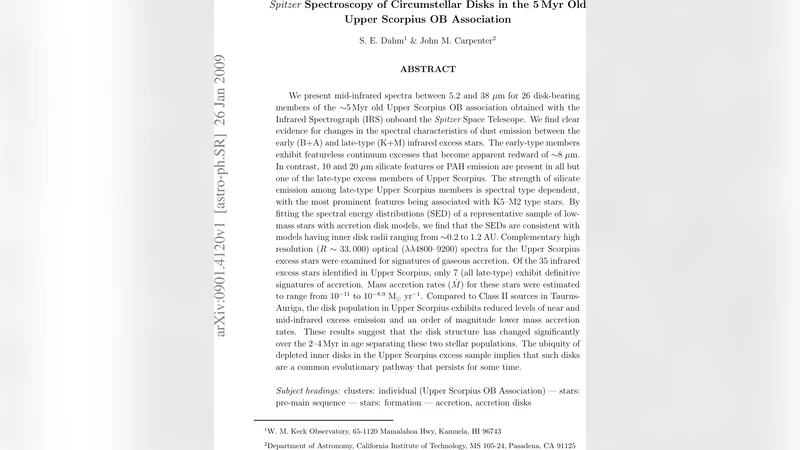
We present mid-infrared spectra between 5.2 and 38 microns for 26 disk-bearing members of the ~5 Myr old Upper Scorpius OB association obtained with the Infrared Spectrograph onboard the Spitzer Space Telescope. We find clear evidence for changes in the spectral characteristics of dust emission between the early (B+A) and late-type (K+M) infrared excess stars. The early-type members exhibit featureless continuum excesses that become apparent redward of ~8 microns. In contrast, 10 and 20 micron silicate features are present in all but one of the late-type excess members of Upper Scorpius. The strength of silicate emission among late-type Upper Scorpius members is spectral type dependent, with the most prominent features being associated with K5-M2 type stars. By fitting the spectral energy distributions (SED) of a sample of low-mass stars with accretion disk models, we find that the SEDs are consistent with models having inner disk radii ranging from ~0.2 to 1.2 AU. Complementary high resolution optical spectra for the Upper Scorpius excess stars were examined for signatures of gaseous accretion. Of the 35 infrared excess stars identified in Upper Scorpius, only 7 (all late-type) exhibit signatures of accretion. Mass accretion rates for these stars range from ~1e-11 to 1e-9 solar masses/yr. Compared to Class II sources in Taurus-Auriga, the disk population in Upper Scorpius exhibits reduced levels of near and mid-infrared excess emission and an order of magnitude lower mass accretion rates. These results suggest that the disk structure has changed significantly over the 2-4 Myr in age separating these two stellar populations. The ubiquity of depleted inner disks in the Upper Scorpius excess sample implies that such disks are a common evolutionary pathway that persists for some time.
💡 Research Summary
This study presents a comprehensive mid‑infrared spectroscopic survey of circumstellar disks in the ~5 Myr old Upper Scorpius OB association, using the Infrared Spectrograph (IRS) aboard the Spitzer Space Telescope. A total of 26 disk‑bearing members were observed over the 5.2–38 µm wavelength range, encompassing both early‑type (B and A) and late‑type (K and M) stars. The early‑type objects display a largely featureless excess that only becomes apparent beyond ~8 µm, indicating a paucity of small silicate grains in their inner regions. In contrast, virtually all late‑type stars exhibit prominent 10 µm and 20 µm silicate emission features; the strength of these features peaks for spectral types K5–M2, suggesting that modestly processed, micron‑sized silicates dominate the surface layers of their disks.
Spectral energy distributions (SEDs) for a subset of the low‑mass stars were fitted with radiative‑transfer disk models. The best‑fit solutions require inner disk radii ranging from ~0.2 to 1.2 AU, consistent with “transitional” disks that possess cleared inner cavities while retaining substantial outer dust reservoirs. The models also reproduce the observed reduction in near‑infrared excess, supporting the notion that the inner disk regions have been substantially depleted.
High‑resolution optical spectroscopy was employed to search for accretion signatures (e.g., broad Hα emission). Of the 35 infrared‑excess stars identified in Upper Scorpius, only seven— all late‑type—show clear accretion diagnostics. Mass accretion rates derived from line profiles lie between 10⁻¹¹ and 10⁻⁹ M☉ yr⁻¹, an order of magnitude lower than typical rates measured for Class II sources in the younger Taurus‑Auriga region (∼10⁻⁸–10⁻⁷ M☉ yr⁻¹).
When compared with Taurus, the Upper Scorpius disk population exhibits systematically weaker near‑ and mid‑infrared excesses and markedly reduced accretion activity. This suggests that, over the 2–4 Myr separating the two regions, disk structures evolve rapidly: inner dust is cleared, silicate emission becomes weaker, and gas accretion dwindles. The prevalence of disks with depleted inner zones in Upper Scorpius implies that such transitional configurations represent a common, perhaps long‑lived, evolutionary pathway rather than a fleeting phase.
The authors conclude that disk evolution proceeds on timescales of a few Myr, with significant restructuring occurring between 2 and 5 Myr. The findings have important implications for planet formation theories, as the clearing of inner disk material may set the stage for the emergence of terrestrial planets or the migration of giant planets. Future high‑resolution (e.g., ALMA) imaging and continued spectroscopic monitoring will be essential to trace the detailed physical processes governing disk dispersal and to assess the longevity of transitional disks in young stellar associations.