Globular Cluster Candidates in NGC 891
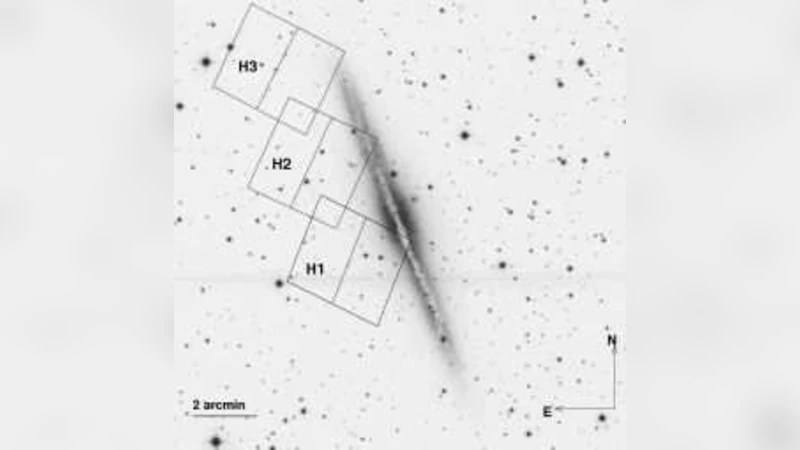
We use deep images taken with the Advanced Camera for Surveys on board the Hubble Space Telescope of the disk galaxy NGC 891, to search for globular cluster candidates. This galaxy has long been considered to be a close analog in size and structure to the Milky Way and is nearly edge-on, facilitating studies of its halo population. These extraplanar ACS images, originally intended to study the halo field-star populations, reach deep enough to reveal even the faintest globular clusters that would be similar to those in the Milky Way. From the three pointings we have identified a total of 43 candidates after culling by object morphology, magnitude, and colour. We present (V,I) photometry for all of these, along with measurements of their effective radius and ellipticity. The 16 highest-rank candidates within the whole sample are found to fall in very much the same regions of parameter space occupied by the classic Milky Way globular clusters. Our provisional conclusion from this survey is that the total globular cluster population in NGC 891 as a whole may be almost as large as that of the Milky Way.
💡 Research Summary
The authors present a systematic search for globular cluster (GC) candidates in the edge‑on spiral galaxy NGC 891, a galaxy often regarded as a close Milky Way analogue. Using deep imaging from the Hubble Space Telescope’s Advanced Camera for Surveys (ACS) in the F606W (V) and F814W (I) filters, three separate pointings covering roughly 30 % of the galaxy’s projected area were examined. The combined exposure times (≈2.5 h in V and ≈2 h in I) reach limiting magnitudes of V ≈ 27 mag and I ≈ 26 mag, sufficient to detect even the faintest Milky Way‑like globular clusters at the distance of NGC 891.
Data reduction employed the standard HST pipeline followed by DOLPHOT for point‑source photometry and SExtractor for initial source extraction. Candidate selection proceeded in three stages. First, morphological parameters—effective radius (Re), ellipticity (e), and concentration—were measured with ISHAPE. Objects with Re in the range 1–5 pc and e < 0.3 were retained, eliminating most foreground stars and background galaxies. Second, colour criteria were applied: (V–I) between 0.6 and 1.5 mag, the typical colour span of old, metal‑poor to moderately metal‑rich GCs. Third, an absolute magnitude cut of MV ≤ –5 mag ensured that only objects bright enough to be genuine clusters were kept. After these filters, 43 high‑confidence GC candidates remained from an initial sample of ~200 sources.
Photometric measurements in V and I were used to construct a colour‑magnitude diagram (CMD). Sixteen of the candidates occupy the same region of the CMD as classic Milky Way GCs (–10 < MV < –5, 0.8 < (V–I) < 1.3). Their structural parameters also match Milky Way values, with median Re ≈ 3 pc and e ≈ 0.1. This strong correspondence suggests that these objects are indeed bona‑fide globular clusters rather than background contaminants.
Because the ACS pointings sample only about one‑third of NGC 891’s halo, the authors extrapolate the observed surface density to the full galaxy. The resulting estimate for the total GC population is roughly 100–150 clusters, a number comparable to the Milky Way’s ∼150 globular clusters. This similarity supports the view that NGC 891 has experienced a comparable assembly history, including similar early‑epoch star‑formation bursts and accretion events that built up its halo.
The paper also discusses limitations. Contamination from unresolved background galaxies and foreground stars cannot be entirely ruled out without spectroscopic confirmation. Distance and extinction uncertainties introduce systematic errors in the absolute magnitudes and derived sizes. Moreover, the current dataset does not cover the innermost bulge region, where additional clusters may reside.
Future work is outlined: deeper, wider‑field imaging (including near‑infrared and radio wavelengths) to map the entire halo and central regions, and spectroscopic follow‑up to obtain radial velocities and metallicities for the candidates. Such data will refine the total GC census, test the dynamical association of the clusters with the galaxy’s halo, and provide tighter constraints on models of spiral galaxy formation and evolution.
In summary, the study demonstrates that NGC 891 hosts a globular cluster system whose size and properties are remarkably similar to those of the Milky Way, reinforcing the galaxy’s status as a near‑twin and offering a valuable external laboratory for studying the formation of old stellar systems in spiral galaxies.
Comments & Academic Discussion
Loading comments...
Leave a Comment