Models of turbulent dissipation regions in the diffuse interstellar medium
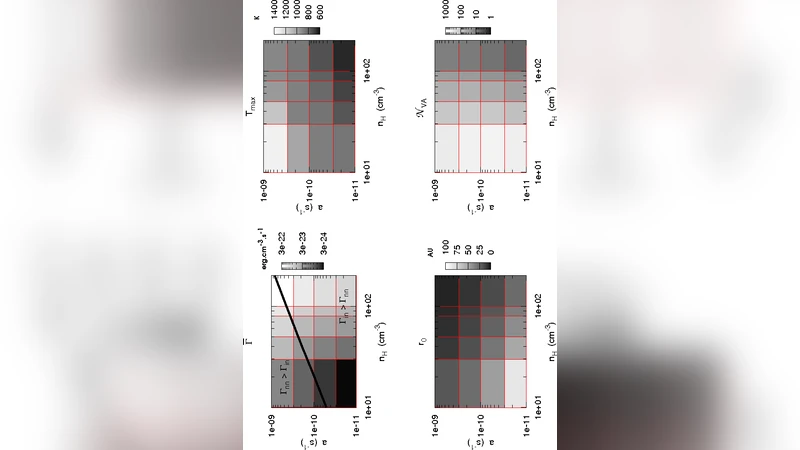
Supersonic turbulence is a large reservoir of suprathermal energy in the interstellar medium. Its dissipation, because it is intermittent in space and time, can deeply modify the chemistry of the gas. We further explore a hybrid method to compute the chemical and thermal evolution of a magnetized dissipative structure, under the energetic constraints provided by the observed properties of turbulence in the cold neutral medium. For the first time, we model a random line of sight by taking into account the relative duration of the bursts with respect to the thermal and chemical relaxation timescales of the gas. The key parameter is the turbulent rate of strain “a” due to the ambient turbulence. With the gas density, it controls the size of the dissipative structures, therefore the strength of the burst. For a large range of rates of strain and densities, the models of turbulent dissipation regions (TDR) reproduce the CH+ column densities observed in the diffuse medium and their correlation with highly excited H2. They do so without producing an excess of CH. As a natural consequence, they reproduce the abundance ratios of HCO+/OH and HCO+/H2O, and their dynamic range of about one order of magnitude observed in diffuse gas. Large C2H and CO abundances, also related to those of HCO+, are another outcome of the TDR models that compare well with observed values. The abundances and column densities computed for CN, HCN and HNC are one order of magnitude above PDR model predictions, although still significantly smaller than observed values.
💡 Research Summary
The paper investigates how supersonic turbulence in the cold neutral medium (CNM) of the diffuse interstellar medium (ISM) can drive non‑thermal chemistry through intermittent dissipation events. The authors develop a hybrid model that couples magnetohydrodynamic (MHD) descriptions of a dissipative structure (a “turbulent dissipation region”, TDR) with a detailed chemical‑thermal network. The central physical parameter is the turbulent rate of strain, denoted a (s⁻¹), which together with the gas density n(H) determines the characteristic size L≈(ν/a)¹ᐟ² of the shear layer and the burst duration τ≈1/a. Energy is injected into the gas at a rate ε≈ρ a³L², where ρ is the mass density; this energy is dissipated by viscous and ion–neutral friction processes.
The model proceeds in two steps. First, the authors prescribe a one‑dimensional shear flow that mimics the small‑scale structure generated by the ambient turbulent cascade. They compute the instantaneous heating rate and the resulting temperature evolution. Second, they feed this heating history into a chemical network comprising roughly 150 species, solving the coupled ordinary differential equations for temperature, density, and abundances as a function of time. The network includes key reactions for CH⁺ formation (C⁺ + H₂ → CH⁺ + H, an endothermic reaction requiring T ≳ 1000 K), the excitation of H₂ to high rotational levels, and the production pathways for HCO⁺, OH, H₂O, C₂H, CO, CN, HCN, and HNC.
A crucial insight is the comparison between the burst duration τ and the thermal and chemical relaxation timescales (τ_th, τ_chem). When τ < τ_th and τ < τ_chem, the gas does not have time to cool or re‑equilibrate chemically before the next burst, leading to a sustained population of high‑temperature chemistry. By sampling a wide range of a (10⁻¹¹–10⁻⁹ s⁻¹) and n (30–200 cm⁻³), the authors find that the model reproduces the observed CH⁺ column densities (10¹³–10¹⁴ cm⁻²) and the correlation with highly excited H₂ (J ≥ 3) without overproducing CH, a problem that plagued earlier turbulent‑chemistry models.
The TDR framework also naturally yields the observed abundance ratios HCO⁺/OH and HCO⁺/H₂O (≈ 1–10). In the heated layer, the reaction CO⁺ + H₂ → HCO⁺ + H is strongly enhanced, while OH and H₂O are formed via O + H₂ → OH + H and OH + H₂ → H₂O + H, respectively. The model predicts large C₂H and CO abundances, matching the high C₂H/CO ratios measured in diffuse sightlines. For nitrogen‑bearing species, the TDR produces CN, HCN, and HNC column densities about an order of magnitude higher than standard PDR predictions, yet still below the observed values, suggesting that additional non‑thermal processes (e.g., shocks or enhanced electron impact) may be required.
Strengths of the work include: (1) a physically motivated parametrization of turbulent dissipation through the rate‑of‑strain a, (2) explicit treatment of the burst‑to‑relaxation time ratio, which captures the intermittency of turbulence, and (3) successful simultaneous reproduction of multiple molecular diagnostics that have been difficult to reconcile in a single framework. Limitations are acknowledged: the use of a one‑dimensional shear flow, simplified prescriptions for viscous and ion‑neutral friction, and the under‑prediction of CN‑family abundances. The authors propose that future studies incorporate full three‑dimensional MHD‑chemistry simulations, better constraints on electron density and magnetic field strength, and additional dissipation mechanisms such as magnetosonic shocks.
In summary, this paper demonstrates that intermittent turbulent dissipation can provide the necessary suprathermal energy to drive the observed non‑equilibrium chemistry of the diffuse ISM. By linking the turbulent strain rate to observable molecular column densities, the authors offer a coherent picture that bridges the gap between large‑scale turbulence statistics and small‑scale chemical signatures, highlighting turbulence as a key agent in shaping interstellar chemistry beyond the traditional photon‑driven paradigm.
Comments & Academic Discussion
Loading comments...
Leave a Comment