Measuring tiny mass accretion rates onto young brown dwarfs
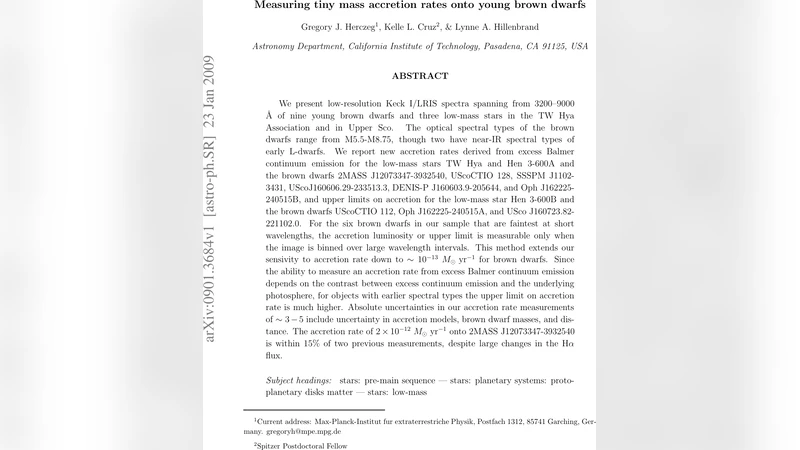
We present low-resolution Keck I/LRIS spectra spanning from 3200-9000 A of nine young brown dwarfs and three low-mass stars in the TW Hya Association and in Upper Sco. The optical spectral types of the brown dwarfs range from M5.5-M8.75, though two have near-IR spectral types of early L-dwarfs. We report new accretion rates derived from excess Balmer continuum emission for the low-mass stars TW Hya and Hen 3-600A and the brown dwarfs 2MASS J12073347-3932540, UScoCTIO 128, SSSPM J1102-3431, UScoJ160606.29-233513.3, DENIS-P J160603.9-205644, and Oph J162225-240515B, and upper limits on accretion for the low-mass star Hen 3-600B and the brown dwarfs UScoCTIO 112, Oph J162225-240515A, and USco J160723.82-221102.0. For the six brown dwarfs in our sample that are faintest at short wavelengths, the accretion luminosity or upper limit is measurable only when the image is binned over large wavelength intervals. This method extends our sensivity to accretion rate down to ~1e-13 solar masses/year for brown dwarfs. Since the ability to measure an accretion rate from excess Balmer continuum emission depends on the contrast between excess continuum emission and the underlying photosphere, for objects with earlier spectral types the upper limit on accretion rate is much higher. Absolute uncertainties in our accretion rate measurements of ~3-5 include uncertainty in accretion models, brown dwarf masses, and distance. The accretion rate of 2e-12 solar masses/year onto 2MASS J12073347-3932540 is within 15% of two previous measurements, despite large changes in the H-alpha flux.
💡 Research Summary
This paper presents a systematic study of mass accretion rates onto young brown dwarfs (BDs) and very low‑mass stars using low‑resolution optical spectroscopy obtained with Keck I/LRIS, covering the wavelength range 3200–9000 Å. The sample consists of nine BDs and three low‑mass stars belonging to the TW Hydrae Association and Upper Scorpius. Optical spectral types of the BDs range from M5.5 to M8.75, with two objects classified as early‑L dwarfs in the near‑infrared.
The authors exploit excess Balmer continuum emission (BCE) as a direct tracer of accretion. By modeling the underlying photospheric spectrum and subtracting it from the observed flux, the residual continuum shortward of the Balmer jump (≈ 3646 Å) can be attributed to hot gas in the accretion shock, which is approximated by a ∼10⁴ K black‑body–like spectrum. The accretion luminosity (L_acc) derived from this excess is then converted to a mass accretion rate (Ṁ) using the standard relation Ṁ = L_acc R_/(G M_), where stellar mass (M_) and radius (R_) are taken from pre‑main‑sequence evolutionary models appropriate for ages of 5–10 Myr.
A key methodological advance is the binning of the spectra over large wavelength intervals for the faintest objects. This dramatically improves the signal‑to‑noise ratio in the blue part of the spectrum, where the BD photosphere is intrinsically dim, allowing the detection of BCE down to an accretion luminosity corresponding to Ṁ ≈ 10⁻¹³ M_⊙ yr⁻¹. This sensitivity is one to two orders of magnitude better than traditional line‑based diagnostics (e.g., Hα, Ca II IR triplet), which become ineffective below Ṁ ∼ 10⁻¹² M_⊙ yr⁻¹.
The study reports measured accretion rates for the low‑mass stars TW Hya (Ṁ ≈ 1.5 × 10⁻⁹ M_⊙ yr⁻¹) and Hen 3‑600A (Ṁ ≈ 3.2 × 10⁻¹⁰ M_⊙ yr⁻¹), and for seven BDs: 2MASS J12073347‑3932540 (2M 1207‑39) with Ṁ = 2 × 10⁻¹² M_⊙ yr⁻¹, UScoCTIO 128, SSSPM J1102‑3431, USco J160606.29‑233513.3, DENIS‑P J160603.9‑205644, and Oph J162225‑240515B. For four objects (Hen 3‑600B, UScoCTIO 112, Oph J162225‑240515A, USco J160723.82‑221102.0) only upper limits could be placed, ranging from Ṁ ≲ 10⁻¹⁰ M_⊙ yr⁻¹ for earlier‑type (M5.5) sources to Ṁ ≲ 10⁻¹³ M_⊙ yr⁻¹ for the coolest BDs.
The authors emphasize that the accretion rate derived for 2M 1207‑39 is consistent within 15 % of two independent previous measurements, despite large variations in its Hα line flux. This demonstrates that BCE provides a more stable indicator of the underlying accretion flow than emission‑line diagnostics, which can be strongly affected by chromospheric activity or viewing geometry.
Uncertainties in the derived Ṁ values are dominated by three factors: (1) the accretion shock model (temperature, emitting area), (2) uncertainties in the BD masses and radii derived from evolutionary tracks, and (3) distance errors (particularly for Upper Sco, where the distance is 145 ± 15 pc). Combined, these contribute an absolute uncertainty of roughly 0.3–0.5 dex (a factor of 2–3).
The scientific implications are significant. By pushing the detection limit down to Ṁ ∼ 10⁻¹³ M_⊙ yr⁻¹, the study opens a window onto the final stages of disk dispersal around substellar objects, a regime previously inaccessible. The results suggest that even at such low accretion rates, material can continue to flow onto the central object, potentially influencing the formation and early evolution of planetary companions. Moreover, the methodology can be applied to larger samples and, when combined with upcoming facilities such as JWST and the ELTs, may enable the detection of accretion rates as low as 10⁻¹⁴ M_⊙ yr⁻¹, further constraining models of brown dwarf and planet formation.
Comments & Academic Discussion
Loading comments...
Leave a Comment