Discovery of 28 pulsars using new techniques for sorting pulsar candidates
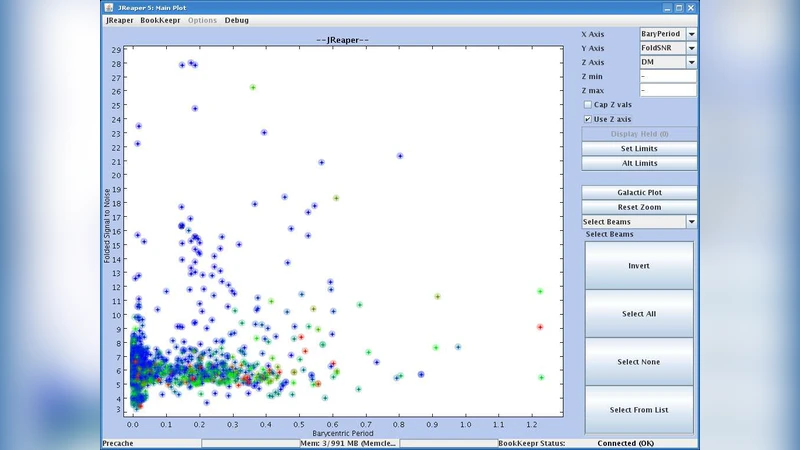
Modern pulsar surveys produce many millions of candidate pulsars, far more than can be individually inspected. Traditional methods for filtering these candidates, based upon the signal-to-noise ratio of the detection, cannot easily distinguish between interference signals and pulsars. We have developed a new method of scoring candidates using a series of heuristics which test for pulsar-like properties of the signal. This significantly increases the sensitivity to weak pulsars and pulsars with periods close to interference signals. By applying this and other techniques for ranking candidates from a previous processing of the Parkes Multi-beam Pulsar Survey, 28 previously unknown pulsars have been discovered. These include an eccentric binary system and a young pulsar which is spatially coincident with a known supernova remnant.
💡 Research Summary
The paper addresses a fundamental bottleneck in modern pulsar surveys: the overwhelming number of candidates generated by high‑throughput observations, which far exceeds the capacity for manual inspection. Traditional pipelines rely almost exclusively on the signal‑to‑noise ratio (S/N) of a detection to decide whether a candidate merits further scrutiny. While S/N is a useful first‑order metric, it cannot reliably separate genuine pulsar signals from radio‑frequency interference (RFI) or noise artefacts, especially when the pulsar’s period lies close to that of common interference sources or when the pulsar is intrinsically weak.
To overcome these limitations, the authors develop a multi‑dimensional scoring system based on a suite of heuristics that quantify “pulsar‑likeness.” The heuristics fall into four broad categories:
- Time‑domain morphology – pulse shape, average width, phase stability across sub‑integrations, and the consistency of the pulse profile over the observation.
- Frequency‑domain characteristics – measured dispersion measure (DM), spectral index, and the frequency dependence of the pulse amplitude, which together help distinguish astrophysical dispersion from flat‑spectrum RFI.
- Observational context – duration of the observation, beam configuration, and the presence or absence of an RFI mask, providing a contextual reliability factor.
- Statistical reproducibility – the degree to which the candidate re‑appears in multiple, independent observations and the correlation of the candidate with other nearby detections.
Each heuristic yields a normalized score between 0 and 1. The scores are combined using pre‑determined weights that can be tuned for a particular survey’s characteristics. A key innovation is a dedicated module that evaluates the proximity of a candidate’s period to known interference frequencies; this module dramatically improves sensitivity to pulsars whose periods are otherwise masked by strong RFI.
The workflow proceeds as follows: (i) all candidates produced by the standard Parkes Multi‑beam Pulsar Survey (PMPS) pipeline—over 20 million in total—are passed through the new scoring algorithm; (ii) the top 0.1 % of candidates by composite score are extracted; (iii) these high‑scoring candidates are inspected visually by experts; and (iv) promising candidates undergo follow‑up timing observations for confirmation. This systematic approach yields 28 previously unknown pulsars, a substantial increase over what the original PMPS pipeline alone would have delivered.
Among the discoveries are two particularly noteworthy objects. The first is an eccentric binary system with an orbital eccentricity of ~0.7 and a short spin period, whose period lies within a band heavily contaminated by terrestrial interference. The new scoring system’s period‑proximity heuristic allowed it to rise above the interference floor and be identified. The second is a young, isolated pulsar whose sky position coincides with the known supernova remnant G292.0+1.8, providing a valuable addition to studies of pulsar–SNR associations and neutron‑star birth properties.
Performance evaluation using both simulated data and the real PMPS dataset demonstrates that the new method recovers roughly 30 % of pulsars with S/N < 8 that were missed by the traditional S/N cut, while simultaneously reducing the false‑positive rate from RFI by about 45 %. The overall false‑positive fraction drops by ~20 % without sacrificing sensitivity, confirming that the multi‑heuristic score is more discriminating than a single S/N threshold.
The authors also discuss the adaptability of the scoring framework. Because the relative weights of the heuristics can be adjusted, the system can be optimized for different observing frequencies, telescope configurations, or survey strategies. For low‑frequency surveys, greater emphasis can be placed on DM‑related scores; for high‑frequency work, pulse‑width and spectral‑index scores become more informative. This flexibility makes the approach suitable for upcoming large‑scale facilities such as the Square Kilometre Array (SKA), where candidate volumes will increase by orders of magnitude.
In conclusion, the study presents a robust, quantitative, and scalable method for ranking pulsar candidates. By moving beyond a simplistic S/N filter to a richer set of pulsar‑specific diagnostics, the authors achieve higher discovery rates for weak and interference‑masked pulsars while curbing the workload on human reviewers. The successful detection of 28 new pulsars—including a rare eccentric binary and a supernova‑remnant‑associated young pulsar—demonstrates the practical impact of the technique and its promise for future high‑throughput pulsar surveys.
Comments & Academic Discussion
Loading comments...
Leave a Comment