Circular polarization survey of intermediate polars I. Northern targets in the range 17h<R.A.<23h
Context. The origin, evolution, and ultimate fate of magnetic cataclysmic variables are poorly understood. It is largely the nature of the magnetic fields in these systems that leads to this poor understanding. Fundamental properties, such as the field strength and the axis alignment, are unknown in a majority of these systems. Aims. We undertake to put all the previous circular polarization measurements into context and systematically survey intermediate polars for signs of circular polarization, hence to get an indication of their true magnetic field strengths and try to understand the evolution of magnetic cataclysmic variables. Methods. We used the TurPol instrument at the Nordic Optical Telescope to obtain simultaneous UBVRI photo-polarimetric observations of a set of intermediate polars, during the epoch 2006 July 31 - August 2. Results. Of this set of eight systems two (1RXS J213344.1+510725 and 1RXS J173021.5-055933) were found to show significant levels of circular polarization, varying with spin phase. Five others (V2306 Cyg, AO Psc, DQ Her, FO Aqr, and V1223 Sgr) show some evidence for circular polarization and variation of this with spin phase, whilst AE Aqr shows little evidence for polarized emission. We also report the first simultaneous UBVRI photometry of the newly identified intermediate polar 1RXS J173021.5-055933. Conclusions. Circular polarization may be ubiquitous in intermediate polars, albeit at a low level of one or two percent or less. It is stronger at longer wavelengths in the visible spectrum. Our results lend further support to the possible link between the presence of soft X-ray components and the detectability of circular polarization in intermediate polars.
💡 Research Summary
The paper presents a systematic circular‑polarization survey of intermediate polars (IPs) located in the northern sky between right ascensions 17 h and 23 h. Using the TurPol instrument on the 2.5 m Nordic Optical Telescope, the authors obtained simultaneous UBVRI photo‑polarimetric data for eight IPs during three nights in late July 2006. The primary goal was to place all previous circular‑polarization measurements in a unified context, assess how common circular polarization is among IPs, and infer magnetic‑field strengths and geometries that are otherwise difficult to determine.
Two objects—1RXS J213344.1+510725 and 1RXS J173021.5‑055933—show clear, spin‑phase‑dependent circular polarization at the 0.5–2 % level. Both systems are known soft‑X‑ray emitters, reinforcing a previously suggested link between the presence of a soft X‑ray component and the detectability of circular polarization in IPs. Five additional targets (V2306 Cyg, AO Psc, DQ Her, FO Aqr, and V1223 Sgr) exhibit marginal polarization signals (typically ≤0.8 %) that also vary with spin phase. In these cases the polarization amplitude tends to increase toward longer optical wavelengths (R and I bands), consistent with the expectation that cyclotron emission from magnetically confined electrons becomes more circularly polarized at redder wavelengths. The remaining target, AE Aqr, shows essentially no circular polarization, likely due to its highly asynchronous rotation and rapid, chaotic accretion flow that can wash out any coherent magnetic signature.
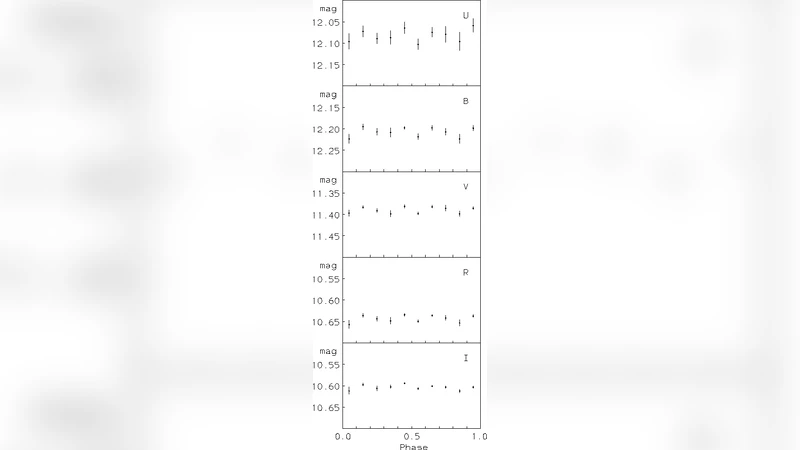
A notable ancillary result is the first simultaneous UBVRI photometry of the newly identified IP 1RXS J173021.5‑055933. The authors report spin‑phase‑dependent colour changes that mirror the polarization behaviour, suggesting that temperature and magnetic‑field geometry variations across the white‑dwarf surface are being observed simultaneously.
From a methodological standpoint, the study demonstrates the power of simultaneous multi‑band polarimetry for disentangling spin‑phase effects from instrumental or atmospheric noise. By observing each target for several spin cycles and applying a 3σ detection threshold, the authors provide robust statistical evidence for low‑level polarization that would be missed in single‑band or non‑phase‑resolved observations.
The broader astrophysical implications are threefold. First, circular polarization appears to be a ubiquitous, albeit weak (≤2 %), property of IPs, implying that most of these systems possess magnetic fields strong enough to produce cyclotron emission, even if the fields are weaker than those in polars. Second, the wavelength dependence of the polarization supports cyclotron‑origin models and offers a diagnostic for estimating field strengths when combined with spectral energy distribution fitting. Third, the correlation between soft X‑ray emission and detectable polarization may point to a common physical origin: a heated accretion region near the magnetic pole that both emits soft X‑rays and hosts the cyclotron‑emitting plasma.
In conclusion, the paper provides compelling evidence that low‑level circular polarization is common among intermediate polars and that its detection can serve as a valuable probe of magnetic field strength, geometry, and accretion physics. Future work should expand the sample size, incorporate longer monitoring to improve phase coverage, and combine optical polarimetry with high‑resolution X‑ray spectroscopy to refine models of magnetic accretion and the evolutionary pathways linking IPs to the strongly magnetic polars.
Comments & Academic Discussion
Loading comments...
Leave a Comment