X-ray Absorption and Optical Extinction in the Partially Obscured Seyfert Nucleus in Mrk 1393
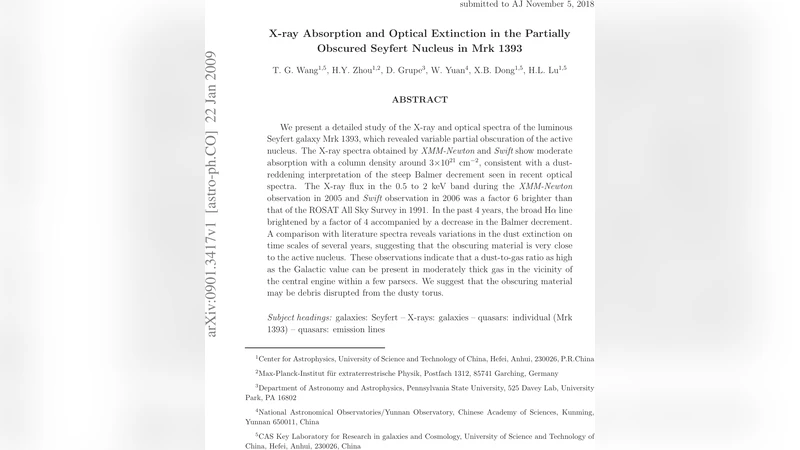
We present a detailed study of the X-ray and optical spectra of the luminous Seyfert galaxy Mrk 1393, which revealed variable partial obscuration of the active nucleus. The X-ray spectra obtained by XMM-Newton and Swift show moderate absorption with a column density around 3x10^21 cm^-2, consistent with a dust-reddening interpretation of the steep Balmer decrement seen in recent optical spectra. The X-ray flux in the 0.5 to 2 keV band during the XMM-Newton observation in 2005 and Swift observation in 2006 was a factor 6 brighter than that of the ROSAT All Sky Survey in 1991. In the past 4 years, the broad H\alpha line brightened by a factor of 4 accompanied by a decrease in the Balmer decrement. A comparison with literature spectra reveals variations in the dust extinction on time scales of several years, suggesting that the obscuring material is very close to the active nucleus. These observations indicate that a dust-to-gas ratio as high as the Galactic value can be present in moderately thick gas in the vicinity of the central engine within a few parsecs. We suggest that the obscuring material may be debris disrupted from the dusty torus.
💡 Research Summary
This paper presents a comprehensive multi‑wavelength investigation of the luminous Seyfert galaxy Mrk 1393, focusing on the variable partial obscuration of its active nucleus. X‑ray observations obtained with XMM‑Newton in 2005 and Swift in 2006 reveal a modest intrinsic absorption column of N_H ≈ 3 × 10²¹ cm⁻². Spectral fitting shows that a partial‑covering absorber (covering factor ≈ 0.6) superimposed on a typical Seyfert power‑law continuum (photon index Γ ≈ 1.8) provides the best description of the 0.3–10 keV data. The 0.5–2 keV flux during these observations is about six times higher than the value measured by ROSAT in the 1991 All‑Sky Survey, indicating a significant change in the X‑ray output or line‑of‑sight opacity over a timescale of ~15 yr.
In the optical domain, the authors compile spectra from the literature (1995 SDSS, 1991 ROSAT epoch, and new observations in 2005 and 2009). The Balmer decrement (Hα/Hβ) has decreased dramatically from ≈ 7.5 to ≈ 3.5, corresponding to a reduction in visual extinction from A_V ≈ 2 mag to A_V ≈ 0.9 mag. Simultaneously, the broad Hα line flux has increased by a factor of four over the past four years, indicating that the broad‑line region (BLR) has become substantially less reddened and more luminous. The concordant timing of the X‑ray brightening and the optical de‑reddening suggests that the same intervening material is responsible for both phenomena.
By comparing the extinction derived from the Balmer decrement with the X‑ray column density, the authors find a dust‑to‑gas ratio A_V/N_H ≈ 5 × 10⁻² mag cm², essentially identical to the Galactic value. This result demonstrates that moderately thick gas (N_H ~ 10²¹–10²² cm⁻²) located within a few parsecs of the central engine can retain a dust content comparable to that of the Milky Way, contrary to some models that predict severe dust destruction in the harsh AGN environment.
The paper argues that the observed variability on year‑scale intervals implies that the obscuring clouds are situated very close to the nucleus, likely at distances ≤ a few parsecs. The authors propose that these clouds are fragments of the dusty torus, torn apart by radiation pressure, turbulence, or gravitational instabilities, and that they intermittently cross our line of sight, producing partial covering in X‑rays and variable reddening in the optical. This dynamic picture complements the classic static torus paradigm and provides a natural explanation for the simultaneous changes in X‑ray absorption and optical extinction.
Finally, the study highlights the diagnostic power of coordinated X‑ray and optical monitoring for probing the structure and composition of the circumnuclear medium in active galaxies. Future high‑resolution X‑ray spectroscopy (e.g., with XRISM or Athena) combined with infrared interferometry could pinpoint the location, kinematics, and physical state of these clumpy absorbers, further refining our understanding of AGN feeding and feedback processes.
Comments & Academic Discussion
Loading comments...
Leave a Comment