Internal dynamics of the galaxy cluster Abell 959
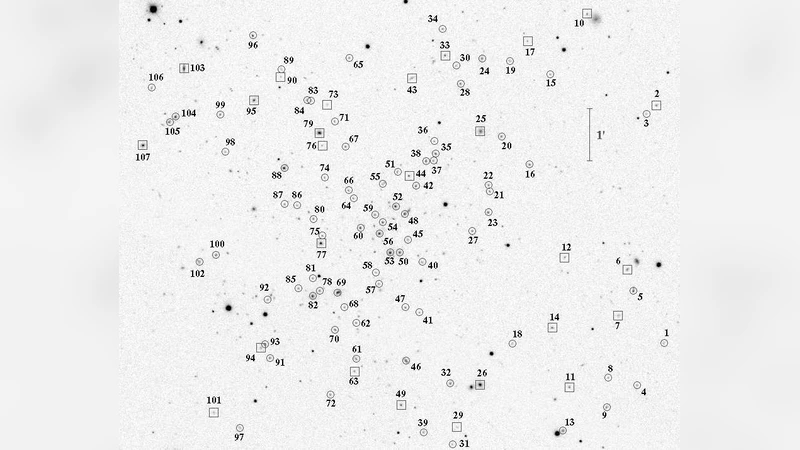
The connection of cluster mergers with the presence of extended, diffuse radio sources in galaxy clusters is still being debated. In this paper we aim to obtain new insights into the internal dynamics of Abell 959, showing evidence of a diffuse radio source, analyzing velocities and positions of member galaxies. Our analysis is based on redshift data for 107 galaxies in the cluster field acquired at the Telescopio Nazionale Galileo. We also use photometric data from the Sloan Digital Sky Survey (Data Release 6). We combine galaxy velocities and positions to select 81 galaxies recognized as cluster members and determine global dynamical properties. We analyze the cluster searching for substructures by using several statistical methods. We also study the 2D galaxy distribution in the field of the cluster. We compare our results with those from X-ray and gravitational lensing analyses. We estimate a cluster redshift of z=0.2883 +/- 0.0004. We detect an NE high velocity group at 5’ from the cluster center with a relative line–of–sight (LOS) velocity of ~ +1900 km/s with respect to the main system. We also detect a central, dense structure elongated along the SE–NW direction likely connected with the two dominant galaxies and their surrounding cores. This elongated central structure is probably the trace of an old cluster merger. The LOS velocity dispersion of galaxies is very high (1025 (-75/+104) km/s). The virial mass is M(<R=1.48 Mpc)= 1.15 (-0.19/+0.25) Msun. Our results suggest that this cluster is forming along two main directions of mass accretion and show the typical characteristics of radio clusters; i.e., it is very massive and shows a young dynamical state. However, deeper radio observations are needed to clarify the nature of the diffuse radio emission in Abell 959.
💡 Research Summary
This paper investigates the internal dynamics of the galaxy cluster Abell 959, a system at redshift z≈0.29 that shows hints of diffuse radio emission. The authors obtained new spectroscopic data for 107 galaxies in the cluster field using the Telescopio Nazionale Galileo (TNG) and complemented these with photometric information from the Sloan Digital Sky Survey (Data Release 6). By applying a combination of the “shifting‑gapper” technique and a 3‑σ clipping algorithm, they identified 81 reliable cluster members.
The mean redshift of the selected galaxies is z = 0.2883 ± 0.0004, and the line‑of‑sight (LOS) velocity dispersion is exceptionally high, σₗₒₛ = 1025 km s⁻¹ (−75/+104). Such a large dispersion indicates that the system is not yet virialised and is likely undergoing active merging. Using the standard virial theorem, the authors estimate a mass within a radius of 1.48 Mpc of M(<1.48 Mpc) = 1.15 × 10¹⁵ M⊙ (−0.19/+0.25), a value consistent with, or slightly higher than, previous X‑ray and gravitational‑lensing measurements.
To search for substructures, the study employs several statistical tools: the Dressler‑Schectman (DS) test, Kaye’s Mixture Model (KMM) analysis, and adaptive‑kernel density mapping. Two distinct components emerge. First, a high‑velocity group located ∼5 arcmin (≈1.2 Mpc) north‑east of the cluster centre exhibits a LOS velocity offset of about +1900 km s⁻¹ relative to the main system, suggesting it is an infalling subcluster. Second, a dense central feature elongated along the south‑east to north‑west (SE‑NW) axis connects the two brightest cluster galaxies and their surrounding cores. This elongated core is interpreted as the relic of an earlier major merger, still imprinting asymmetries in the galaxy distribution and in the X‑ray temperature map.
The authors compare these optical results with existing X‑ray images and weak‑lensing mass maps, finding good agreement in the location of the central elongation and the overall mass distribution. The presence of a massive, dynamically young system with clear signs of recent and ongoing accretion aligns with the typical properties of clusters that host diffuse radio sources (radio halos or relics). However, the current radio data for Abell 959 are insufficient to confirm the nature of the reported diffuse emission. The paper concludes that deeper, low‑frequency radio observations are required to determine whether the cluster indeed harbours a genuine radio halo or relic, and to explore how the identified merger axes influence the generation of such non‑thermal phenomena.
Overall, the study provides a comprehensive dynamical portrait of Abell 959, highlighting two principal mass‑accretion directions (NE–SW and SE‑NW), quantifying its high mass and velocity dispersion, and establishing a solid framework for future multi‑wavelength investigations of its radio properties.
Comments & Academic Discussion
Loading comments...
Leave a Comment