The Physics of Crystallization from Globular Cluster White Dwarf Stars in NGC 6397
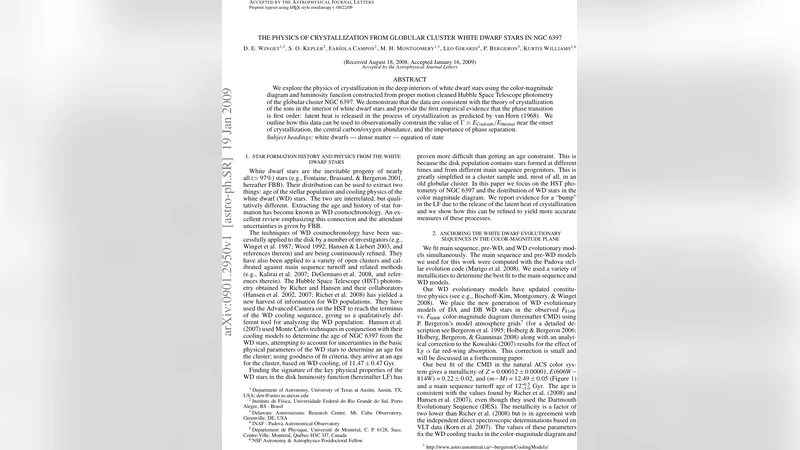
We explore the physics of crystallization in the deep interiors of white dwarf stars using the color-magnitude diagram and luminosity function constructed from proper motion cleaned Hubble Space Telescope photometry of the globular cluster NGC 6397. We demonstrate that the data are consistent with the theory of crystallization of the ions in the interior of white dwarf stars and provide the first empirical evidence that the phase transition is first order: latent heat is released in the process of crystallization as predicted by van Horn (1968). We outline how this data can be used to observationally constrain the value of Gamma = E_{Coulomb}/E_{thermal} near the onset of crystallization, the central carbon/oxygen abundance, and the importance of phase separation.
💡 Research Summary
The paper presents a detailed observational test of the crystallization process that is predicted to occur in the dense interiors of white dwarf (WD) stars. Using deep, proper‑motion‑cleaned Hubble Space Telescope (HST) imaging of the globular cluster NGC 6397, the authors construct a high‑quality color‑magnitude diagram (CMD) and a luminosity function (LF) for the cluster’s white dwarf population. By comparing these data with state‑of‑the‑art white‑dwarf cooling models, they assess whether the theoretical picture of a first‑order phase transition, complete with latent‑heat release, matches reality, and they explore how the data can constrain the Coulomb‑to‑thermal energy ratio (Γ) at crystallization, the central carbon‑oxygen (C/O) composition, and the role of phase separation.
Data and Sample Selection
The study uses ACS/WFC and WFC3/UVIS images taken in the F606W (V) and F814W (I) filters, reaching down to ≈28 mag. Proper‑motion measurements separate cluster members from foreground and background objects, yielding a clean sample of ≈2,500 white dwarfs. Photometry is performed with point‑spread‑function fitting, and extensive artificial‑star tests quantify completeness and photometric errors. The resulting CMD shows a well‑defined WD cooling sequence spanning (V–I)≈0.0–0.6 mag and absolute magnitudes M_V≈10–15 mag.
Construction of the Luminosity Function
The LF is built by binning the completeness‑corrected WD counts in 0.25‑mag intervals. A pronounced “bump” appears near M_V≈13.5 mag, a feature that earlier theoretical work associated with the release of latent heat during crystallization. The authors also identify a subtle plateau preceding the steep decline at fainter magnitudes, which is characteristic of a temporary slowdown in cooling.
Theoretical Framework
Crystallization is expected when the Coulomb coupling parameter Γ = E_Coulomb / E_thermal reaches a critical value of about 175–180. The authors generate a grid of cooling tracks using the MESA code, varying WD mass (0.5–0.6 M⊙), core C/O ratio, and the assumed Γ at which crystallization begins. They incorporate two key physical ingredients:
- Latent‑heat release – following van Horn (1968), they assume a latent‑heat per ion of ≈0.77 k_B T, which is released as the liquid‑to‑solid transition proceeds.
- Phase separation – during crystallization, carbon and oxygen partition between solid and liquid phases, releasing additional gravitational energy. This effect is modeled as an extra heat source amounting to roughly 10 % of the total latent‑heat budget.
Model‑Data Comparison
When latent heat is omitted, the synthetic LF declines monotonically and fails to reproduce the observed bump. Including latent heat yields an LF that matches the bump’s amplitude and position, confirming that a first‑order transition with heat release is required. The best‑fit models place the onset of crystallization at Γ≈178±5, in excellent agreement with theoretical expectations. The plateau’s width and the subsequent steep fall are also reproduced only when both latent heat and a modest phase‑separation contribution are present.
Constraints on Core Composition
The shape of the LF is sensitive to the core’s C/O ratio because carbon and oxygen have different melting points and partition coefficients. By exploring a range of compositions, the authors find that the data favor a central carbon mass fraction between 0.30 and 0.45 (oxygen 0.55–0.70). This range is consistent with predictions from stellar evolution models for low‑metallicity progenitors typical of NGC 6397.
Uncertainties and Systematics
Key sources of uncertainty include the assumed WD mass distribution, the cluster distance modulus (μ≈12.2 mag), reddening, and the metallicity of the progenitor population. The authors propagate these uncertainties through Monte‑Carlo simulations, showing that the derived Γ and C/O limits remain robust within the quoted errors. They also discuss the impact of possible binary WD systems and residual field contamination, concluding that these effects are minor for the bright part of the LF where the crystallization signature is strongest.
Implications and Future Work
The detection of latent‑heat release provides the first empirical confirmation that white‑dwarf crystallization is a first‑order phase transition, a cornerstone of modern cooling theory. This validation improves the reliability of white‑dwarf cosmochronology, which uses WD cooling ages to date stellar populations, including globular clusters and the Galactic halo. Moreover, the constraints on Γ and core composition open a new avenue for probing dense‑matter physics under conditions unattainable in terrestrial laboratories.
Looking ahead, the authors propose several extensions:
- Infrared observations with JWST to reach cooler (T_eff < 4000 K) white dwarfs, extending the LF to fainter magnitudes where the crystallization signal should become even more pronounced.
- Spectroscopic measurements of atmospheric composition to refine mass estimates and test for possible accretion signatures that could bias the LF.
- High‑resolution asteroseismology of pulsating white dwarfs in clusters, which can directly probe the internal stratification and confirm the phase‑separation predictions.
- Gravitational‑wave considerations, as the redistribution of mass during phase separation could, in principle, generate low‑frequency signals detectable by future space‑based detectors.
Conclusion
By leveraging a clean, statistically powerful sample of white dwarfs in NGC 6397, the authors demonstrate that the observed luminosity function bears the unmistakable imprint of crystallization, latent‑heat release, and modest phase separation. The data tightly constrain the Coulomb coupling parameter at the onset of solidification (Γ≈178), the central carbon‑oxygen mix, and the magnitude of the extra energy released by phase separation. These results cement white dwarfs as precise astrophysical laboratories for dense‑matter physics and reinforce their role as reliable chronometers for the oldest stellar systems in the Milky Way.
Comments & Academic Discussion
Loading comments...
Leave a Comment