A Search for Radio Supernova Remnants in Four Irregular Galaxies
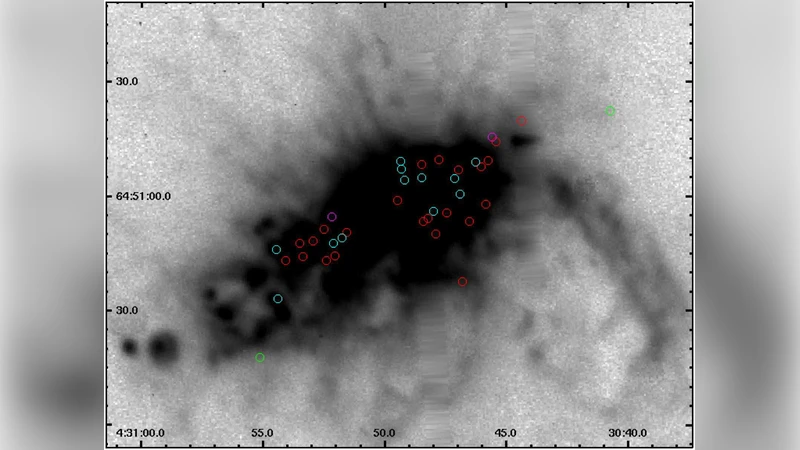
We survey four nearby irregular galaxies for radio supernova remnants (SNRs) using deep (1 sigma ~ 20 microJy), high resolution (~20 pc) VLA continuum data at 20, 6, and 3.6 cm. We identify discrete sources in these galaxies and use radio spectral indices and H alpha images to categorize them as SNRs, H II regions, or background radio galaxies. Our classifications are generally in good agreement agreement with the literature. We identify a total of 43 SNR candidates: 23 in NGC 1569, 7 in NGC 4214, 5 in NGC 2366, and 8 in NGC 4449. Only one SNR–the well-studied object J1228+441 in NGC 4449–is more luminous at 20 cm than Cas A. By comparing the total thermal flux density in each galaxy to that localized in H II regions, we conclude that a significant fraction must be in a diffuse component or in low-luminosity H II regions.
💡 Research Summary
The authors present a systematic radio survey of four nearby irregular galaxies—NGC 1569, NGC 4214, NGC 2366, and NGC 4449—aimed at identifying supernova remnant (SNR) candidates. Using the Very Large Array (VLA) they obtained deep continuum images at three wavelengths (20 cm, 6 cm, and 3.6 cm) with an rms noise of roughly 20 µJy beam⁻¹ and an angular resolution corresponding to about 20 pc at the distances of the target galaxies. This combination of sensitivity and spatial resolution is sufficient to resolve individual compact radio sources in external galaxies and to distinguish between thermal and non‑thermal emission based on spectral index measurements.
Source extraction was performed independently at each frequency, selecting detections with signal‑to‑noise ratios ≥5. After cross‑matching the catalogs, the authors derived spectral indices (α, where S∝ν^α) for sources detected in at least two bands. They adopted a classification scheme in which α < −0.4 indicates non‑thermal, synchrotron‑dominated emission typical of SNRs, α > −0.1 signals thermal free‑free emission from H II regions, and intermediate values are attributed to background radio galaxies or mixed sources. To increase reliability, the radio positions were overlaid on narrow‑band Hα images. Sources coincident with bright Hα emission were flagged as H II regions, while those lacking an Hα counterpart but exhibiting steep spectra were retained as SNR candidates.
Applying this methodology, the study identifies a total of 43 SNR candidates: 23 in NGC 1569, 7 in NGC 4214, 5 in NGC 2366, and 8 in NGC 4449. The classifications are largely consistent with previous work, confirming many known remnants and adding new candidates, especially in NGC 1569 where the bulk of the detections reside. The most luminous object in the sample is the well‑studied source J1228+441 in NGC 4449; its 20 cm flux density exceeds that of the Galactic supernova remnant Cassiopeia A, making it the only extragalactic SNR in the sample that is brighter than Cas A at this frequency. This exceptional brightness suggests a relatively young age, a low‑density surrounding medium, or efficient particle acceleration that preserves a high synchrotron output.
Beyond source cataloging, the authors compare the total thermal radio flux inferred from the integrated galaxy emission with the sum of the fluxes from identified H II regions. They find that the discrete H II regions account for only about 30–50 % of the total thermal component, implying that a substantial fraction of the ionized gas is either diffusely distributed or resides in low‑luminosity H II regions below the detection threshold. This result aligns with the picture of irregular galaxies having widespread, patchy star formation and a significant diffuse ionized medium.
The paper demonstrates the power of combining multi‑frequency radio data with optical line imaging to disentangle thermal and non‑thermal sources in complex, star‑forming systems. The achieved sensitivity (∼20 µJy) and resolution (∼20 pc) set a benchmark for future extragalactic SNR searches, especially with upcoming facilities such as the Square Kilometre Array (SKA) and the Next Generation VLA, which will push these limits further. High‑resolution follow‑up observations (e.g., with VLBI or deep X‑ray imaging) will be essential to confirm the SNR nature of the candidates, measure expansion velocities, and probe the interaction between supernova shocks and the interstellar medium in low‑metallicity, irregular environments.
Comments & Academic Discussion
Loading comments...
Leave a Comment