The Spatial Variation of the 3micron Dust Features in Circinus
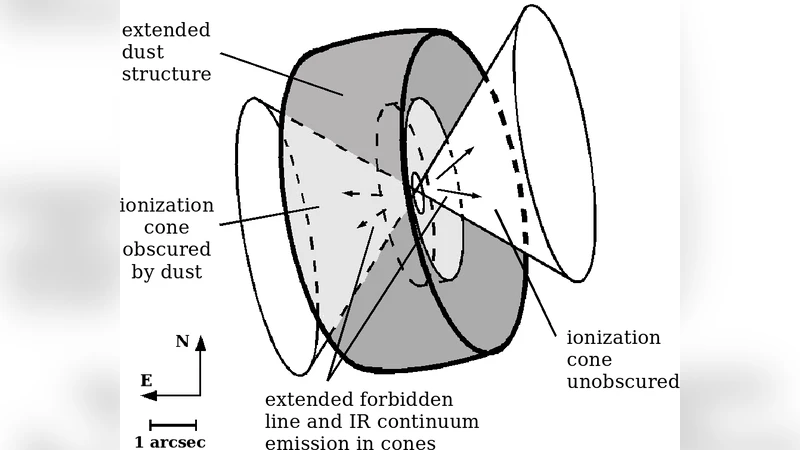
We report spatially-resolved variations in the 3.4micron hydrocarbon absorption feature and the 3.3micron polycyclic aromatic hydrocarbon (PAH) emission band in the Circinus galaxy over the central few arcsec. The absorption is measured towards warm emitting dust associated with Coronal line regions to the east and west of the nucleus. There is an absorption optical depth tau(3.4um) ~0.1 in the core which decreases to the west and increases to the east. This is consistent with increased extinction out to ~40 pc east of the core, supported by the Coronal emission line intensities which are significantly lower to the east than the west. PAH emission is measured to be symmetrically distributed out to +/- 4 arcsec, outside the differential extinction region. The asymmetry in the 3.4micron absorption band reflects that seen in the 9.7micron silicate absorption band reported by Roche et al. (2006) and the ratio of the two absorption depths remains approximately constant across the central regions, with tau(3.4um) / tau(9.7um) ~ 0.06 +/-0.01. This indicates well-mixed hydrocarbon and silicate dust populations, with no evidence for significant changes near the nucleus.
💡 Research Summary
The authors present a spatially resolved study of the 3.4 µm aliphatic hydrocarbon absorption and the 3.3 µm polycyclic aromatic hydrocarbon (PAH) emission in the central few arcseconds of the Circinus galaxy. Using high‑resolution infrared spectroscopy, they measured the absorption toward warm dust associated with the coronal line regions on both sides of the nucleus. The optical depth of the 3.4 µm feature peaks at τ≈0.10 in the core, declines toward the west, and rises to τ≈0.12 about 40 pc east of the nucleus. This asymmetry mirrors the distribution of coronal line intensities, which are significantly weaker on the eastern side, indicating that additional extinction is suppressing the line emission there. In contrast, the PAH 3.3 µm band is detected symmetrically out to ±4″ (≈80 pc), well beyond the region of differential extinction, suggesting that star‑forming or photodissociation regions are evenly distributed outside the heavily obscured zone. A key result is that the ratio of the 3.4 µm hydrocarbon depth to the 9.7 µm silicate depth remains essentially constant across the central region, τ(3.4 µm)/τ(9.7 µm)=0.06 ± 0.01. This constancy implies that aliphatic carbonaceous grains and silicate grains are well mixed, with no evidence for a distinct dust population near the active nucleus. The authors argue that the observed east‑west asymmetry likely reflects large‑scale structural effects such as a tilted galactic disk, asymmetric inflow/outflow, or localized dust lanes, rather than a change in dust composition. Their findings reinforce the notion that the dust chemistry in active galactic nuclei can be similar to that of the Milky Way’s interstellar medium, while still exhibiting pronounced geometric variations that influence the observed line and continuum properties. The paper concludes by recommending future high‑resolution, multi‑wavelength observations to map the three‑dimensional dust distribution and to disentangle the dynamical processes shaping the circumnuclear environment.
Comments & Academic Discussion
Loading comments...
Leave a Comment