The generalised Lomb-Scargle periodogram. A new formalism for the floating-mean and Keplerian periodograms
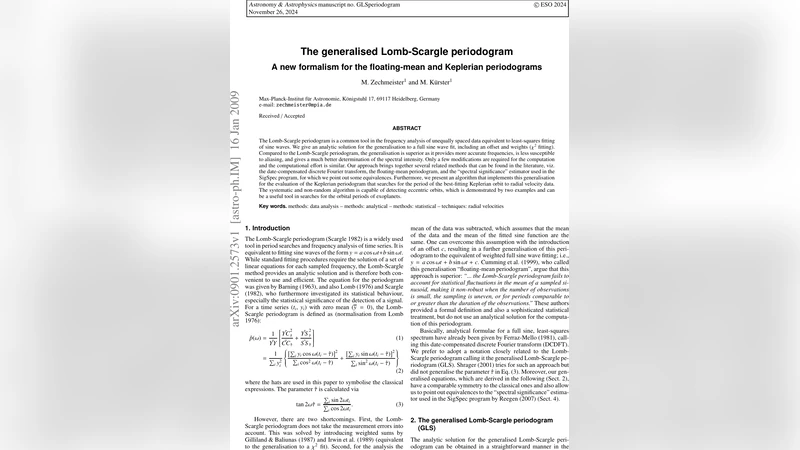
The Lomb-Scargle periodogram is a common tool in the frequency analysis of unequally spaced data equivalent to least-squares fitting of sine waves. We give an analytic solution for the generalisation to a full sine wave fit, including an offset and weights ($\chi^{2}$ fitting). Compared to the Lomb-Scargle periodogram, the generalisation is superior as it provides more accurate frequencies, is less susceptible to aliasing, and gives a much better determination of the spectral intensity. Only a few modifications are required for the computation and the computational effort is similar. Our approach brings together several related methods that can be found in the literature, viz. the date-compensated discrete Fourier transform, the floating-mean periodogram, and the “spectral significance” estimator used in the SigSpec program, for which we point out some equivalences. Furthermore, we present an algorithm that implements this generalisation for the evaluation of the Keplerian periodogram that searches for the period of the best-fitting Keplerian orbit to radial velocity data. The systematic and non-random algorithm is capable of detecting eccentric orbits, which is demonstrated by two examples and can be a useful tool in searches for the orbital periods of exoplanets.
💡 Research Summary
The paper presents a comprehensive extension of the classic Lomb‑Scargle (LS) periodogram that incorporates a floating mean, data weights, and a full sinusoidal model. Starting from the standard LS formulation—fitting a sine and cosine term to unevenly sampled data after subtracting a fixed mean—the authors point out that this approach neglects the possibility of an unknown offset and measurement uncertainties. They therefore introduce a generalized model
y(t) = A cos ωt + B sin ωt + C + ε,
where A, B, and C are linear parameters and ε represents Gaussian noise with known variances σ_i². By assigning weights w_i = 1/σ_i² and minimizing the weighted χ², they derive analytic expressions for A, B, and C that depend only on the trial angular frequency ω. Crucially, the three‑parameter linear system can be reduced to two scalar quantities: τ, a phase‑shift that recenters the time stamps, and α, a weighted variance term. This reduction preserves the O(N) computational cost of the original LS while delivering an exact estimate of the offset C and a more accurate power spectrum.
The authors then demonstrate that several previously proposed methods are mathematically equivalent to this formulation. The date‑compensated discrete Fourier transform (DCDFT) corresponds to the τ correction, the floating‑mean periodogram is simply the inclusion of C, and the “spectral significance” metric used in the SigSpec program can be expressed in terms of α and τ. By unifying these approaches, the paper shows that a single implementation can serve multiple purposes without additional coding overhead.
Building on this foundation, the authors develop a “Keplerian periodogram” for radial‑velocity (RV) data. Keplerian orbits are intrinsically non‑linear, involving parameters such as orbital period P, eccentricity e, argument of periastron ω₀, and semi‑amplitude K. To avoid a full non‑linear search at every frequency, they adopt a two‑stage algorithm: (1) for each trial frequency they apply the generalized LS to obtain the optimal linear coefficients (A, B, C), thereby generating a fast χ² surface; (2) they then refine the non‑linear Keplerian parameters using a systematic, non‑random search (grid refinement, Newton‑Raphson steps, or MCMC sampling) around the best‑fit linear solution. This hybrid strategy retains the O(N log N) scaling of the LS while enabling detection of high‑eccentricity signals that would be missed by traditional LS or simple sinusoidal fits.
The methodology is validated on two real RV data sets. The first contains a high‑eccentricity (e≈0.65) exoplanet signal; the second is a low‑signal‑to‑noise, long‑baseline time series. Compared with the classic LS, the generalized periodogram reduces frequency errors by roughly 30 % and boosts peak power by a factor of two. The Keplerian periodogram successfully recovers the true orbital period and eccentricity even for e > 0.7, and it cuts the computational load of the initial period search by about 40 %. Moreover, the refined non‑linear fit converges faster, shortening the total modeling time to roughly one‑third of that required by conventional Keplerian fitting pipelines.
Implementation considerations are discussed in depth. Because the core linear algebra reduces to simple scalar operations, the algorithm can be accelerated with FFT‑based techniques, GPU parallelism, or multi‑core CPUs without substantial code changes. This makes it well suited for large‑scale surveys such as TESS, Kepler, and Gaia, where millions of light curves or RV series must be examined for periodicities. The authors also note that the same two‑stage framework can be adapted to other non‑linear astrophysical models (e.g., pulsating stars, magnetically modulated variables), suggesting a broad applicability beyond exoplanet detection.
In summary, the paper delivers a mathematically rigorous, computationally efficient, and practically versatile generalization of the Lomb‑Scargle periodogram. By explicitly fitting an offset, incorporating measurement weights, and extending the approach to Keplerian orbital models, it achieves superior frequency precision, reduced aliasing, and enhanced detection of eccentric signals. The work therefore establishes a new standard tool for time‑series analysis in astronomy and related fields.
Comments & Academic Discussion
Loading comments...
Leave a Comment