Evidence of a link between the evolution of clusters and their AGN fraction
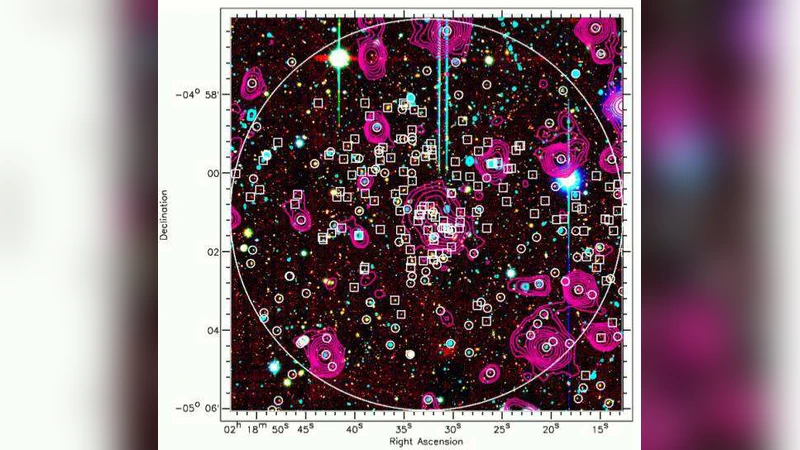
We discuss the optical properties, X-ray detections, and Active Galactic Nucleus (AGN) populations of four clusters at z ~ 1 in the Subaru-XMM Deep Field (SXDF). The velocity distribution and plausible extended X-ray detections are examined, as well as the number of X-ray point sources and radio sources associated with the clusters. We find that the two clusters that appear virialised and have an extended X-ray detection contain few, if any, AGN, whereas the two pre-virialised clusters have a large AGN population. This constitutes evidence that the AGN fraction in clusters is linked to the clusters’ evolutionary stage. The number of X-ray AGN in the pre-virialised clusters is consistent with an overdensity of factor ~ 200; the radio AGN appear to be clustered with a factor of three to six higher. The median K-band luminosities of L_K = 1.7 +/- 0.7 L* for the X-ray sources and L_K = 2.3 +/- 0.1 L* for the radio sources support the theory that these AGN are triggered by galaxy interaction and merging events in sub-groups with low internal velocity distributions, which make up the cluster environment in a pre-virialisation evolutionary stage.
💡 Research Summary
This paper presents a multi‑wavelength investigation of four galaxy clusters at redshift ≈ 1 in the Subaru‑XMM Deep Field (SXDF) with the aim of testing whether the fraction of active galactic nuclei (AGN) depends on the evolutionary stage of the host cluster. The authors combine optical imaging and spectroscopy, X‑ray observations from XMM‑Newton and Chandra, and 1.4 GHz radio data from the VLA to characterize each system’s dynamical state, intracluster medium (ICM) properties, and AGN content.
First, member galaxies are identified through photometric redshifts and spectroscopic confirmations. The line‑of‑sight velocity distributions reveal two distinct dynamical classes. Two clusters display a single, well‑defined velocity peak, high velocity dispersion (≈ 800–1000 km s⁻¹), and clear extended X‑ray emission consistent with a hot, virialised ICM. The remaining two clusters show multiple velocity peaks, lower dispersions (≈ 300–500 km s⁻¹), and no significant extended X‑ray component, indicating that they are still assembling from sub‑groups – a pre‑virialised stage.
AGN are identified in two complementary ways. X‑ray point sources are extracted from the deep XMM/Chandra images; their optical counterparts are cross‑matched and vetted for cluster membership using redshift information. Radio AGN are selected from the VLA 1.4 GHz catalog, again requiring optical counterparts consistent with the cluster redshift. The authors find a striking contrast: the two pre‑virialised clusters host a substantial AGN population (≈ 5–6 X‑ray AGN and 8–10 radio AGN per cluster), whereas the two virialised clusters contain at most one or none of either type.
Quantitatively, the X‑ray AGN overdensity in the pre‑virialised systems is ≈ 200 times the field expectation, while the radio AGN overdensity ranges from a factor of three to six. The K‑band luminosities of the AGN host galaxies are measured to assess stellar mass. X‑ray AGN hosts have a median luminosity of L_K = 1.7 ± 0.7 L*, and radio AGN hosts are slightly more massive with L_K = 2.3 ± 0.1 L*. These values indicate that the AGN reside in galaxies that are modestly brighter than the characteristic L* galaxy, consistent with the idea that interactions among relatively massive galaxies in low‑velocity sub‑structures trigger nuclear activity.
The authors interpret these findings within the framework of hierarchical cluster formation. In the early, pre‑virialised phase, clusters consist of several infalling groups whose internal velocity dispersions are low (a few hundred km s⁻¹). Such conditions favour galaxy–galaxy mergers and tidal interactions, which can funnel cold gas toward the central supermassive black holes, igniting both X‑ray and radio AGN. As the system collapses and the ICM heats up, the velocity dispersion rises to several thousand km s⁻¹, dramatically reducing the merger cross‑section and cutting off the gas supply. Consequently, AGN activity is quenched, leaving the mature, virialised clusters largely devoid of luminous AGN.
This work provides direct observational evidence that the AGN fraction is not a static property of clusters but evolves in step with the dynamical state of the host environment. It supports theoretical predictions that AGN feedback is most effective during the assembly phase of massive structures, potentially influencing star‑formation histories of member galaxies and the thermodynamic evolution of the ICM. The study also highlights the power of combining deep X‑ray, radio, and optical data to trace the co‑evolution of galaxies, black holes, and large‑scale structure. Future surveys with eROSITA, the Square Kilometre Array, and next‑generation spectroscopic facilities will be able to extend this analysis to larger samples and higher redshifts, refining our understanding of how AGN activity regulates the growth of galaxy clusters across cosmic time.
Comments & Academic Discussion
Loading comments...
Leave a Comment