The nature of the ASCA/INTEGRAL source AX J183039-1002: a new Compton-thick AGN?
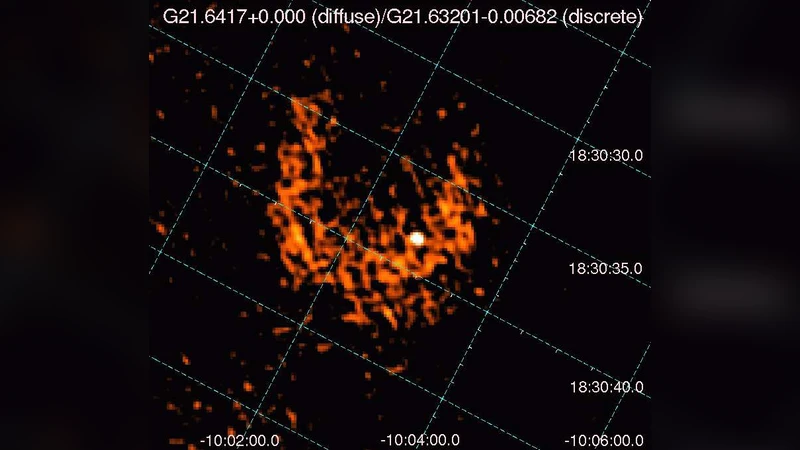
We report on the identification of the X/soft gamma-ray source AX J183039-1002 detected with ASCA and INTEGRAL/IBIS. The source, which has an observed 20-100 keV flux of about 8.6 x 10^-11 erg/cm^2/s, is inside a diffuse radio supernova remnant (SNR) and is spatially coincident with a compact radio source. We analyzed archival Chandra and XMM-Newton observations in order to identify the ASCA/INTEGRAL source. A point-like Chandra X-ray object was found to be positionally coincident with the compact radio source and within the error circle of the ASCA and INTEGRAL sources. Although the association of a compact radio/X-ray source with a radio supernova remnant could be indicative of a pulsar wind nebula (PWN), the XMM-Newton X-ray spectrum is compatible with an absorbed, Seyfert-2 like AGN, since it provides evidence for an iron emission line of about 1 keV equivalent width; furthermore the X-ray source spectrum is similar to that of other Compton thick AGN where the <2 keV data are associated to a warm reflector and the >10 keV one to a cold reflector.
💡 Research Summary
The paper presents a multi‑wavelength investigation of the high‑energy source AX J183039‑1002, originally detected by ASCA in the 2–10 keV band and later confirmed by INTEGRAL/IBIS in the 20–100 keV range with a flux of roughly 8.6 × 10⁻¹¹ erg cm⁻² s⁻¹. The source lies projected against a diffuse radio supernova remnant (SNR) and coincides with a compact radio emitter, raising the initial hypothesis that the X‑ray object could be a pulsar wind nebula (PWN) associated with the SNR. To resolve this ambiguity, the authors re‑examined archival Chandra and XMM‑Newton observations.
Chandra’s sub‑arcsecond imaging revealed a single point‑like X‑ray source within the ASCA and INTEGRAL error circles. Its coordinates match precisely those of the compact radio source, establishing a firm multi‑band counterpart. The XMM‑Newton EPIC‑PN and MOS spectra (0.5–10 keV) were then modeled. A simple absorbed power‑law proved insufficient; a strong Fe Kα emission line at ~6.4 keV with an equivalent width of ~1 keV had to be added to achieve an acceptable fit. The derived intrinsic column density is N_H ≈ (1.5 ± 0.3) × 10²³ cm⁻², indicating heavy obscuration typical of Seyfert 2 nuclei.
When the INTEGRAL/IBIS hard‑X‑ray data are combined with the XMM‑Newton spectrum, the broadband (0.5–100 keV) fit requires a two‑component reflection model: a warm (ionised) reflector dominating the soft (<2 keV) part and a cold (neutral) reflector shaping the hard (>10 keV) continuum. This configuration mirrors that observed in well‑studied Compton‑thick AGN such as NGC 1068 and the Circinus galaxy, where the primary continuum is almost entirely blocked and only reflected/scattered emission is visible.
The presence of a compact radio core further supports an active galactic nucleus (AGN) interpretation, as radio‑quiet Seyfert 2 galaxies often exhibit weak, flat‑spectrum cores. Conversely, the surrounding SNR shows no X‑ray counterpart that would be expected for a genuine PWN, and the spatial coincidence appears to be a line‑of‑sight superposition rather than a physical association.
Consequently, the authors conclude that AX J183039‑1002 is most plausibly a newly identified Compton‑thick AGN seen through the Galactic plane, projected against an unrelated SNR. The study underscores the importance of high‑resolution X‑ray imaging and broadband spectroscopy for disentangling complex source environments, especially in crowded regions of the Milky Way. The paper recommends follow‑up observations in the infrared (to detect the hidden nucleus directly), optical spectroscopy (to measure redshift and confirm AGN line ratios), and long‑term radio monitoring (to assess variability and spectral index) to fully characterize the source.
Comments & Academic Discussion
Loading comments...
Leave a Comment