Time-dependent simulations of steady C-type shocks
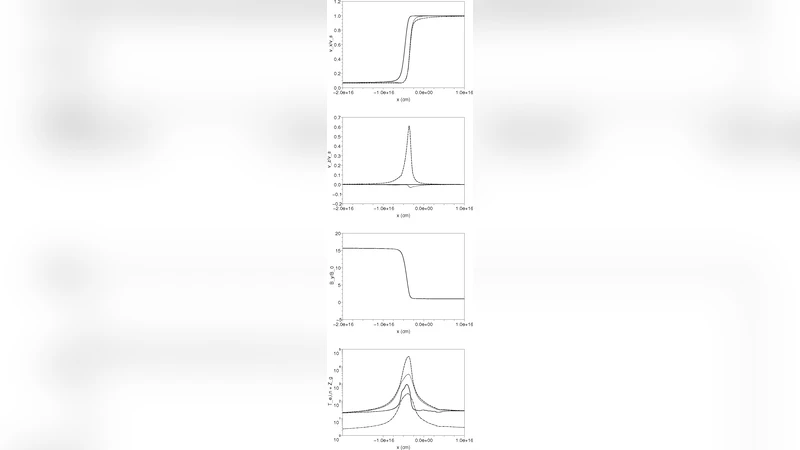
Using a time-dependent multifluid, magnetohydrodynamic code, we calculated the structure of steady perpendicular and oblique C-type shocks in dusty plasmas. We included relevant processes to describe mass transfer between the different fluids, radiative cooling by emission lines and grain charging and studied the effect of single-sized and multiple sized grains on the shock structure. Our models are the first of oblique fast-mode molecular shocks in which such a rigorous treatment of the dust grain dynamics has been combined with a self-consistent calculation of the thermal and ionisation structures including appropriate microphysics. At low densities the grains do not play any significant role in the shock dynamics. At high densities, the ionisation fraction is sufficiently low that dust grains are important charge and current carriers and, thus, determine the shock structure. We find that the magnetic field in the shock front has a significant rotation out of the initial upstream plane. This is most pronounced for single-sized grains and small angles of the shock normal with the magnetic field. Our results are similar to previous studies of steady C-type shocks showing that our method is efficient, rigorous and robust. Unlike the method employed in the previous most detailed treatment of dust in steady oblique fast-mode shocks, ours allows a reliable calculation even when chemical or other conditions deviate from local statistical equilibrium. We are also able to model transient phenomena.
💡 Research Summary
This paper presents a comprehensive, time‑dependent multifluid magnetohydrodynamic (MHD) study of steady C‑type (continuous) shocks in dusty molecular plasmas. Using a newly developed code that treats neutral gas, charged species (electrons and ions), and dust grains as separate fluids, the authors incorporate a suite of microphysical processes: mass exchange between fluids via adsorption, desorption and chemical reactions; radiative cooling by key molecular and atomic lines (CO, H₂O, O I, C II, etc.); and a detailed grain charging model that accounts for electron and ion collisions, photoelectric emission, and thermionic emission. Both single‑size and multi‑size grain populations are examined, allowing the investigation of how grain size distribution influences shock dynamics.
Two geometrical configurations are simulated: a perpendicular (purely normal) shock and an oblique (fast‑mode) shock where the upstream magnetic field makes a finite angle with the shock normal. In the perpendicular case, the magnetic field remains in the upstream plane and the shock structure is essentially identical to classic C‑type models because electrons and ions dominate the charge and current transport. In the oblique case, however, the magnetic field is found to rotate significantly out of the initial plane as the shock front is traversed. This rotation is most pronounced when the grain population is represented by a single size and when the shock normal is only slightly inclined relative to the magnetic field.
A key result concerns the density dependence of grain influence. At low pre‑shock densities (∼10³ cm⁻³), the ionisation fraction is high enough that dust grains contribute little to the overall charge balance; the shock width, temperature profile, and magnetic field behavior closely follow earlier C‑type studies that neglect detailed grain dynamics. At high densities (∼10⁶ cm⁻³), the ionisation fraction drops dramatically, and dust grains become the primary carriers of charge and electric current. Grain‑neutral drag then dominates momentum exchange, leading to a broader shock front, a lower peak temperature, and a substantial rotation of the magnetic field (up to 30–45°) within the shock transition zone. The multi‑size grain model moderates these effects because small grains rapidly lose charge while larger grains retain it, distributing the current over a range of grain sizes and reducing the net magnetic rotation compared with the single‑size case.
The authors also emphasize that their method does not rely on the assumption of local chemical equilibrium. By solving the full reaction network in a time‑dependent fashion, the code captures rapid chemical transients that occur as the gas is compressed and heated. This capability reveals fine‑scale structures in the temperature and ionisation profiles that are absent in equilibrium‑based models. Moreover, the time‑dependent framework enables the study of transient phenomena such as sudden changes in upstream radiation fields, impulsive shock strengthening, or rapid variations in grain charging conditions—situations that are inaccessible to static, equilibrium‑based approaches.
Overall, the paper demonstrates that (1) a rigorous multifluid treatment of dust, coupled with self‑consistent thermal and ionisation calculations, yields shock structures that agree with previous steady‑state results in the appropriate limits; (2) the inclusion of realistic grain physics uncovers new behavior, notably magnetic field rotation and density‑dependent grain dominance; and (3) the methodology is robust, efficient, and capable of handling non‑equilibrium chemistry and transient events. These advances provide a powerful tool for interpreting observations of molecular outflows, protostellar jets, and other astrophysical environments where C‑type shocks and dust grains coexist.
Comments & Academic Discussion
Loading comments...
Leave a Comment