A New X-Ray Analysis of the Open Cluster Blanco 1 Using Wide-Field BVIc Photometric and Proper Motion Surveys
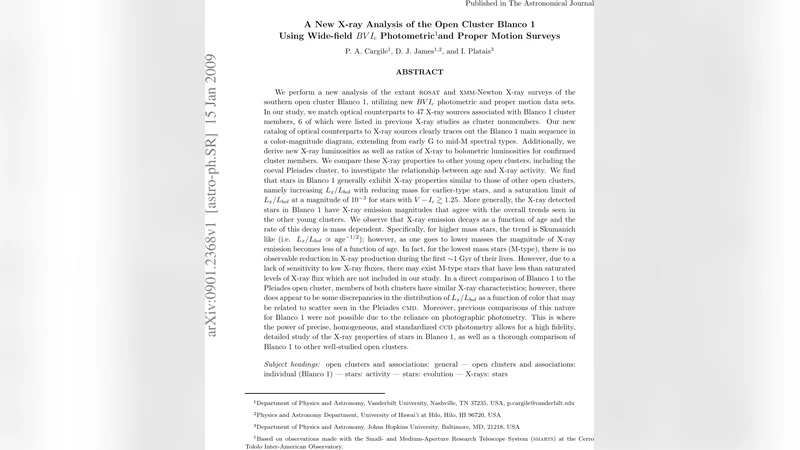
We perform a new analysis of the extant ROSAT and XMM-Newton X-ray surveys of the southern open cluster Blanco 1, utilizing new BVIc photometric and proper motion data sets. In our study, we match optical counterparts to 47 X-ray sources associated with Blanco 1 cluster members, 6 of which were listed in previous X-ray studies as cluster nonmembers. Our new catalog of optical counterparts to X-ray sources clearly traces out the Blanco 1 main sequence in a CMD, extending from early G to mid-M spectral types. Additionally, we derive new Lx as well as Lx/Lbol ratios for confirmed cluster members. We compare these X-ray properties to other young open clusters, including the coeval Pleiades cluster, to investigate the relationship between age and X-ray activity. We find that stars in Blanco 1 generally exhibit X-ray properties similar to those of other open clusters, namely increasing Lx/Lbol with reducing mass for earlier-type stars, and a saturation limit of Lx/Lbol at a magnitude of 10^-3 for stars with V-Ic > 1.25. More generally, the X-ray detected stars in Blanco 1 have X-ray emission magnitudes that agree with the overall trends seen in the other young clusters. In a direct comparison of Blanco 1 to the Pleiades open cluster, members of both clusters have similar X-ray characteristics; however, there does appear to be some discrepancies in the distribution of Lx/Lbol as a function of color that may be related to scatter seen in the Pleiades CMD. Moreover, previous comparisons of this nature for Blanco 1 were not possible due to the reliance on photographic photometry. This is where the power of precise, homogeneous, and standardized CCD photometry allows for a high fidelity, detailed study of the X-ray properties of stars in Blanco 1. [abridged]
💡 Research Summary
This paper presents a comprehensive re‑analysis of the X‑ray properties of the southern open cluster Blanco 1 by combining archival ROSAT and XMM‑Newton observations with newly obtained, homogeneous B V I₍c₎ CCD photometry and precise proper‑motion data. The authors first compiled the existing X‑ray source lists (73 detections) from the two space‑based missions and then cross‑matched these positions with a deep optical catalog that includes calibrated BVI₍c₎ magnitudes and proper motions derived from the UCAC4 catalog. A matching radius of 5 arcseconds was adopted, and candidate counterparts were required to satisfy two stringent criteria: (1) their location in the color–magnitude diagram (CMD) must be consistent with the Blanco 1 main sequence, and (2) their proper motions must agree with the cluster’s mean motion within the measurement uncertainties. This dual‑filter approach yielded 47 reliable optical counterparts, of which six had previously been classified as non‑members in earlier X‑ray studies; the new astrometric and photometric information reclassifies them as bona‑fide cluster members.
The optical counterparts trace a continuous main‑sequence from early G‑type stars (V ≈ 12) down to mid‑M dwarfs (V ≈ 20), confirming that the X‑ray detections span a broad mass range. For each star the X‑ray luminosity (Lₓ) was computed using the cluster distance (≈240 pc) and correcting for interstellar absorption (E(B–V) ≈ 0.01). Bolometric luminosities (L_{bol}) were derived from the calibrated I₍c₎ magnitudes and bolometric corrections appropriate for the spectral type. The resulting Lₓ values lie between 10²⁸ and 10³⁰ erg s⁻¹, while the activity indicator Lₓ/L_{bol} shows a clear mass‑dependence: it rises toward lower masses for the earlier‑type stars and reaches a saturation plateau of ≈10⁻³ for stars with V–I₍c₎ > 1.25 (approximately spectral type M0 and later). This behavior reproduces the well‑known “activity saturation” observed in other young clusters such as the Pleiades and α Persei.
To place Blanco 1 in a broader context, the authors directly compared its X‑ray activity trends with those of the co‑eval Pleiades cluster (age ≈125 Myr). Both clusters display similar Lₓ/L_{bol} versus color relations, confirming that age alone does not produce large differences in activity levels at ~100 Myr. However, the Pleiades data exhibit a larger scatter in the CMD and consequently a broader spread in Lₓ/L_{bol} at a given color. The authors argue that this additional dispersion likely stems from the reliance of earlier Pleiades studies on photographic photometry, which suffers from larger systematic uncertainties than the CCD photometry employed here for Blanco 1. Consequently, the high‑precision, homogeneous photometric dataset for Blanco 1 enables a cleaner separation of intrinsic stellar activity trends from observational noise.
The paper emphasizes two major implications. First, the quality of the optical data critically determines the reliability of X‑ray activity studies. By using CCD photometry with <1 % photometric errors and proper motions accurate to ~1 mas yr⁻¹, the authors dramatically reduce the contamination by field stars and improve the fidelity of the Lₓ/L_{bol} measurements. Second, the similarity of the activity saturation level and its mass dependence between Blanco 1 and the Pleiades supports the notion that the rotation‑driven dynamo, which governs magnetic activity, reaches a universal saturation threshold at ages of ~100 Myr, independent of modest differences in metallicity or initial rotation distributions.
In conclusion, this work demonstrates that precise, homogeneous optical surveys combined with archival X‑ray observations can revitalize the study of stellar magnetic activity in young clusters. Blanco 1, with its well‑defined main sequence and minimal CMD scatter, emerges as an excellent benchmark for testing age‑activity relations and dynamo models. The authors suggest that future investigations incorporating high‑resolution spectroscopy (to measure rotation periods and metallicities) and deeper X‑ray exposures (to push the detection limit toward the lowest‑mass brown dwarfs) will further elucidate the physical mechanisms governing the evolution of stellar coronae in the first few hundred million years of stellar life.
Comments & Academic Discussion
Loading comments...
Leave a Comment