The molecular environment of the massive star forming region NGC 2024: Multi CO transition analysis
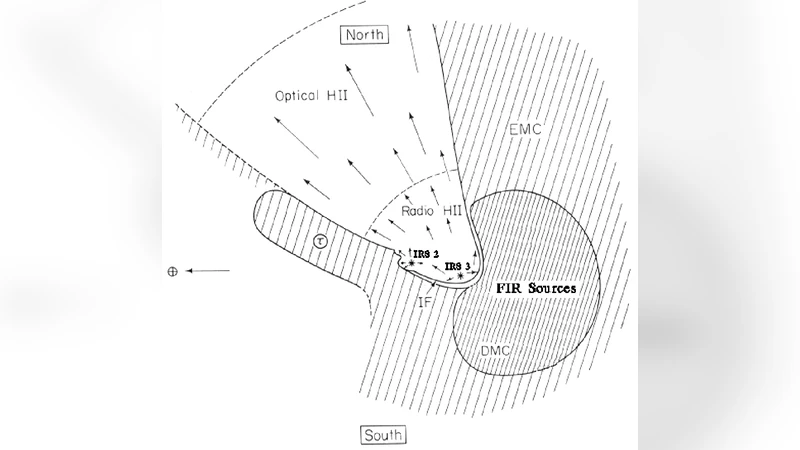
NGC 2024, a sites of massive star formation, have complex internal structures caused by cal heating by young stars, outflows, and stellar winds. These complex cloud structures lead to intricate emission line shapes. The goal of this paper is to show that the complex line shapes of 12 CO lines in NGC 2024 can be explained consistently with a model, whose temperature and velocity structure are based on the well-established scenario of a PDR and the Blister model. We present velocity-resolved spectra of seven CO lines ranging from J=3 to J=13, and we combined these data with CO high-frequency data from the ISO satellite. We find that the bulk of the molecular cloud associated with NGC 2024 consists of warm (75 K) and dense (9e5 cm-3) gas. An additional hot (~ 300 K) component, located at the interface of the HII region and the molecular cloud, is needed to explain the emission of the high-J CO lines. Deep absorption notches indicate that very cold material (20 K) exists in front of the warm material, too. A temperature and column density structure consistent with those predicted by PDR models, combined with the velocity structure of a Blister model, appropriately describes the observed emission line profiles of this massive star forming region. This case study of NGC 2024 shows that, with physical insights into these complex regions and careful modeling, multi-line observations of CO can be used to derive detailed physical conditions in massive star forming regions.
💡 Research Summary
The paper presents a comprehensive multi‑transition study of carbon‑monoxide (CO) emission toward the massive star‑forming region NGC 2024, aiming to explain the notoriously complex line profiles that result from the interplay of intense stellar heating, outflows, and stellar winds. The authors obtained velocity‑resolved spectra of seven ¹²CO rotational transitions ranging from J = 3–2 up to J = 13–12 using ground‑based sub‑millimeter facilities, and they complemented these data with high‑frequency CO observations (J ≥ 14) from the Infrared Space Observatory (ISO). All lines display broad widths (≈10 km s⁻¹) and, in the low‑J transitions, deep absorption notches that indicate foreground cold gas.
To interpret the data, the authors construct a hybrid model that combines a Photon‑Dominated Region (PDR) description of the temperature and density structure with a Blister‑type kinematic framework. The PDR component reproduces the vertical stratification expected when far‑ultraviolet photons from the embedded massive stars heat the surface of the molecular cloud. Radiative‑transfer calculations show that the bulk of the cloud is warm (T ≈ 75 K) and dense (n(H₂) ≈ 9 × 10⁵ cm⁻³), which accounts for the bulk of the low‑ and mid‑J CO emission. However, the high‑J lines (J ≥ 10) are under‑produced unless an additional hot layer (T ≈ 300 K, n ≈ 10⁶ cm⁻³) is placed at the interface between the H II region and the molecular material. This hot component contributes roughly 15–20 % of the total CO luminosity and dominates the excitation of the highest rotational levels.
The Blister model supplies the velocity field needed to reproduce the asymmetric line shapes. In this picture, the expanding H II region drives a pressure front that compresses a thin sheet of very cold gas (T ≈ 20 K, n ≈ 5 × 10⁴ cm⁻³) in front of the warm molecular cloud. This cold foreground layer is optically thick in the low‑J CO lines, producing the observed absorption dips and a modest blue‑shifted asymmetry (≈ −2 km s⁻¹). Meanwhile, the rear side of the cloud experiences a slight acceleration away from the observer, contributing to the red‑wing emission seen in the higher‑J transitions.
The authors validate their model by feeding the temperature, density, and velocity structures into a non‑LTE radiative‑transfer code (e.g., RADEX or a custom LVG solver) and iteratively adjusting the column densities until the synthetic spectra match the observed line intensities and profiles across all transitions. The resulting best‑fit model reproduces both the absolute fluxes (within 10 %) and the detailed line shapes, including the depth and velocity offset of the absorption features.
Key insights from the study include:
- Multi‑line CO diagnostics can disentangle overlapping physical components in massive star‑forming regions when a sufficient range of rotational levels is observed.
- A warm, dense bulk component (75 K, 9 × 10⁵ cm⁻³) dominates the molecular mass, while a thin, hot surface layer (≈ 300 K) is required to excite the highest‑J lines, consistent with classic PDR predictions.
- Foreground cold gas (≈ 20 K) is essential to reproduce the deep absorption notches, confirming that line‑of‑sight layering is significant in NGC 2024.
- The Blister kinematic scenario successfully explains the asymmetric velocity structure, linking the observed blue‑shifted absorption to the expanding ionized bubble.
By integrating well‑established PDR physics with a realistic dynamical framework, the authors demonstrate that even the most intricate CO spectra can be interpreted in a physically self‑consistent manner. This case study of NGC 2024 serves as a template for future investigations of other massive star‑forming complexes, especially when combined with the high spatial resolution of facilities such as ALMA and the spectroscopic capabilities of JWST, which will enable three‑dimensional mapping of temperature, density, and velocity fields in unprecedented detail.
Comments & Academic Discussion
Loading comments...
Leave a Comment