On corotation torques, horseshoe drag and the possibility of sustained stalled or outward protoplanetary migration
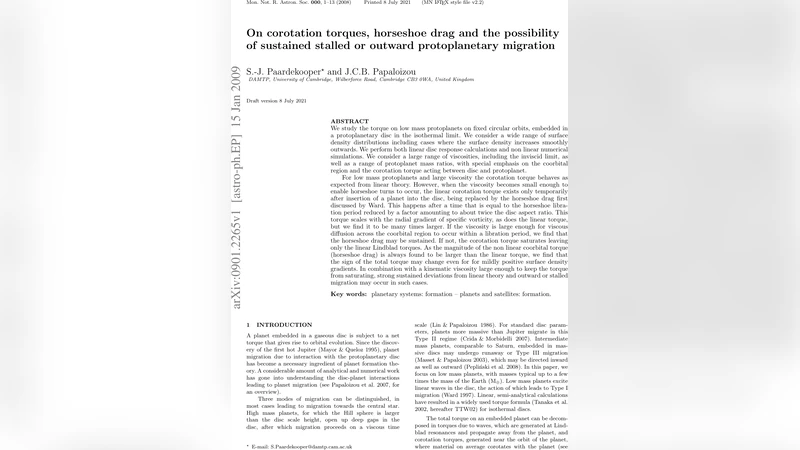
We study the torque on low mass protoplanets on fixed circular orbits, embedded in a protoplanetary disc in the isothermal limit. For low mass protoplanets and large viscosity the corotation torque behaves as expected from linear theory. However, when the viscosity becomes small enough to enable horseshoe turns to occur, the linear corotation torque exists only temporarily after insertion of a planet into the disc, being replaced by the horseshoe drag first discussed by Ward. This happens after a time that is equal to the horseshoe libration period reduced by a factor amounting to about twice the disc aspect ratio. This torque scales with the radial gradient of specific vorticity, as does the linear torque, but we find it to be many times larger. If the viscosity is large enough for viscous diffusion across the coorbital region to occur within a libration period, we find that the horseshoe drag may be sustained. If not, the corotation torque saturates leaving only the linear Lindblad torques. As the magnitude of the non linear coorbital torque (horseshoe drag) is always found to be larger than the linear torque, we find that the sign of the total torque may change even for for mildly positive surface density gradients. In combination with a kinematic viscosity large enough to keep the torque from saturating, strong sustained deviations from linear theory and outward or stalled migration may occur in such cases (abridged).
💡 Research Summary
This paper investigates the torque exerted on low‑mass protoplanets (typically ≤10 M⊕) that are held on fixed circular orbits within an isothermal protoplanetary disc. The authors focus on two distinct contributions to the total torque: the linear corotation torque, which is predicted by classical linear theory, and a non‑linear component known as the horseshoe drag (or horseshoe torque) that arises when fluid elements execute U‑shaped, horseshoe‑type turns in the planet’s co‑orbital region.
Linear regime and initial behaviour
When the disc viscosity is relatively high, the flow around the planet remains laminar and the corotation region does not develop the characteristic horseshoe streamlines. In this case the torque measured in the simulations matches the linear prediction: it scales with the radial gradient of the specific vorticity (or vortensity) and is typically much smaller than the negative Lindblad torque generated by spiral density waves launched interior and exterior to the orbit. Consequently, the net torque is negative and the planet would migrate inward on the classical Type I timescale.
Transition to the non‑linear horseshoe regime
If the kinematic viscosity ν is reduced below a critical value, fluid parcels are able to execute horseshoe turns. The authors show that the linear corotation torque is only a transient feature after the planet is introduced. After a time comparable to the horseshoe libration period, but shortened by a factor of roughly twice the disc aspect ratio h (i.e., t ≈ T_lib / 2h), the torque abruptly switches to the horseshoe drag. This non‑linear torque still depends on the vortensity gradient, but its magnitude is amplified by a factor of several to tens relative to the linear value. The amplification arises because the horseshoe region sweeps a finite radial width x_s, which scales with the planet‑to‑star mass ratio q and the disc thickness (x_s ≈ 1.2 r_p √(q/h)). The larger the width, the larger the mass of gas that participates in the exchange, and thus the larger the torque.
Saturation and the role of viscosity
A crucial aspect of the horseshoe drag is its susceptibility to saturation. If viscous diffusion across the co‑orbital region is too slow, the vortensity within the horseshoe zone becomes homogenised, eliminating the gradient that drives the torque. In this saturated state the horseshoe contribution collapses, leaving only the Lindblad torque, and the planet resumes rapid inward migration. Conversely, if ν is sufficiently large that diffusion can replenish the vortensity contrast within one libration period, the horseshoe drag remains unsaturated and can be sustained indefinitely. The authors derive an approximate condition for non‑saturation: ν ≳ x_s² Ω / (2π), where Ω is the local orbital frequency. For typical disc parameters this translates to ν ≈ 10⁻⁶ r²Ω or larger.
Implications for migration direction
Because the horseshoe drag is always larger in magnitude than the linear corotation torque, the sign of the total torque can change even when the surface density Σ has a mildly positive radial gradient (∂Σ/∂r > 0). In such cases the positive horseshoe torque can outweigh the negative Lindblad torque, producing either a stalled migration state (net torque ≈ 0) or outward migration (net torque > 0). The authors demonstrate, through a suite of numerical experiments, that with a sufficiently high viscosity to prevent saturation, strong and sustained deviations from linear theory occur, leading to outward or halted migration for a wide range of disc profiles.
Broader astrophysical significance
The findings provide a natural mechanism to alleviate the “too‑fast inward migration” problem that plagues many planet‑formation models. By allowing a low‑mass planet to remain in the inner disc for extended periods, or even to migrate outward, the horseshoe drag offers a pathway to the observed distribution of super‑Earths and mini‑Neptunes that are found at a variety of orbital distances. Moreover, the dependence of the torque on disc viscosity and aspect ratio suggests that temporal evolution of disc properties (e.g., viscous heating, turbulence decay) could produce complex migration histories, including phases of inward drift, stalling, and outward movement.
In summary, the paper establishes that (1) the linear corotation torque is transient in low‑viscosity discs, (2) the horseshoe drag quickly dominates and is many times stronger, (3) its longevity hinges on viscous diffusion across the co‑orbital region, and (4) when unsaturated, the horseshoe drag can reverse the direction of Type I migration. These results underscore the importance of non‑linear co‑orbital dynamics in shaping the early orbital architecture of planetary systems.
Comments & Academic Discussion
Loading comments...
Leave a Comment