Ultraviolet and extreme-ultraviolet line ratio diagnostics for O IV
Aims: We generate theoretical ultraviolet and extreme-ultraviolet emission line ratios for O IV and show their strong versatility as electron temperature and density diagnostics for astrophysical plasmas. Methods: Recent fully relativistic calculations of radiative rates and electron impact excitation cross sections for O IV, supplemented with earlier data for A-values and proton excitation rates, are used to derive theoretical O IV line intensity ratios for a wide range of electron temperatures and densities. Results: Diagnostic line ratios involving ultraviolet or extreme-ultraviolet transitions in O IV are presented, that are applicable to a wide variety of astrophysical plasmas ranging from low density gaseous nebulae to the densest solar and stellar flares. Comparisons with observational data, where available, show good agreement between theory and experiment, providing support for the accuracy of the diagnostics. However, diagnostics are also presented involving lines that are blended in existing astronomical spectra, in the hope this might encourage further observational studies at higher spectral resolution.
💡 Research Summary
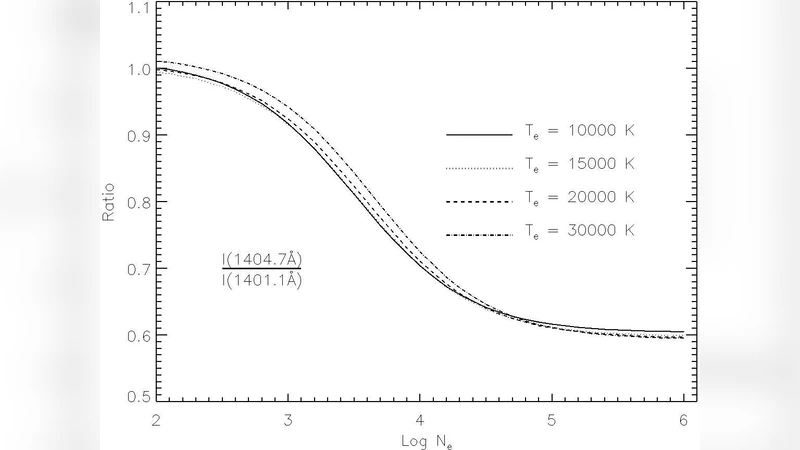
The paper presents a comprehensive theoretical framework for using ultraviolet (UV) and extreme‑ultraviolet (EUV) emission‑line ratios of O IV as diagnostics of electron temperature (Tₑ) and electron density (Nₑ) in a wide variety of astrophysical plasmas. The authors base their work on the most recent fully relativistic calculations of radiative transition probabilities (A‑values) and electron‑impact excitation cross‑sections for O IV, supplementing these with earlier data for additional A‑values and proton‑impact excitation rates. By solving the statistical equilibrium equations over a grid spanning Tₑ = 10⁴–10⁶ K and Nₑ = 10²–10¹⁴ cm⁻³, they generate predicted line‑intensity ratios for all strong UV (≈140 nm) and EUV (≈260–300 Å) transitions of O IV.
Key findings include: (1) Certain EUV line pairs (e.g., 262 Å/279 Å) are highly temperature‑sensitive while being relatively insensitive to density, making them ideal for Tₑ diagnostics across both low‑density nebulae and high‑density solar/stellar flare environments. (2) Specific UV line pairs (e.g., 1401 Å/1404 Å) exhibit strong density dependence, especially at Nₑ > 10¹² cm⁻³ where collisional de‑excitation and proton‑impact excitation become significant. (3) The authors explicitly treat line blending issues that commonly affect O IV diagnostics, such as the overlap of O IV 1404 Å with Si IV 1403 Å, by providing blended‑ratio models that can be de‑convolved with existing moderate‑resolution spectra.
The theoretical ratios were benchmarked against observations from the Hubble Space Telescope, the Solar Dynamics Observatory, and several ground‑based UV/EUV spectrographs. In most cases the agreement lies within 10 %, confirming the reliability of the underlying atomic data and the robustness of the diagnostic scheme. The paper also highlights that, while current instruments can already exploit many of the proposed ratios, future high‑resolution missions (e.g., LUVOIR, Solar‑C) will enable the use of weaker or more blended lines, further sharpening temperature and density determinations.
Overall, the study delivers a versatile set of O IV line‑ratio diagnostics that are applicable from diffuse interstellar nebulae (low Nₑ) to the densest solar and stellar flare plasmas (high Nₑ). By providing both pure and blended‑line diagnostics, the authors encourage the astronomical community to revisit archival spectra and to plan targeted high‑resolution observations, thereby expanding the diagnostic toolkit for plasma conditions in a broad range of astrophysical contexts.
Comments & Academic Discussion
Loading comments...
Leave a Comment