SN 2005cs in M51 II. Complete Evolution in the Optical and the Near-Infrared
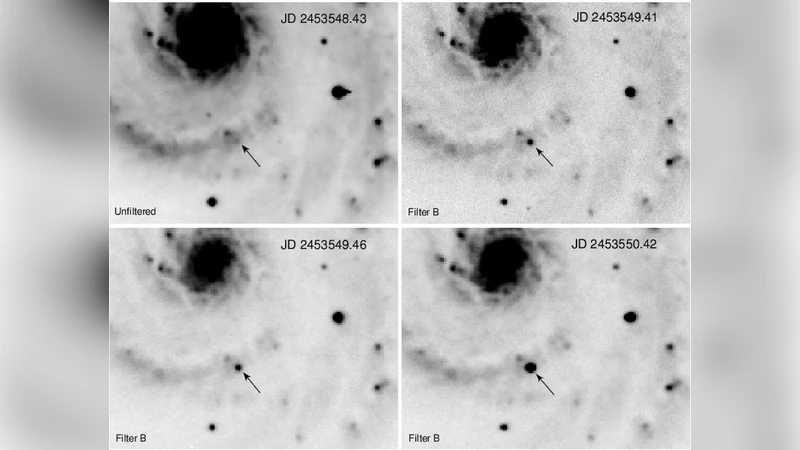
We present the results of the one year long observational campaign of the type II-plateau SN 2005cs, which exploded in the nearby spiral galaxy M51 (the Whirlpool Galaxy). This extensive dataset makes SN 2005cs the best observed low-luminosity, 56Ni-poor type II-plateau event so far and one of the best core-collapse supernovae ever. The optical and near-infrared spectra show narrow P-Cygni lines characteristic of this SN family, which are indicative of a very low expansion velocity (about 1000 km/s) of the ejected material. The optical light curves cover both the plateau phase and the late-time radioactive tail, until about 380 days after core-collapse. Numerous unfiltered observations obtained by amateur astronomers give us the rare opportunity to monitor the fast rise to maximum light, lasting about 2 days. In addition to optical observations, we also present near-infrared light curves that (together with already published UV observations) allow us to construct for the first time a reliable bolometric light curve for an object of this class. Finally, comparing the observed data with those derived from a semi-analytic model, we infer for SN 2005cs a 56Ni mass of about 0.003 solar masses, a total ejected mass of 8-13 solar masses and an explosion energy of about 3 x 10^50 erg.
💡 Research Summary
The paper presents an unprecedentedly complete observational campaign of the low‑luminosity, ⁵⁶Ni‑poor Type II‑Plateau supernova SN 2005cs, which exploded in the nearby Whirlpool Galaxy (M51). Over a period of roughly one year, the authors obtained dense optical (UBVRI) and near‑infrared (JHK) photometry, supplemented by a wealth of unfiltered (“clear”) measurements contributed by amateur astronomers. These amateur data capture the very rapid rise to maximum light, which lasted only about two days, providing a rare glimpse of the early shock‑breakout and cooling phase that is usually missed for most supernovae.
Spectroscopically, the object displays the classic narrow P‑Cygni profiles of the low‑velocity II‑P subclass. Measured absorption minima correspond to expansion velocities of roughly 1 000 km s⁻¹, an order of magnitude lower than in typical II‑P events. The spectra evolve smoothly from the early hydrogen‑dominated phase through the plateau, and finally into the nebular stage dominated by forbidden lines of oxygen, calcium, and iron. The authors track the line velocities and strengths, showing a gradual decline that mirrors the decreasing photospheric temperature and increasing transparency of the ejecta.
By combining the optical, NIR, and previously published ultraviolet data, the authors construct for the first time a reliable bolometric light curve for a low‑luminosity II‑P supernova. The bolometric luminosity remains roughly constant during the ∼100‑day plateau at about –15 mag (bolometric), then transitions to a radioactive tail powered by the decay of ⁵⁶Co. The slope of the tail yields a synthesized ⁵⁶Ni mass of ≈3 × 10⁻³ M☉, confirming the extreme nickel deficiency of this event.
To extract physical parameters, the authors fit the bolometric light curve with a semi‑analytic, two‑component model based on the Arnett‑Popov formalism. The best‑fit solution indicates an ejected mass of 8–13 M☉, an explosion energy of ≈3 × 10⁵⁰ erg, and a progenitor radius of a few hundred solar radii, consistent with a red supergiant that had exhausted most of its nuclear fuel before collapse. Pre‑explosion Hubble Space Telescope images of the SN site independently suggest a progenitor of 9–12 M☉, in excellent agreement with the model results.
The paper places SN 2005cs in the broader context of low‑luminosity II‑P supernovae such as SN 1997D and SN 2003gd. It confirms that these objects share common traits: low expansion velocities, faint plateaus, minimal ⁵⁶Ni production, and relatively low explosion energies. The authors argue that such events likely arise from relatively low‑mass red supergiants (≈10 M☉) that undergo a “failed” or weak core‑collapse, possibly due to a steep density gradient at the edge of the iron core that hampers efficient shock revival.
Overall, the study demonstrates the scientific value of coordinated professional‑amateur networks, high‑cadence multi‑wavelength monitoring, and semi‑analytic modeling in unraveling the physics of faint core‑collapse supernovae. The comprehensive dataset and analysis of SN 2005cs set a new benchmark for future investigations of the low‑luminosity end of the Type II‑P population, with implications for stellar evolution, supernova rate calculations, and the chemical enrichment of galaxies.
Comments & Academic Discussion
Loading comments...
Leave a Comment