Spitzer-IRAC GLIMPSE of high mass protostellar objects II - SED modelling of a bonafide sample
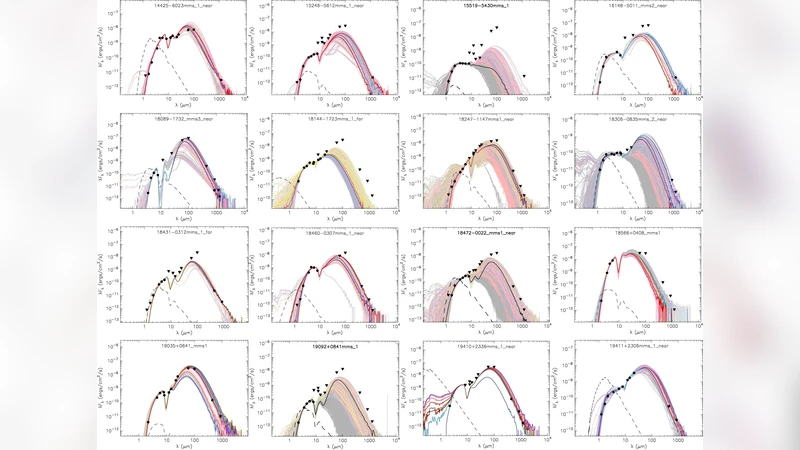
We aim to estimate and analyse the physical properties of the infrared counterparts of HMPOs by comparing their spectral energy distributions (SED) with those predicted by radiative transfer accretion models of YSOs. The SED of 68 IRCs are extended beyond the GLIMPSE photometry to the possible limits, from the near-infrared to the millimetre wavelengths by using the 2MASS, GLIMPSE version 2.0 catalogs, MSX, IRAS and some single dish (and interferometric) (sub)mm data. An online SED fitting tool that uses 2D radiative transfer accretion models of YSOs is employed to fit the observed SED to obtain various physical parameters. The SED of IRCs were fitted by models of massive protostars with a range of masses between 5-42 Msun and ages between 10^3 and 10^6 years. The median mass and age are 10 Msun and 10^4 yrs. The envelopes are large with a mean size of ~ 0.2-0.3 pc and show a distribution that is very similar to the distribution of the sizes of 8 micron nebulae discussed in Paper I. The estimated envelope accretion rates are high with a mean value of 10^(-3) Msun/yr and show a power law dependence to mass with an exponent of 2, suggesting spherical accretion at those scales. Disks are found to exist in most of the sources with a mean mass of 10^(-1.4+-0.7) Msun. The observed infrared-millimetre SED of the infrared counterparts of HMPOs are successfully explained with an YSO accretion model. The modelled sources mostly represent proto-B stars although some of them could become O stars in future. We demonstrate that many of these results may represent a realistic picture of massive star formation, despite some of the results which may be an effect of the assumptions within the models.
💡 Research Summary
The authors set out to characterize the physical properties of infrared counterparts (IRCs) associated with high‑mass protostellar objects (HMPOs) by constructing broad‑band spectral energy distributions (SEDs) that span from the near‑infrared (∼1 µm) to the millimetre regime (∼1 mm). They assembled photometry for 68 IRCs using 2MASS, the GLIMPSE v2.0 catalog, MSX, IRAS, and a variety of single‑dish and interferometric (sub)mm measurements. By feeding these SEDs into the publicly available online SED fitting tool – which relies on a grid of 2‑D radiative‑transfer accretion models of young stellar objects (YSOs) originally developed by Whitney and collaborators – they derived best‑fit model parameters through a χ² minimisation approach.
The fitted models indicate that the central protostars have masses ranging from 5 to 42 M⊙, with a median of ≈10 M⊙, and ages between 10³ and 10⁶ yr, clustering around 10⁴ yr. Such ages confirm that massive star formation proceeds on very short timescales. The surrounding envelopes are large (mean radius ≈0.2–0.3 pc), matching the size distribution of the 8 µm nebulae reported in Paper I, and they exhibit high accretion rates, averaging ∼10⁻³ M⊙ yr⁻¹. Importantly, the envelope accretion rate scales with the protostellar mass as Ṁenv ∝ M², a power‑law exponent of two that is consistent with spherical (Bondi‑type) infall at the spatial scales probed.
Disks are required by the models for the majority of sources (≈70 %). Their masses have a log‑normal distribution centred at 10⁻¹·⁴ M⊙ (≈0.04 M⊙) with a dispersion of about 0.7 dex, indicating that substantial circum‑stellar disks survive even in the high‑mass regime. The disk‑to‑envelope mass ratio is typically ∼0.1, suggesting that while the envelope dominates the mass budget, the disk remains a dynamically relevant component.
The authors acknowledge several caveats. The model grid assumes a relatively simple geometry (axisymmetric disks, spherically symmetric envelopes, fixed dust grain properties) and does not explicitly treat multiplicity, outflow cavities, or external heating by nearby massive stars. The (sub)mm data, essential for constraining envelope mass and density profiles, are sparse for many objects, introducing uncertainties in the derived envelope parameters. Moreover, some IRCs may be composite sources (multiple protostars within a single beam) or may include contributions from unrelated infrared nebulae, which a single‑source model cannot fully capture.
Despite these limitations, the statistical trends across the sample are robust. The high envelope accretion rates and large envelope sizes support a picture in which massive protostars acquire most of their mass through rapid, quasi‑spherical infall, rather than through prolonged disk‑mediated accretion alone. The presence of massive disks in most objects, however, indicates that disk‑driven processes (e.g., angular momentum transport, launching of outflows) still play a significant role. The median protostellar mass of 10 M⊙ places most of the fitted objects in the proto‑B‑star regime, but the upper end of the mass distribution (≈40 M⊙) suggests that a subset could evolve into O‑type stars if accretion continues.
In conclusion, this work demonstrates that the observed infrared‑to‑millimetre SEDs of HMPO infrared counterparts can be successfully reproduced by contemporary YSO accretion models. The derived physical parameters – especially the mass‑dependent accretion law and the coexistence of large envelopes with substantial disks – provide valuable empirical constraints for theories of massive star formation. Future high‑resolution (sub)mm interferometry (e.g., ALMA) and radio continuum studies will be essential to resolve the envelope and disk structures, test the spherical accretion hypothesis, and refine the evolutionary pathways from massive protostars to main‑sequence O and B stars.
Comments & Academic Discussion
Loading comments...
Leave a Comment